
The Tragedy of King Lear
By William Shakespeare
Produced by Oliver Rosser for the AUSA Outdoor Shakespeare Trust
Executive Producers: Sam Neill, Alan Smythe
Directed by Lisa Harrow
Outdoors in the Old Arts Quad, behind the University of Auckland ClockTower
2 March, 2013 to 30 March, 2013 at 7.30pm
Reviewed on Saturday 2 March, 2013
Published at http://www.theatreview.org.nz
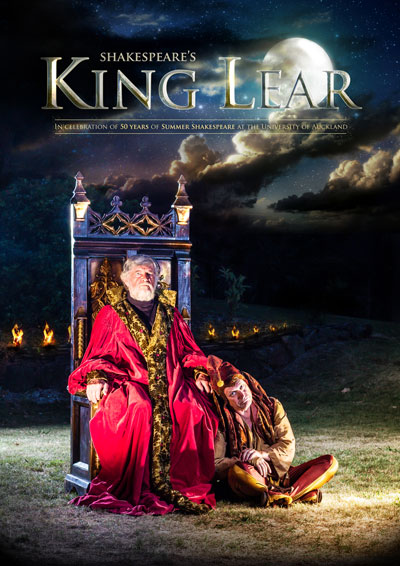
The cover of the flash programme ($15) for King Lear informs us, in case we didn’t already know, that Auckland Summer Shakespeare’s 2013 production is celebrating 50 years of outdoor summer Shakespeare at the University of Auckland.
Given the very nature of theatre – and student-driven theatre in particular – this is a noteworthy achievement.
Inside the publication there is a succinct welcome from Stuart McCutcheon, Vice Chancellor of The University of Auckland, who chats briefly about ‘capitalising on the talents of our students and staff’ and congratulates those who have contributed to the productions of the past, and to this current one.
There is also a welcome from Michael Hurst ONZM, chair of the AUSA Outdoor Shakespeare Trust. Hurst talks about ‘infrastructure’, ‘proper financial management’ and ‘building resources’. He also talks about ‘taking care of the things that speak to our collective spirit’, ‘coming to grips with what it means to be human’ and suggests that ‘we are all in this together’. Then he looks forward to seeing us at future productions.
The next welcome is from Dan Haines, AUSA President. Haines talks about collaboration, mentions that student life is about more than just getting a degree and expresses his excitement at bringing us, the audience, the ‘highest possible calibre of Shakespearean theatre’ where ‘seasoned professionals and veteran thespians are joined by an extraordinary cohort of emerging student talent.’ Let’s hope the real student talent doesn’t get swamped along the way and that student involvement at all levels continues to be a valued factor. A quick peruse of the grizzled male faces in this production would suggests that the category ‘mature students’ is very well represented.
Now add a smiling welcome from the Maidment staff, a lovely welcome at the entrance to the site, a chatty welcome at the on-site ticket office, a warm welcome from the chatty charmer who checked our tickets at the staging area and the three welcomes the gorgeous whaea gave us before the performance began and it was impossible not to sit with the rest of the liter-glitterati feeling any less than thoroughly welcome.
Ralph Waldo Emerson reminds us that, while life is short, there is always time enough for courtesy and the gala launch of this 50th anniversary production proved to be a case in point. Everyone was incredibly courteous and long may that continue.
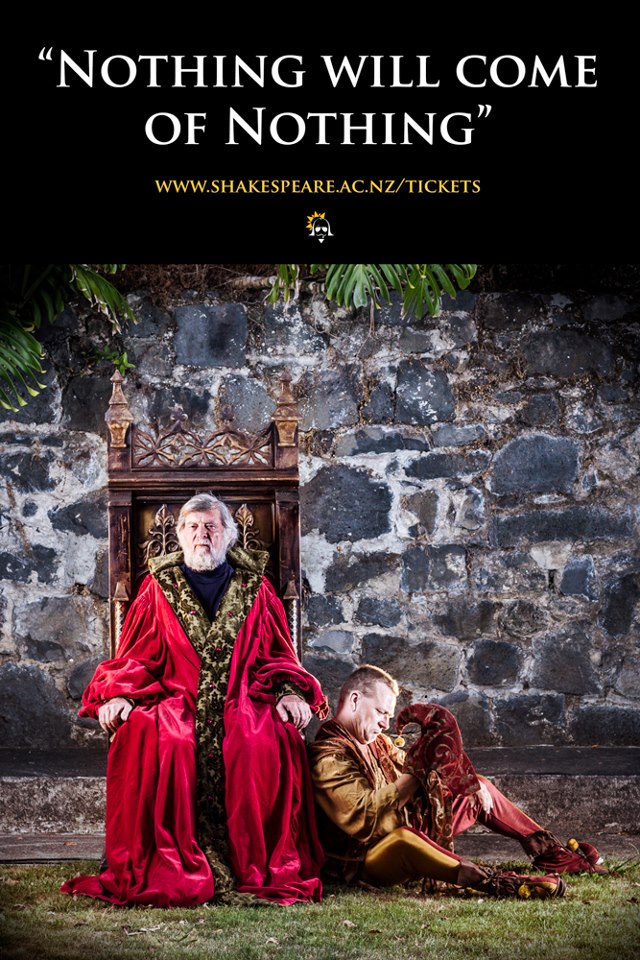
The Old Arts quad is a delightful, if difficult, space to work and design wunderkind Jessika Verryt has got the mix just right. She has worked the attractive old stone wall, a heritage feature so it can’t be touched, into the various curved shapes that make up the backdrop to a large circular stage with many step-up access points. Centre back of the expansive stage surface, alone and imposing, is a large wooden throne.
The scaffold seating is in three blocks and mirrors, in this case, the front edge of the raised stage artfully giving the impression of a production in the round while actually adhering to a much more conventional form, a proscenium but with no arch.
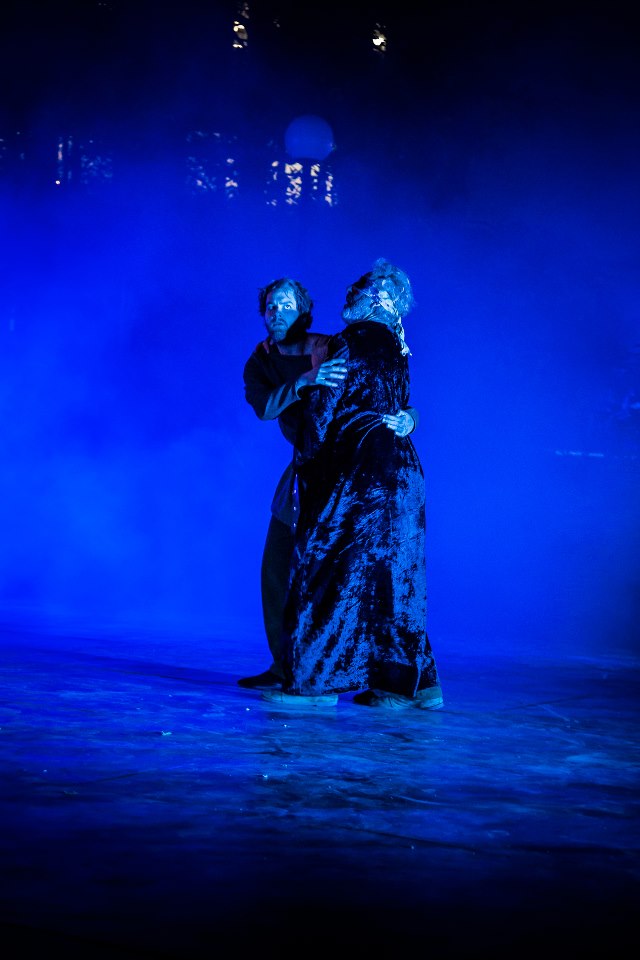
The primary colour splashed on the stage is a deep midnight blue and Verryt has ingeniously used a series of stepped, suspended screens to the right of the stage and disappearing on up the hill providing a alternative visual focus while also allowing actors access to the stage without distracting from the action on it. Depicted on these screens are a series of big bang-like expressionistic images that seem at once to be visualisations taken from the creation of universe, Lear’s inner torment and a more naturalistic ‘madman against the elements’ theme. Whenever you snatched a look at these images they always seemed appropriate to the action being played out on the giant O of the stage and Brad Gledhill’s excellent lighting ensured that they remained a vital part of the production. Smart, attractive and functional, Verryt’s set is every bit as good as I’ve come to expect from this supremely talented young designer.
It should be said at the outset that this is a conventional production of the play and a conventional reading of the text so if you come expecting ‘Baz’ Luhrmann interpretative brilliance and an eccentricity of staging you’ll be disappointed.
Do come though, because, if you’re a Shakespeare nut – and even if you’re not – you won’t be disappointed at all.
The costumes (Gayle Jackson) are excellent, the lighting is by Brad Gledhill which says it all – simply outstanding – and the luminous soundscape by the incredible Gareth Farr is as evocative of text, subtext, themes and the wild outdoors as could ever be wished for.
In the early 17th century, when Shakespeare was writing his The Tragedy of King Lear and its antecedent text The True Chronicle of the History of the Life and Death of King Lear and His Three Daughters, he could have been confident that his audiences would have been familiar with the story because it had been around for centuries and was an essential constituent part of any classical education.
No such claim could reasonably be made today.
The story was first recorded in the writings of twelfth-century historian Geoffrey of Monmouth in his Historia Regium Britanniae but it’s likely Shakespeare would also have known of a deeply Christian version, The True Chronicle History of the Life and Death of King Leir and his Three Daughters, which had been performed in 1594 but was not published until 1605. Shakespeare’s own texts – there are two of them – are dated between 1603 and 1606.
Samuel Harsnett’s A Declaration of Egregious Popish Impostures, an Attack on Jesuit Missionaries and their Exploitation of the Poor and Disadvantaged Members of Society (1603) introduces Edgar as Poor Tom o’ Bedlam to the story and the five fiends that Tom claims haunt him and which are referred to in the Bard’s text are first to be found in Harsnett’s second work Obidicut, Hobbididence, Mahu, Modo and Flibbertigibbet. If you happen to be looking for a excellent demon, hobgoblin, succubus or jin there’s no better place to start looking than Harsnett.
Edmund Spenser expanded on the Lear tradition too, in The Faerie Queene (1590), by having Cordelia hanged and the themes and plot surrounding Edmund, Edgar and Gloucester are to be found in Sir Philip Sidney’s Arcadia, also published in 1590. It seems that almost everyone had a go at the story with Shakespeare left to add Lear’s madness and the role of the Fool, each as vitally important as the other and never more so than in this production.
For all that, Raphael Holinshed’s 1587 reworking of his Chronicles of England, Scotland and Ireland is still Shakespeare’s most likely initial inspiration and it is universally acknowledged that Holinshed’s own primary source was Geoffrey’s Historia Regium Britanniae.
It feels somewhat odd contextualizing King Lear at all with this production being dedicated to the memory of the late Professor Sydney Musgrove, eminent Shakespearean scholar and founder of the outdoor Shakespeare tradition at The University of Auckland and who all agree, knew a fair bit about both the Bard and the contemporary performance of his works. Add to this the indisputable fact that the role of the king himself is played in this anniversary production by none other than Michael Neill, Emeritus Professor of English at The University of Auckland who is also a specialist in Shakespeare and the drama of the Bard’s contemporaries and you can understand why I might feel a bit daunted by this challenge. In case this wasn’t enough also pottering about this production is Tom Bishop, current Professor of English at The University of Auckland, eminent Shakespearean scholar and co-editor of the Shakespeare International Yearbook who plays Oswald and seems to be keeping a weather-eye on the whole kit and caboodle.
Who can guess what the in-house discussions after rehearsal and over a few ales would have been like with all this intellectual firepower and that’s certainly a wall I would have loved to have been a fly on!
On these grounds alone the play feels in great scholarly hands and certainly needs nothing extra from me. The programme contains a wealth of information too, as you can probably imagine but, at the end of the day, it’s what happens on the stage that really matters.
The production begins in the dusk and ends in the dark providing a beautiful metaphor for the play should one be necessary.
The director and cast pay Shakespeare the greatest of compliments, they tell his story as he wrote it, with passion and heart, and we follow it easily. It’s a straightforward, unadorned reading of the text and there are some excellent – and praiseworthy – performances. It’s a large cast and as might be expected performances vary in quality but, all in all, everyone works to the purpose of the play and the odd instance of idiosyncratic acting is easily overlooked.
Director Lisa Harrow has transferred Lear’s complex journey from rehearsal area onto the stage – no easy task – with genuine style and the production is presented with poise and assurance. Sightlines are excellent throughout, entrances are made, and exits, and lines – oodles of them – are delivered with a pleasing sense of self-belief. I heard most of them, too, which is always a challenge in the outdoors. There’s a bit too much ‘performing Shakespeare’ for my liking but not from the principles and it’s a small price to pay for audible clarity.
Not everyone knows the plot of Lear so here’s a none too detailed synopsis.
Old King is ready to retire, divides his kingdom among his three daughters based on who will flatter him most. The two older girls go along with the charade but the youngest refuses to play. Anger and nastiness ensue and the story plays out as a political and personal nightmare for the king with his daughters disempowering and disowning him until he goes mad. The faithful Kent is banished for saying it like it is but disguises himself as Caius and never leaves his master. Lost in the wilderness Lear meets Tom o’ Bedlam (Edgar in disguise), plot and sub-plot join and Fool disappears. The weather deteriorates something shocking. The older sisters deny Lear lodging and demand he dismiss his retinue, Gloucester is needlessly blinded. There is a battle. Lear and Cordelia are reunited only to be parted again. Goneril and Regan fight over the duplicitous Edmund. Regan is poisoned by Goneril who, when found out, commits suicide and Cordelia is hanged. Lear dies with his beloved youngest daughter already dead in his arms.
Does it sound simple?
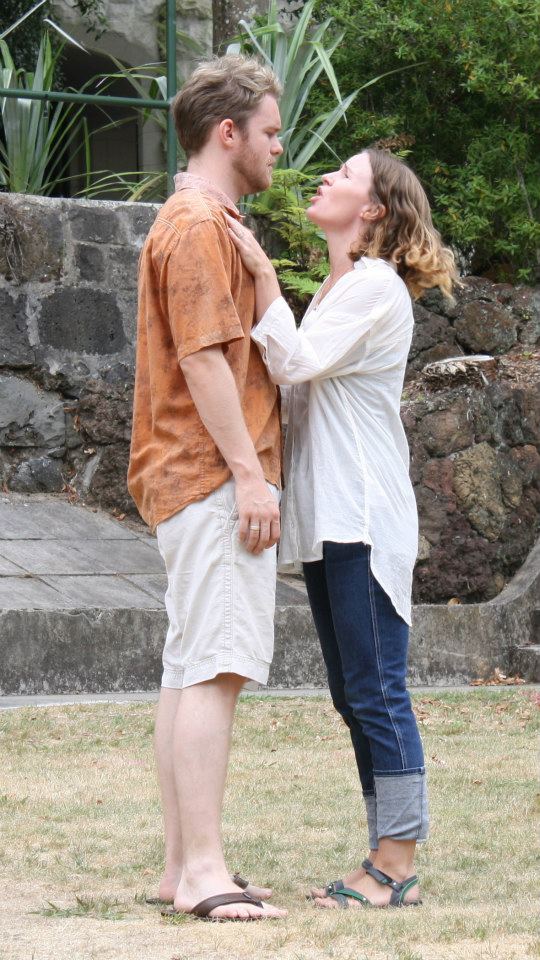
Well, it’s not, and it’s to the credit of the company that they never lose the plot and, because they don’t, we don’t either. Nor do we ever lose interest and that’s an excellent outcome especially when the air begins to get nippy, the helicopters circle overhead and the passage of the play hits three hours. My son, age ten, is a Shakespeare nut. He’s been known to say ‘if it’s Shakespeare it must be good’ and I have yet to disavow him of this. He thoroughly enjoyed his first meeting with Lear, having seen all the other great tragedies apart from Hamlet, and his love of the bard is undiminished. His favourite bits were the excellent battle with the knights, the smoke and the swish swordplay. He also narrated the entire plot without fault or hesitation in the car on the way home. This says it all for me. If the production can tell the story to audience members of any age, and keep their attention, then it’s really doing its job.
This isn’t to say that the production is perfect. It’s not.
There are parts that are far too evenly paced, the desire to be heard results in quite a lot of shouting and some of the cast work too much on the throat but these are all faults that are easily forgiven because the overall pace drives to the end of the play and we’re grateful for that. Subtleties of text and playing are sacrificed and, at times, there is a one dimensional aspect to the story telling but, again, we move on and are not too much affected.
Michael Neill, already a very good Lear, will grow in the role.
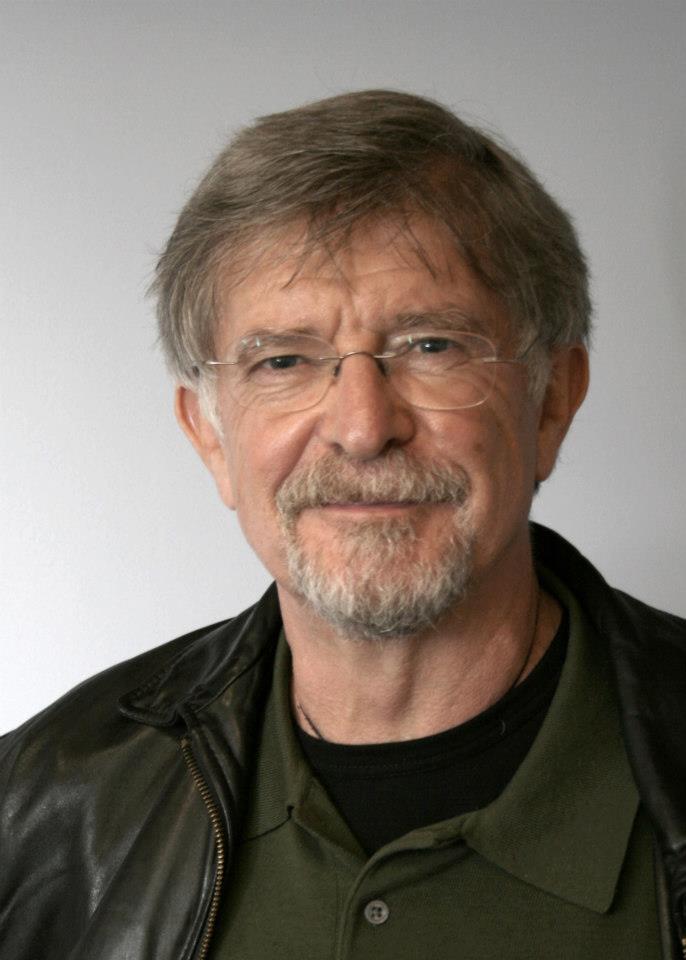
Clever Mr Shakespeare, even though it’s Neill’s play, doesn’t leave its success – or otherwise – entirely up to him. There are times when the action is taken over by Gloucester (Geoff Snell), Edmund (Calum Gittins) and Edgar (Andrew Paterson), Kent (Peter Stephens) and the three excellent women Goneril (Lucinda Hare), Regan (Kate Watson) and Cordelia (Anthea Hill). They play with the play and find all the right levels – and we love them for it.
Lear is, we must remember, eighty years old and while Neill clearly is not but is actually a sprightly somewhat less, it’s still a big emotional and physical haul even for the fittest of men and I’m sure he needs the occasional break. So do we because, when the play is working on an emotional level which it does most of the time, our withers do not remain unwrung!
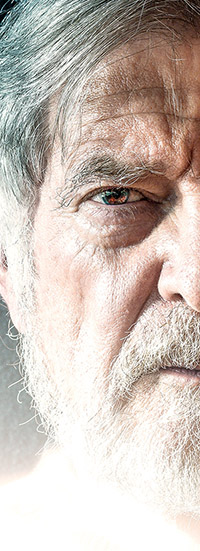
Neill looks right, is audible throughout, but could benefit from continuing to look for the richer emotional nuances in the role that will enable his already fine work to grow even more. This will vary his rate of delivery which is occasionally too even and his anger is sometimes indistinguishable from his distress or simple shock but these are quibbles as I really valued his work and applaud him long and hard for his effort. Perhaps he needs to trust himself a tad more, trust those around him and simply give himself over to the forces that Shakespeare has built into the play to support and sustain him. When he takes these small steps he will be truly magnificent.
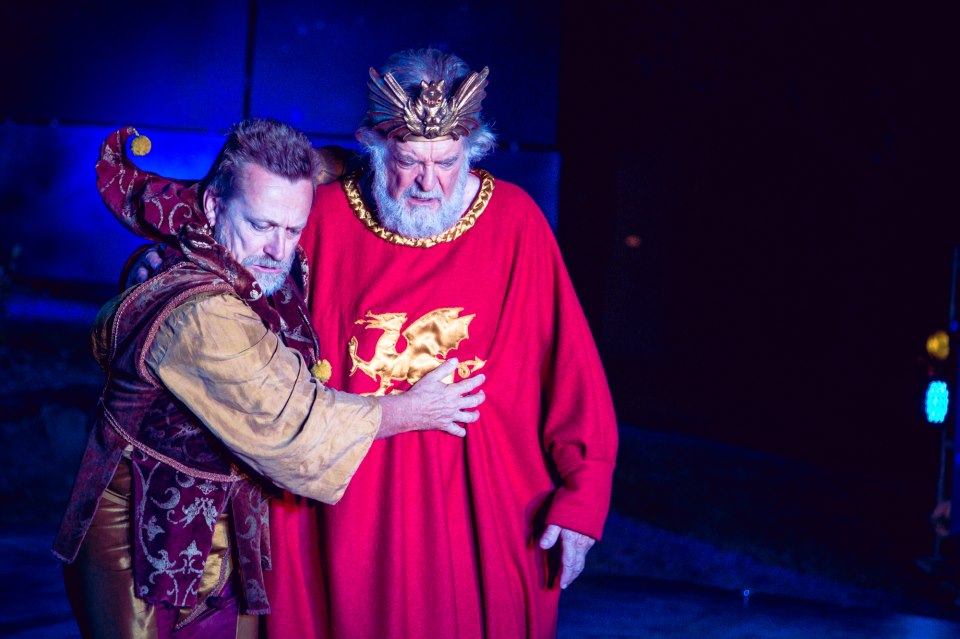
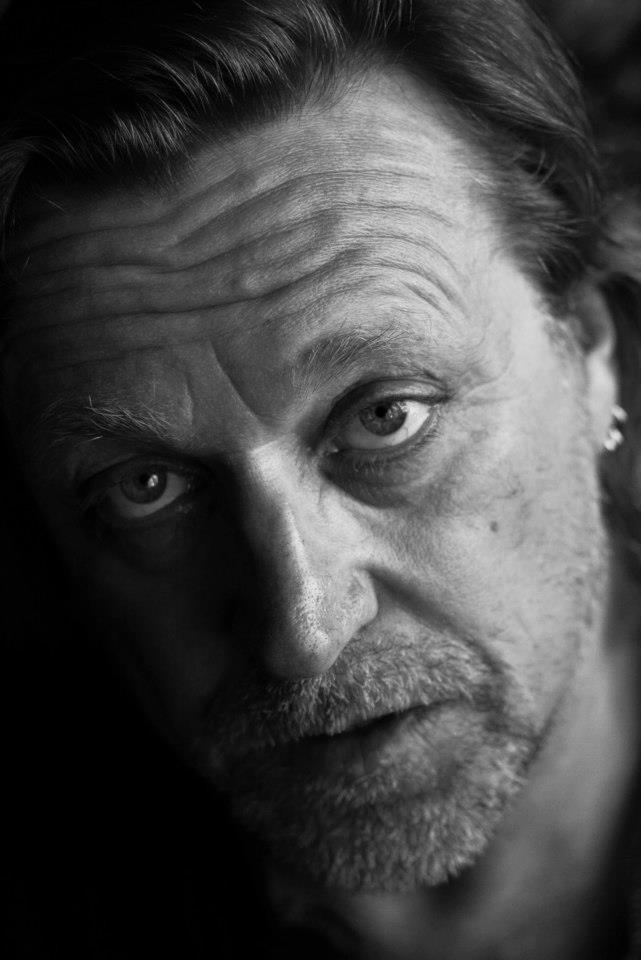
Michael Hurst plays Fool straight down the middle and it was heartening to see an actor so enmeshed in the essence of the role. Had Shakespeare seen Hurst’s version of Lear’s touchstone and how he played this tragic coxcomb there may well have been a sequel but he didn’t so you’ll just have to go and see this one instead. We all know the bravura Hurst, the showman, but this aspect of the Hurst we know and love isn’t evident in this finely judged performance. As a mirror in which Lear could, if he wished, have seen the reality of his own situation and the mendacity surrounding him, Hurst was exceptional, becoming, from the first moment, the master of the all the play’s ironic interplay.
The older sisters Goneril (Lucinda Hare) and Regan (Kate Watson) were excellent from go to woe. I was personally pleased when I realized they were to be played as real women and not the evil cartoon witches they are so often portrayed as being. Director Harrow has allowed them to be beautiful and why not? They are the daughters of the king, after all. This smart and accurate interpretation enabled me, for the first time ever, to fully acknowledge Lear’s vile misogyny, the public loathing, objectification and denigration of women that he engages in and his kingly assumption that everyone will agree with him. This explains, to some extent, why the sisters are the way they are and why they feel so little empathy for their father in his time of need. In this Neill was superb cleverly threading Lear’s outbursts together and making us gag with shock at the extent of his woman-hating while at the same time providing a sound, human explanation as to the degree of hostility his two older daughters express towards him. With a father whose views on women are so odious, whose rhetoric regarding female genitalia so appalling and whose friends aren’t that much better, it’s not so much of a surprise then that there’s no Mrs Lear spoken of anywhere in the play nor a real Mrs Gloucester in evidence either. It’s impossible to believe that a playwright whose affection for his tragic heroines – Ophelia, Juliet, Desdemona, Andromache – shines through in every line he writes didn’t know exactly what he was doing in depicting a contemptible, misogynistic Lear and recording, with brutal honesty, the tragic effect his sickening attitude to women has on his own daughters. It’s karma in action and the tragic consequences are there for everyone to witness at the end of the play because Neill has courageously laid them bare for all of us to see.
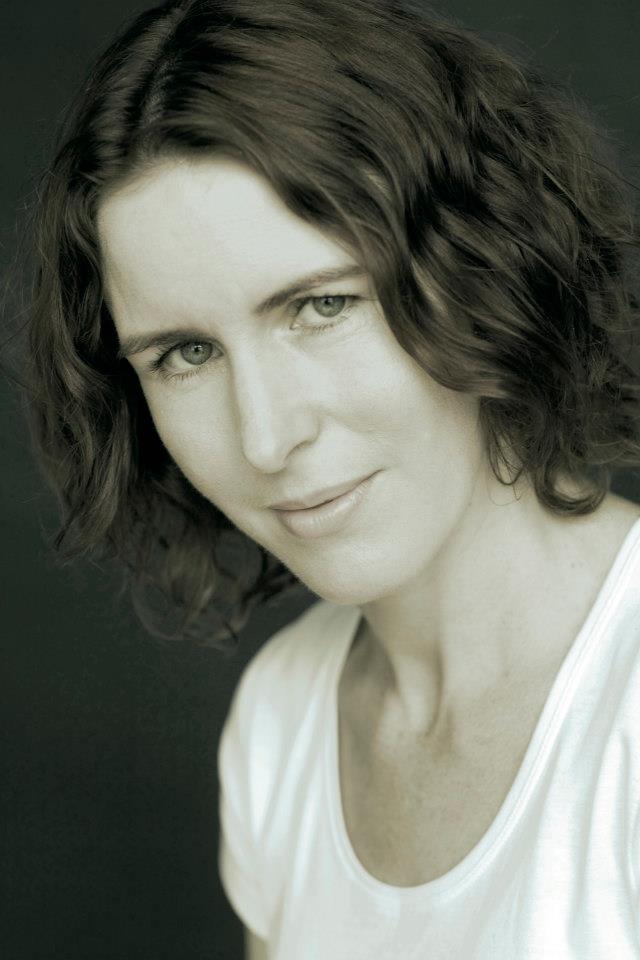
Cordelia (Anthea Hill) is, to some extent, a thankless role and Hill did all that was asked of her and Kate Watson, with much more to do, absolutely shone as Regan.
Geoff Snell (Gloucester) and Peter Stephens (Kent) were equally impressive with Stephens’ loyalty to the king a model of the manliness so often referred to but so seldom evident in the play. The blinding of Gloucester was stunningly effective, a tour de force in fact, and as good an effect as I have ever seen.
The casting of Edgar (Tom o’ Bedlam) and Edmund, the sons of Gloucester, is the key to ensuring the powerful subplot of the play works and in Andrew Paterson (Edgar) and Calum Gittins (Edmund) director Harrow had twin gems. Each was able to play the text with ease and each had the courage to pull back the volume and trust the acoustics of the venue. The reward was subtle performances of power and depth with the balance between the siblings ever changing. Gittins in particular had the audience eating out of his somewhat mucky hand from the get go.

To sum up, this Lear is well worthy of being the 50th anniversary production and this director, cast and crew serve the play utterly and they do themselves, and their history, proud. Michael Neill has well and truly earned this special swansong and the entire ensemble can justifiably take a bow.
The play, after all, is the thing.
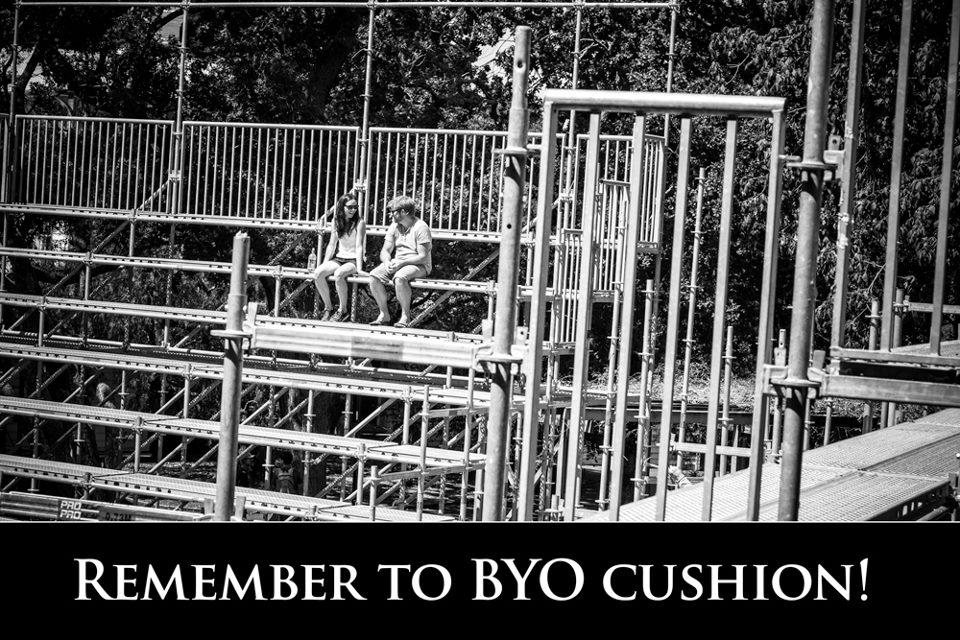
For those considering attending this production you will find the service excellent. There’s an attractive, well stocked marquee bar and a couple of those big outdoor heaters for the interval but, take a cushion and, if you’re in a seat where your feet don’t reach the ground, some judicious and unobtrusive toe wriggling will ensure you can still walk when you stand up.
All in all it was a thoroughly excellent night.
 dykiegirl
Hi there, this weekend is fastidious in favor of me, since this moment i am reading this
fantastic educational post here at my home.