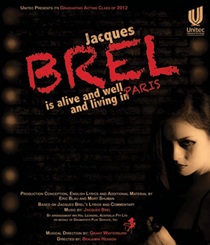
Jacques Brel is Alive and Well and Living in Paris
Music by Jacques Brel
Directed by Benjamin Henson
Musical direction by Grant Winterburn
Production Concept/English Lyrics/Additional Material by Eric Blau and Mort Shuman
Produced by UNITEC School of Performing and Screen Arts
UNITEC Theatre, Carrington Road, Mt Albert, Auckland
9 – 17 November, 2012 at 7pm
10 & 11 November, 2012 at 2pm
Published at http://www.theatreview.org.nz
There’s nothing more exciting than being in the audience of a graduation performance and attending the UNITEC School of Performing and Screen Arts Graduating Acting Class 2012 final soiree was absolutely no exception.
The fact that it was stunning was merely a bonus.
One of the features of the evening is the excellent balance that exists between male and female performers. The boys, dressed largely but not exclusively as matelot and dock workers create a world of ambiguous sexuality and real manliness. The girls are vulgar, often androgynous, and create a disquieting world where sex, love, cruelty and a mouth-wateringly amoral brutality can walk hand in hand.
Choosing the vehicle for students is always a challenge, one that has been met on this occasion with supreme courage and elegance. There’s always the choice between production and showcase and on this occasion director Benjamin Henson has managed to achieve both. This is credit to him but also to the talent he had at his disposal and a school prepared to take this not inconsiderable risk.
Jacque Brel was a Belgian chansonnier who became hugely popular in France and subsequently the rest of the world. His work falls into line with that of Edith Piaf, Charles Aznavour, Jean Ferrat and more recently Mathieu Boogearts and Olivia Ruiz and has been recorded by such luminaries as David Bowie, Rod McKuen, Nina Simone, Leonard Cohen and Marlene Dietrich
Jacques Brel is Alive and Well and Living in Paris was created in 1968 as an off-Broadway show where it ran successfully for 5 years. In 1972 a gala performance of the work entitled Hommage à Jacques was staged at Carnegie Hall with Brel, who died in 1978 age 49, in attendance.
A film was made of the show in 1975 and new songs were added, the most significant being My Childhood, Song for Old Lovers (La Chanson Des Vieux Amants) and Ne Me Quitte Pas all of which feature strongly in the UNITEC production.
Many new productions have been staged internationally since its inception including a number in New Zealand and an off Broadway revival was staged at the Zipper Theatre in 2006 which ran for a year.
Jacques Brel, it would seem, has always been popular as can be seen locally with two shows featuring his work running concurrently.
This production follows more closely the running order of the original than it does the revival but some songs have been dropped from the schedule and none added. This production dies not suffer from the cutting.
UNITEC theatre is as attractive as I have ever seen it.
In front of closed, conventional salmon pink curtains there is a small, square table covered with a rumpled white cloth on which sits a wood-encased valve radio with a fret-worked front.
The opening night full house sat silently in a fine mist of smoke – and so the tone was set.
The curtains opened on an astonishing design by Rachael Walker.
I am unashamedly a fan of Walker’s design but in this instance she has exceeded both my expectations and her own high standards.
To the left sat musicians Grant Winterburn (piano) and Aaron Coddel (double bass). I am no musician but would hazard a guess that the work of these gentlemen was flawless throughout.
Grant Winterburn’s direction of the singers would certainly support this view
The set suggested, at various times, a deserted warehouse, at others a disused mortuary. Odd-sized wooden crates are used as seats, a place to lounge or even lie and the whole reeked of Skid Row on Bedlam Night. It was immensely practical too, with ample space for the seventeen actors to strut their stuff and with six tunnel-like spaces inset into the back, where ever alert performers could lounge, squatt, perch and hover.
The whole was lit by Michael Forkert, a 3rd year technical student, with intricacy and skill and, considering the intentionally disjointed nature of the evening and the large cast, it’s a sublime compliment to the rehearsal process that no actor missed their light or their singular moment to shine.
Add to the above a collection of period-perfect costumes (Suzanne Sturrock) and you have a degree of technical excellence that would be hard to beat in any theatre.
Jacques Brel may have achieved legendary status in the performing arts but his songs remain complex and extremely difficult for actors to sing. They are rare in the nature and richness of the emotion they are driven by and embrace three minute narratives that lesser artists would take volumes to embody.
Jacques Brel is Alive and Well and Living in Paris was created for four actors – two men and two women. They carry not only the songs and the inner narrative of each but a through-line driven by this inner narrative that connects the whole thing together. It’s one of the powers of the piece. Like Side by Side by Sondheim and other such works, the character through line is what separates these shows from a standard concert format.
Director Henson has seventeen actors but manages, with a high degree of subtlety, to link each characterisation with a connecting vision that might otherwise have further split the disintegrated personas created for the original. The result is characterisations that work in every case and each is supported beautifully by a cleverly referenced costume – a couple of toffs, some matelot, a dock worker or two and a variety of working girls.
While I will focus on the extraordinary highlights of this bittersweet evening it has to be said that there were no imperfect performances, no weak links, and barely a foot out of place in the 80 minutes which passed in the blink of an eye.
Benjamin Henson has created an intensely ‘50s European netherworld and his direction never lets up. It’s refined and delicate work and I can imagine it being an absolute joy for him to work with a group of young actors at the top of their game.
Laura Daniel begins the evening – and further sets the tone – with a classy performance of Le Diable and this is followed by Cole Jenkins, Rebecca McFadzien joining Daniel in If We Only Have Love, the song that is reprised throughout the evening
Jackie is sung splendidly by Saraid Cameron and this is followed by Brussels, the first full cast number. Assembled together, the full cast work as one without sacrificing any of the individuality that is so attractive and essential if this piece is to work.
My Childhood is an extraordinary song.
In Rebekah Brady’s hands all the resonances of Brel’s original are present and we get to experience, first hand, what it was like for him – and what it was also like for us – to approach the end of innocence – and then my childhood burst open, that was adolescence, and the wall of silence tumbled down one morning.
Madeleine is one of Brel’s best known chanson and in the hands of Eli Matthewson she lived on. The song was inspired by Madeleine Zeffa Biver, a Bohemian friend of Brel in the ‘50s who died in Spain in 2007. Her final letter epitomised Brel and the Bohemian’s and is worth quoting here as, to some considerable extent, it encapsulates the work. Prior to her assisted death she wrote to Le Pais newspaperthat she wished to ‘die with dignity’, with ‘a glass of water, wine or whiskey’ with ‘my head held high, blowing kisses to those who have helped me with their love and words’.1
These words could have easily been written by Brel himself.
Just when you think there will be no further surprises, Walker springs a few with the set and the cast create some acutely disconcerting moments with cages, masks and red balloons.
Jason Hodzelmans rendition of the fiendishly difficult Fanette showcased a lyric tenor voice of power and subtlety. Hodzelmans handling of the topsy-turvey emotion in the lyric – it starts with we were two friends in love, Fanette and I and ends with but let’s talk of something else, we were never two friends, Fanette and I, the empty streets are cold and crying in July – was exhilarating.
In an evening marked by extraordinary solo performances it has to be said that Paul Lewis’s Amsterdam was an absolute highlight. Lewis’s passion, his exceptional phrasing and his incredible assurance paints a picture of tortured melancholy that would have pleased even the master himself.
There are times when Rebecca McFadzien owns the stage and performing Brel’s 1959 epic Ne Me Quitte Pas (Don’t Leave Me) constitutes one of those moments. It’s simply breathtaking. Representing the slumming classes in a dazzling red cocktail dress she embarks on Ne Me Quitte Pas as a hauntingly dark ballad and makes it even darker. Her repetition of the phase ‘if you go away’ is compellingly beautiful. Brel denied that Ne Me Quitte Pas was a love song despite writing it after he was unceremoniously dumped by his pregnant mistress Zizou (Suzanne Gabriello). He said, rather, that the song celebrated ‘the cowardice of men’ and this explanation seeps lusciously into McFadzien’s fine interpretation.
In The Middle Class Paul Lewis, Eli Matthewson, Jason Wu and the ensemble, replete with oinky pig masks, seem to channel Maxim Gorky’s characters from The Lower Depths as they belt out this angry and disillusioned peaen to poverty and it leads poignantly into James Roque’s darkly funny Funeral Tango.
A trio of fine solos – with a satisfying respite provided by Paul Lewis, Eli Matthewson, Tayla Pitt and Chye-Ling Huang who slap us with The Desperate Ones – escort us towards the finale beginning with Rebecca Brady’s My Death.
Blessed with a magnificent voice, Brady simply stands and sings and there was a silence in the theatre that you could taste. I’d done some research in advance of the show and when Brady came to the lines ‘where the blackest shadow, blackest shadow cowers, let’s pick lilacs for the passing time’, written as early as 1957, it was impossible not to be touched by Brel’s prescience and reminded of his tragic death from lung cancer at such a young age.
Laura-Jean Bainbridge sings Marieke – a song to yet another of Brel’s lovers, this time Flemish – as the second of the three solos and this is followed by Jason Hodzelmans’ extraordinary performance of Song for Old Lovers where he sings ‘in spite of all, we’re still together’ to the body of the woman whose life he has just snuffed out with a pillow. ‘A thousand times you’ve packed your cases, a thousand times I’ve flown the nest’ might better have summed up the clever incongruity of this interpretation and indeed Brel’s life itself.
Jacques Brel is Alive and Well and Living in Paris isn’t a record of a man’s life, however, but more a reflection on life itself through the work of a genius – but Brel is there alright, in the psyche of every lost soul, in every single breath of despair, in every sublimely human moment.
All musicals, no matter how bleak, disturbing and bitter, need an ensemble number to end with and, in this case, Laura Daniel leads her excellent cast in a magnificent version of Carousels. Originally entitled La Valse à Mille Temp (To Waltz a Thousand Times) it can best be described as a Parisian love song written, it is rumoured, in a car travelling between Tangiers and Casablanca – which in itself tells us a lot. It’s Brel at his most light hearted and is a fitting finale. The ensemble moves subtly into a triangular formation with Daniel at its peak becoming a head-nodding carnival calliope that is quite simply tremendous. This is cabaret at its absolute best and, as the earth shook and the sky fell, the artists simply carried on as they – and the show must always do – providing a fitting metaphor, should one have been needed, for any, and every, actor’s career.
Only an ensemble reprise of If We Only Have Love was mandatory to allow us to express our thanks and to bring across the final curtain.
Fitting, then, that the final voice heard from the crackling old valve radio was that of Jacques Brel himself.
He’d have been well pleased.
References:
1) http://www.guardian.co.uk/world/2007/jan/19/spain.musicnews – accessed 11 Nov, 2012
 dykiegirl