
The Shakespeare Memorial by Lord Ronald Gower. Bronze and stone, with a pedestal designed by Parisian architects, Peigniet and Marnez. 1888. Bancroft Gardens, Stratford-upon-Avon.
At each corner of the Memorial, the sculptor has placed a representative Shakespearean character: “Hamlet, Prince Hal, Lady Macbeth and Falstaff. These characters were intended to be emblematic of Shakespeare’s creative versatility: representing Philosophy, Tragedy, History, and Comedy (Mapping Sculpture). Philip Ward-Jackson rightly describes this as “probably one of the country’s most prominent and best loved public monuments, seen” by thousands if not millions of pilgrims to Shakespeare’s birthplace.”
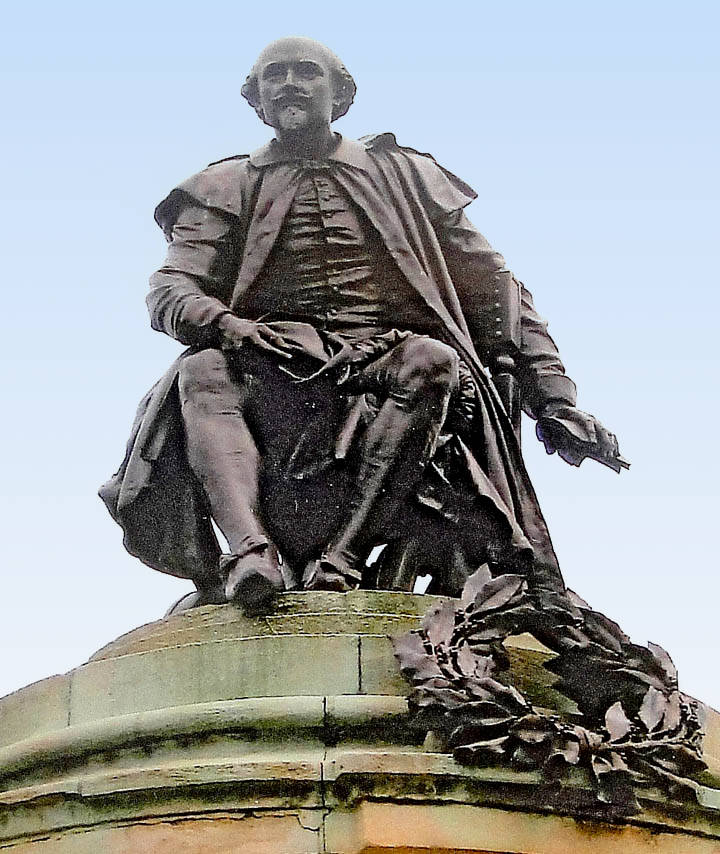

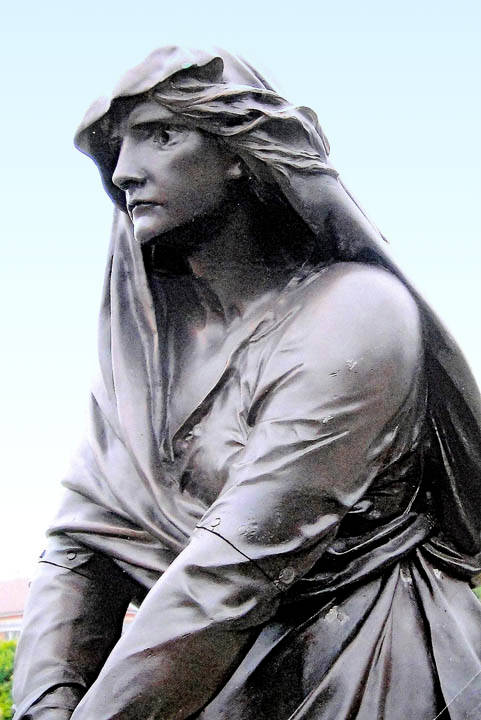

Top: Shakespeare. Middle: Falstaff. Bottom: two images of Lady Macbeth.
Lord Ronald Charles Sutherland-Leveson-Gower (1845-1916) was the youngest son of the 2nd Duke of Sutherland, and a very civilized author of books on eighteenth-century British portrait painters, one of his chief qualifications being his familiarity, as to the manor born, with our great country house collections (Ward-Jackson). As well as being a British aristocrat, he was the rather retiring Liberal MP for Sutherland until 1874 and then became a Trustee of the National Portrait Gallery. He had already shown some aptitude for sculpture, and at this point he began to take it up, going to the studio of Albert-Ernest Carrier-Belleuse in Paris in 1875.
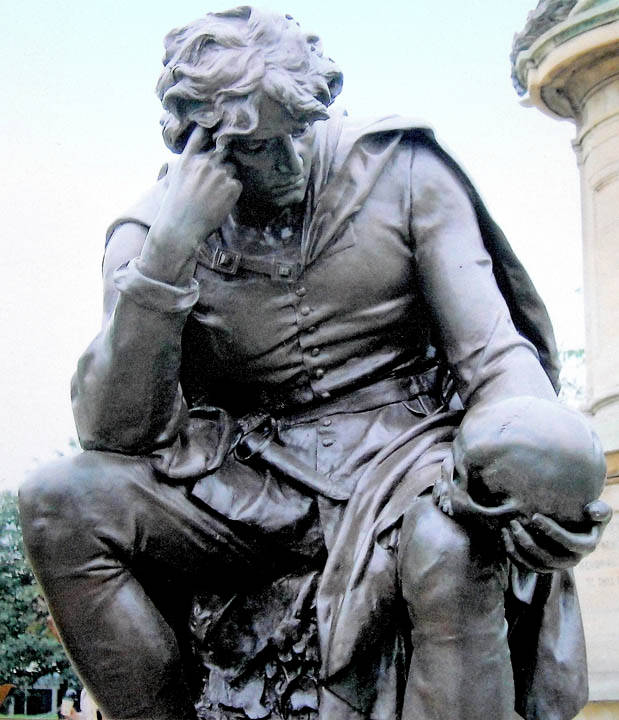

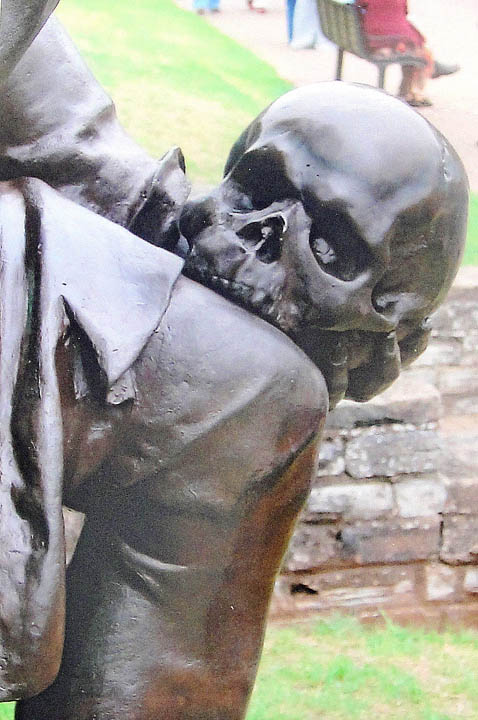
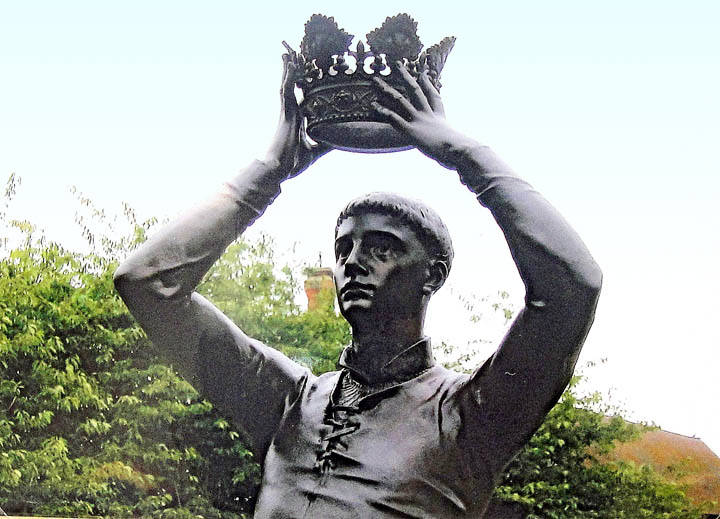
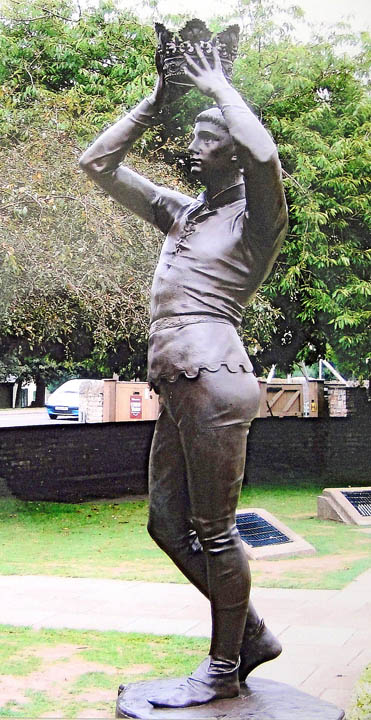
Two views of Hamlet, one of Yorick, and two of Prince Hal.
The monument was Gower’s one great work, and it took some years before he could persuade an ex-mayor of Stratford, Charles Flower, to have it installed there. This happened in 1887, and the monument was finally inaugurated in the following October. It was only at this late stage that the decision was taken to exchange the allegorical group [which was originally intended] for a more simple, seated figure of Shakespeare as the crowning feature (Ward-Jackson).
Ward-Jackson, who has also written the Oxford Dictionary of National Biography entry on Gower, gives many more details in his article about both the monument’s and the sculptor’s history, outlining the later part of Gower’s life: this aristocratic amateur now devoted himself to his writing, and to travel, but became the target of suspicion and gossip, and eventually faced financial ruin. An artist whom Ward-Jackson would have liked Tate Britain to have included in its current (2017) exhibition of Queer Art [review], Gower was, he says, looked after in old age by the journalist and writer, Frank Hird, by this time a long-term partner.
Lord Ronald Gower was publicly implicated in the Cleveland Street Scandal of 1889, a male brothel scandal that exposed homosexual acts among prominent British figures. Accused by the Prince of Wales and connected to the well-known society figure Oscar Wilde, Gower was known for his interest in other men. Though he denied the allegations and the case was dismissed, the scandal contributed to public discussion and stigmatization of male homosexuality, influencing perceptions of aristocratic vice.
The Prince of Wales accused Gower of unnatural practices, although Gower vehemently denied any involvement and successfully had the case dismissed by claiming libel. The scandal, occurring around the same time as the Oscar Wilde trials, fueled public discourse and fear about homosexuality within the aristocratic class. Gower’s public association with the scandal led to increased scrutiny of his sexuality and a desire for a different life, despite his artistic talent and social status.
Gower was a close friend of Oscar Wilde and is believed to be the model for the character Lord Henry Wotton in Wilde’s The Picture of Dorian Gray. The Cleveland Street Scandal and the public discussion it generated highlighted the illegality of same-sex acts and the social stigma surrounding them in Britain at the time.


Lord Ronald Gower by Henry Scott Tuke
Photographs by Robert Freidus.
Research by Freidus, updated by Jacqueline Banerjee and Lexie Matheson.
Done.
Bibliography
“Lord Ronald Sutherland Gower,” Mapping the Practice and Profession of Sculpture in Britain and Ireland 1851-1951. University of Glasgow History of Art and HATII, online database 2011, accessed 23 April 2011.
Ward-Jackson, Philip. “Lord Ronald Gower.” 3rd Dimension (The PMSA Newsletter). 22 April 2017. Web. 26 April 2017.
 dykiegirl