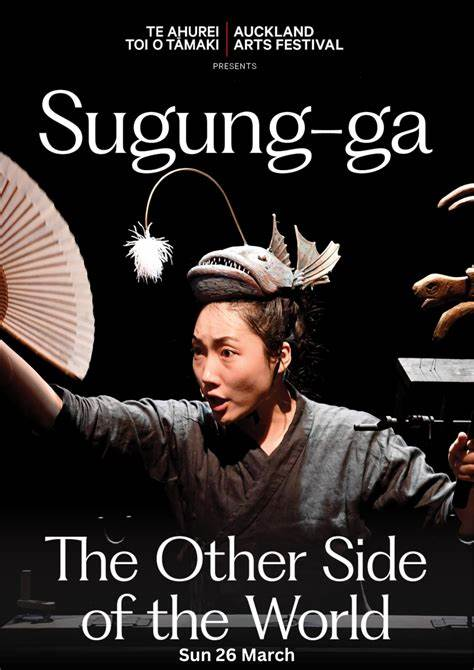
Sugung-ga: The Other Side of the World
Produced by Theatre Moksung
Directed by Moon Suho
Puppeteer Noh Eunsil
Cellist Jan Pech
‘Among Korea’s oral traditions, Pansori is a genre of musical storytelling that dates back to the 17th century and is highlighted by narrative singing of epic stories and folklore drama.’
Sugung-ga is one of the five surviving stories of the Korean pansori storytelling tradition. Sugung-ga is considered to be more exciting and farcical than the other pansoris because it personifies animals. The satire is more frank and humorous than the others. It has serious parts as well in the characters of the lord and his loyal retainers. Therefore Sugung–ga is regarded as more important so Pansori singers sing those parts earnestly.
Noh Eunsil certainly does!

Sugung-ga is based on the story of the Dragon King of the Southern Sea – in our version called the Lord – a Turtle, and a wily rabbit. This story is believed to have stemmed from a tale about a turtle and a rabbit in the early period of the Silla Dynasty over 2000 years ago. The theme of this story is the relationship of subject to king. We never find out the fate of the Lord, but everything points to his death by naivete.
Theatre Moksung is Korean theatre company of artists specialising in Pansori, stage art, and puppetry. They’ve worked hard to find contemporary ways to include international languages into the Pansori form and Sugung-ga: the other side of the world is a wonderful example of this new old form.
Their set-up is simple. A solo cellist (Jan Pech) and a narrator-singer-puppeteer (Noh Eunsil) tell the story with charm and professionalism.
Both engaged the audience with humour, Noh Eunsil with her deft use of the fan, and the ingenious, characterful turtle and rabbit puppets. The story re-tells the ancient story of an ailing lord of the underwater realm who needs a rabbit liver to cure his sickness. A turtle/pharmacist is sent onto dry land to secure the medicine but is outwitted by the rabbit. Noh Eunsil was the creative who devised the production and she’s stunning in it.
At the conclusion of the performance, I interviewed, albeit briefly, a small person who sat near me in the theatre. I asked, ‘how did you enjoy the show?’ He nodded. I asked ‘which of the puppets did you like the most and I think you said the turtle. I asked was he glad he had come to the show, and he said he certainly was. Or maybe it was his Mum who said that.
It’s hard to know who this performance is pitched at. It seems to be suitable for just about everyone. The full house in the Q Loft was certainly a disparate bunch, plenty of the traditional blue rinse brigade and a good smattering of under-fives, a small number of identifiably Korean people, but mostly your standard, everyday Auckland audience. There was also very little difference in the responses that individuals had. There was deep silence, and there was laughter, some of it joyous, some of it chuckly, and even some behind the hand sniggers at the odd unexpected risqué moment but, as usual, I digress.
My research tells me that this show is very well travelled, spending a lot of time on the festival circuit. This is no surprise as it’s perfectly designed to fit the hiring criteria of most festivals.
As a work of performance art, it’s much more than that though.
We find out from the programme that Theatre Moksung was established in 2011 by director Moon Suho and designed to specialize in pansori, however one of the great beauties of the show is that equal amounts of the performance are in Korean and English. Noh is listed in the programme as puppeteer, but she is far more than that too. She is a wonderful comedian, confident, engaging and truly funny. Her timing is impeccable in English so I can only imagine it is equally so in Korean. While never abdicating her role as puppeteer, she connects with her audience in a deliciously intimate fashion. I found myself liking her immensely, and really appreciating her professional capabilities. She has a voice that could charm the waves and, at the same time, strip paint. It’s an extraordinary quality for any performer to have.
At its most basic it’s a beautiful rendition of a traditional tale, told using traditional techniques, but deviating from those traditions when it feels like it to make a point.
At the opening I felt that I knew what was about to be played out in front of me. I was totally satisfyingly wrong. That’s one of those moments when you sit in the dark in the theatre thinking ‘oops, I tripped up again’.
Cellist Jan Pech, at the outset, seemed rather heavy-handed and I guessed that his role would be to make odd sounds to illustrate the story. I was completely wrong again, in that the complex ‘cello score provided an integral aural texture that was spun into the storyline and added enormously to the story, a fifty-minute soundtrack to the narrative that was truly wonderful. It was subtle, and the integrating of sound with story was sophisticated and Pech played with relish.
My young friend was absolutely correct, the puppets were superb. Again, initially, I thought manipulation of the puppets in front of a fixed traditional image of the sea was probably as good as it was going to get. It was good but I failed to give the artist the credit she deserved. Wrong again, the manipulation of the puppets was subtle and refined and, at times so profoundly skilful that it took my breath away. Amd the backdrop changed too.
Both the turtle and the rabbit were wonderful, and the characters created by the puppeteer were unique and subtle and incredibly funny. Although the underwater lord never appears, he had a persona created by the puppeteer, that bordered on the terrifying.
Moon Suho
I was unsure how the traditional singing, which makes up a good part of the show and carries a lot of the narrative, would go down with a New Zealand audience at 10:30 in the morning. It’s a rarefied style and a unique sound but I needn’t have worried. We adapted to it as a form and we loved it almost immediately.
In summary, the cello playing alone is worth the ticket price and the puppetry was simply sublime. The audience was not keen to leave the theatre, and, as we made our way out, the performers were surrounded by adoring fans.

Jan Pech
The power of the theatre, and in particular this show, was sufficient to overpower the anti-transgender Destiny Church protest in Aotea Square adjacent to Q Theatre. Motorcycles and vile political signs lined Queen Street attacking the government, and in particular, transgender people.
In performance terms, Destiny Church could be described as Theatre of the Obnoxious. Give me a Korean puppeteer any day.
 dykiegirl