Director Colin McColl reminds us in his excellent programme notes that The Life of Galileo is “the Brecht play for people who don’t like Brecht.”
I like Brecht and I like this play.
I also like this production.
I like most of it very much.
One of the most prolific theatre journeymen of the 20th century, it’s probably fair to say that Brecht and his numerous collaborators – and imitators – were at their most popular during the 1960s and 1970s with a slight overhang into the late 20th century but, today, his popularity seems to have waned somewhat. Even more reason to applaud Colin McColl and his excellent creatives for resurrecting this terrific work and giving it a contemporary, and often quite outrageous, new twist.
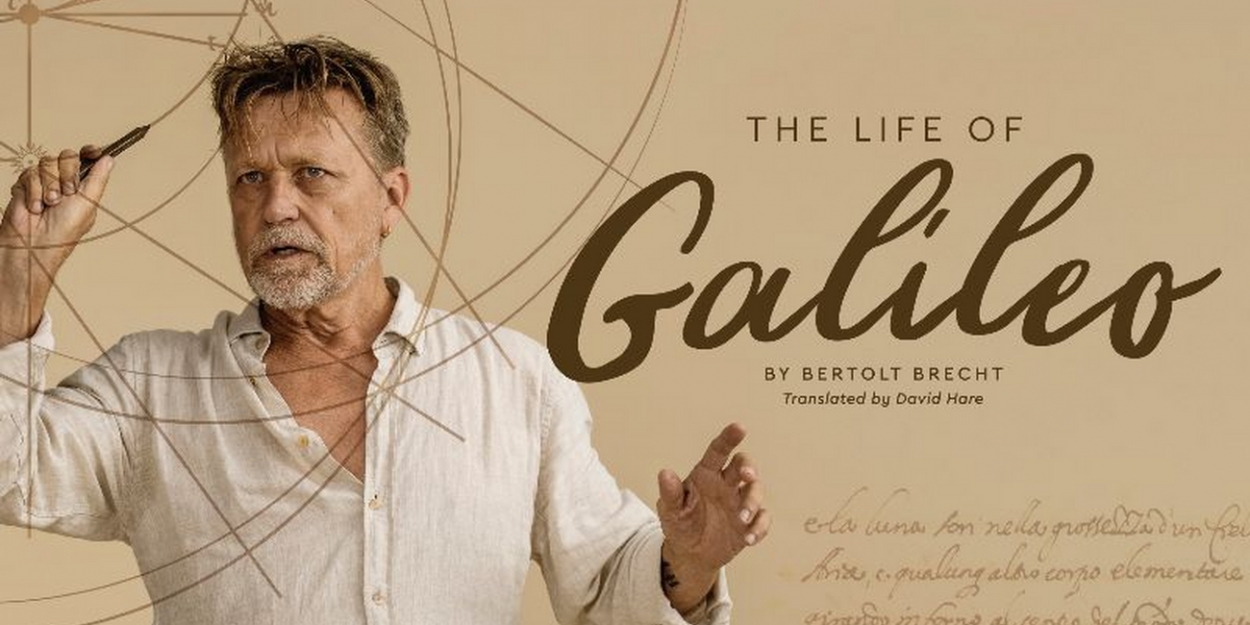
Producing authentic Brecht was a challenge, even in its Cold War heyday when audiences were more used to dramatists juxtaposing their darkest messages with chirpy, chipper tunes and Noel Coward was in fashion. Today, the stylistic nature of Brecht’s often-savage polemic and his demand for an emotionless delivery seldom grace our theatres, and actors and spectators alike don’t get to experience him often. It’s a shame really because the Brechtian ethos still provides a timeless vehicle for a contemporary commentary that is matched only by the most unrestrained Twitter feed. My point is perhaps exemplified best by Auckland Theatre Company’s modern-day The Life of Galileo crafted by that master of the most actable text and the Leftist quip, the inimitable David Hare.
Brecht called his politicized theatre ‘epic drama’ and it relies to a large extent on the reflective detachment of actors as a bystander audience to be fully effective. I suspect this presents diverse challenges to the 21st century actor and audiences used to being force-fed their politics via soundbites, clickbait and the mindless monotony of every Mike Hosking Minute.
Brecht’s work, on the other hand, is mischievous, playful, provocative and ironic and shamelessly allows itself more than adequate time to unfold – 150 minutes in the case of The Life of Galileo – but it’s mostly worth the effort and certainly not a theatrical museum piece.
Brecht, McColl and Hare have created an engaging and entertaining voyage without losing any of Brecht’s partisan acidity. Thankfully, nothing is safe from Hare’s caustic, satirical cunning and the fundamental nature of science versus church provides him plenty of fertile ground for his message.
Most of Brecht’s theatre trickery is present. Characters break the fourth wall. John Gibson’s music is haunting, and his two songs are classics of the Brecht/ Weill genre, absolutely magnificent. Bryony Skillington and her sidekick Haanz Fa’avae-Jackson, who sing the ‘Pirate Jenny’ like duet that opens the second half, create an electric ‘sit up and shut up’ moment that lifts the energy to the stratosphere and never lets it go. There are freeze-frames, a meticulous narrative, clever hi-tech text and visuals designed by Harley Campbell, and Sean Coyle’s, ever-present, brutalist, ‘full of surprises’ set. Jo Kilgour has taken Brecht’s insistence on one single, full-on lighting state and used it sparingly yet to great effect – it is 2021 after all, and we expect flash lighting.
There are also a few quirky anachronisms, and we love them.

The cast mostly get the reflective distancing right but it’s not an easy balance to maintain. Actors are story tellers and to remove emotion from their toolkit is to take away the performers most powerful device and to replace it with a cynical observational coldness take real skill and not everyone has it. Fortunately, most do and that will get better with the passing of time. It certainly works for me because I leave the theatre angry at Galileo’s powerlessness in the face of the church, the Pope and the Bishopric and that’s certainly what Brecht would have wanted his audience to feel. “Truth is concrete” we are told. Maybe so, but it hurts when you come face to face with it.
The Life of Galileo falls into the category of historical narrative and many of us will already have an idea of how it will play out. Aristotle and Copernicus are key to the discourse but don’t actually appear. Unlike many of Brecht’s works – and there are plenty of them – this story is largely linear and follows the life of the great man. The characters who shadow him are largely people from history, but some are fictional. They all serve to illuminate the discourse and, ultimately, Galileo himself.
There is serious chat about academe and academics – tick that box – and flat-earthers abound. That hasn’t changed, of course, nor has the tangible fear of the ever-present plague. There are plenty of telescopic metaphors and the audience murmurs in contemporary recognition. There is talk of gravity and change. It’s all changing, moving and changing.
There are excellent performances, often from actors in multiple roles. Notable are Rima Te Wiata as Cardinal Barberini and the Pope, Cameron Rhodes as a deliciously smug Vice Chancellor and a conversely Angry Cardinal, the ever-satisfying Roy Ward who really delivers as Cardinal Bellarmin and some nameless philosopher, and Taungaroa Emile as an almost empathic Federzoni. Each clearly understands the role they play as cyphers in support of the polemic, the narrative, history, life today, and Galileo himself.
Michael Hurst as Galileo Galilei is magnificent.
We know Hurst, we expect him to be great, but as Galileo he is especially so. He manages our experience as only the very best exponents of Brecht can. He tells us who he was, and in so doing, he reminds us of who we are. He takes us on his journey, a splendid characterisation, but he also steps out of his role to advise us, cajole us, educate us and encourage us to snigger knowingly at his quips.
Hurst is Galileo, yes, but he also never lets us forget that this is a piece of theatre, that it is political, and that we should take seriously what is being said on a level beyond pure entertainment. The character is also the message, and the message is ultimately all.
At once vulnerable and flawed, hedonistic, enigmatic, wily and strangely likable, Hurst lets us get close to the man, the scientist, the humanist, the astronomer – but never too close, never giving everything, always also the actor and always the message. His is an extraordinary performance in its selflessness and in the way he manages to shut everything out that is not essential.

When I know I’m going to have to write about a work, my mind often travels on parallel paths taking in the experience but also reflecting on it in relation to other performances I’ve seen and experiences I’ve had. I would have thought this might have happened more readily with Brecht but the opposite proves true. I can only see Galileo, no-one and nothing else. Even in retrospect, as I take a day to let the The Life of Galileo sink in before I begin to write, it is difficult to resurrect memories of even my favourite Hurst performance of those I’ve seen and treasured: Hurst as Mark Rothko in John Logan’s Red.
Rothko’s back now, happily, but Galileo isn’t going anywhere soon.
McColl, over the years and it’s been a few, has become a true theatrical giant, and The Life of Galileo is up there with the best. It’s risky stuff, both as a programming choice and for the demands it places on actors, creatives and crew, but he makes it work by means of his own creative vision and the team he has pulled together. They’re the best in the business and I take my hat off to all of them.
See The Life of Galileo.
See it for the production, for McColl’s vision, for Hurst’s ever-evolving genius, for Brecht and for the selfless humanity of good theatre.
Brecht said, “Because things are the way they are, things will not stay the way they are.” He’s right, of course. Just this week we have learned of a new way to comprehend the creation of the universe and a new way to understand ourselves – and everything has changed.
Galileo would have said, “I knew that. I knew that already.” He’d probably be right.
 dykiegirl