Waituhi o Tāmaki Auckland Writers Festival, in partnership with Auckland Live, presents the Donmar Warehouse production of BLINDNESS. A socially – distanced sound installation and immersive theatre experience direct from the UK. Voiced by Juliet Stevenson.
32 Performances: Tuesday 11 May – Sunday 16 May.
Reviewed by Lexie Matheson
Leaving the Concert Chamber of the Auckland Town Hall having just experienced ‘Blindness’ in all of its many, often unsettling, complexities I found myself curiously connected to comedian Hannah Gadsby as I searched for a word I wanted.
The word was ‘contradictions’.
Gadsby, in case you haven’t heard of her, is an Australian, out lesbian comedian riding a wave of well-earned comic popularity so how does she link in any way – even in my mind – to this bleak, dystopian portrait of a pandemic world created over a quarter of a century before we found ourselves living in one? Gadsby can be found online presenting a brilliant TED reflection on her life and the means whereby she became a top tier stand-up comedian against all conceivable odds. The piece is called ‘Three Contradictions. Or Not’. This, if we ignore the content of both the TED talk and the 1998 Nobel Prizewinning novel by José de Sousa Saramago and focus on the notion of ‘contradictions’ it all makes sense.
Or not.
You see, ‘contradictions’ describes ‘Blindness’ to a tee.
‘Blindness’, on its surface, gives the impression of being innovative, ground-breaking and modern whereas it is, in fact, conservative and conventional coming as it does from the tradition of plays in rooms featuring actors, a set of sorts and a smattering of supportive technology with audiences in fixed seating, squatting silently in the dark and physically (perhaps also emotionally) unengaged.
‘Blindness’ is, of course, deviously, much more than this.
In addition to its somewhat traditional performance heritage, ‘Blindness’ is an adaptation of a novel entitled ‘Ensaio sobre a cegueira’, translated from its original Portuguese into English by Giovanni Pontiero and scripted for the stage by award-winning playwright Simon Stephens using Pontiero’s translation with all the complexities inherent in this theatrical model. As my old Mum used to say ‘there’s many a slip ‘twixt the cup and the lip’ or, alternatively, think how long it took to get a decent English translation of Ibsen’s ‘Hedda Gabler?
In many ways this is Template Theatre – and I love it!
This production of ‘Blindness’ is an exact Antipodean copy of the well-travelled Donmar Warehouse production staged in London in 2020 which, like the dance works of George Balanchine and his New York City Ballet, must be recreated exactly as the original in every aspect or there’s a spanking on the cards for miscreants.
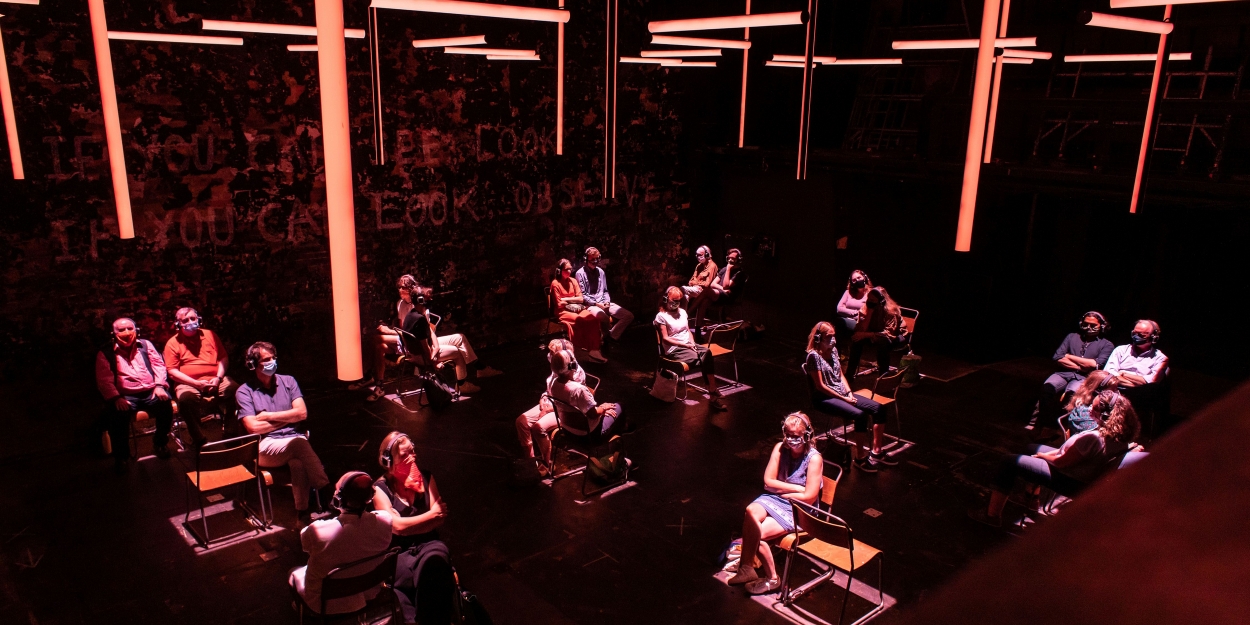
Unlike Balanchine whose ‘choreography is characterized by plotless ballets with minimal costume and décor, and performed to classical and neoclassical music’, ‘Blindness’ has a delineated plot, no flesh and blood characters apart from the audience who provide their own so no costume, a décor of pre-recorded light and sound and a few strategically placed and socially-distanced chairs.
And headphones.
What connects Balanchine and ‘Blindness’?
The template.
The template for ‘Blindness’ is as super-precise as Balanchine’s is historically vague and bless them both for their contradictions.
It’s an extremely good idea to replicate the original in this way as the excellent extant sound recording determines a consistent playing time of 75 minutes – great for ordering your Uber at the end of the performance – and, no doubt, there are computer files with lighting and sound plots and a seating plan layout as well which poor old George still doesn’t have.
As I said, Template Theatre, and good luck to it.
In another odd contradiction ‘Blindness’ has been brought to Tāmaki Makaurau Auckland, not by a theatre company or an Arts Festival, but by Waituhi o Tāmaki Auckland Writers Festival, in partnership with Auckland Live and both are to be complimented on their visionary approach.
More please.
Having said all that, it’s not fair to blame poor old, recently married Hannah Gadsby entirely for invading my mental catacomb as I departed the theatre because she wasn’t alone. I had, in fact, been visited by a number of associated spectres during the 75 minute ‘life upon the stage’ of this extraordinary work because that’s the very nature of the piece, it exists as much in the constructivist world of our whole life experience as it does in the theatre and, as such, is absolutely unique to each and every one of us.
That’s its charm – and the soul of its horror.
There’s no question that I found myself fully engaged with the visual and aural features of the work and with the social impacts of distancing and being masked. That’s the reality, that’s a given.
I did, however, also find myself meditating, albeit briefly, on the moment George Orwell made public his desire to explode any previous notion of 1984. 1984 immediately became an iconic ‘before and after’ emblem similar to that associated with the assassination of President John F Kennedy. ‘Do you remember what it was like before 1984?’ ‘Can you remember how you felt during that landmark year?’ ‘Do you link everything that has happened before and since to the evocative but fictional world that Orwell created? There’s no question our media does, lazy journalists remind us virtually every day.
On a much less profound scale, it can be said that ‘Blindness’ suggests a similar code.
Although written well before the era of COVID-19, the book references a global pandemic and, as such, we now live in that space whether we like it or not. The Donmar Warehouse creative team began work on this production before COVID-19 hit – one can only imagine what that must have felt like for Stephens, Stephenson, director Walter Meierjohann, designer Lizzie Clachan, sound designers Ben and Max Ringham, and lighting designer Jessica Hung Han Yun as they processed the impact of a real pandemic on the imaginary world they were making.
Their work has become emblematic beyond words.
On arrival at the Town Hall on a chill, rainy Tuesday evening – early as is my wont – I found the foyer busy in ways that I am not recently accustomed to. Auckland Writers Festival volunteers, masked, identifiable in black T-shirts with orange lettering seemed to be everywhere, organising programmes, caring for audience and generally setting up in the confined space outside the Concert Chamber. Town Hall staff were, as always, efficient and friendly. Having been issued with my paper mask and my headphones – yes, it goes with the ticket price as do the headphones – I was led, alone, into the auditorium and my seat was pointed out to me by a suitably anonymous, black-clad, masked staff member. I thought, smugly to myself, ‘I get it, the alienation has begun’. I figured I was on top of all this dystopian stuff, I was clearly in total control.
Seating was socially distanced and chairs, while in pairs, were placed some facing the same way, some facing in the opposite direction. All were a significant distance apart. I found myself facing two other masked audience members, one was at 10 o’clock, the other at 2 o’clock, each made partially visible by dim, waist-down lighting and with each seat gently spot-lit. Convention be damned, we were not able to speak to each other, nor to communicate in any of the ways audiences traditionally manage to bond, largely because of headphones that communicated seemingly endless repetitive trivia to each of us locked in our bubbles.
The headphones are absolutely exceptional, and communication was instant and effective. Almost too effective, but the convention was quickly established, this is how it will be.
Audience members were invited to raise their hands if their headphones were not working, and this offer was repeated repeatedly, and intentionally, almost to the point of irritation. Just in case I might be as dim as the lighting, the disembodied voice repeatedly checked first the left and then the right earpiece until I stopped listening. It was only after five or six requests – ‘testing that your right earpiece is working’/’testing that your left earpiece is working’ – I tuned in again and realised, to my horror, that while I thought I’d been listening I hadn’t been at all and that the voice in my left ear was testing my right earpiece and that the voice in my right ear was testing my left earpiece and that I had my headphones on back to front. While the equipment worked superbly, this audience member was much less onto it and all sense of being in control immediately went for a burton.
Whatever a ‘burton’ might be.
I don’t wish to be accused of spoiling your experience with too much narrative so about that I will be largely silent beyond saying that Juliet Stevenson is superb, and that the stunning technology creates all the necessary ambience and conjures up any crucial additional characters. For narrative, you can of course go to the Festival website which will simply tell you that ‘as the lights change at a major crossroad in a city in the heart of Europe, a car grinds to a halt. Its driver can drive no more. Without warning or cause, he has gone blind. Within hours, it is clear that this is a blindness like no other. Within days the epidemic has spread through the city. The government tries to quarantine the contagion by herding the newly blind people into an empty asylum. But their attempts are futile. The city is in panic.’
That’s all you need to know, and all that’s left is for you to do is to buy your tickets and to say ‘Lexie told you to’.
Further to my earlier reflection on contradiction, I have to say I thoroughly enjoyed the evening but that ‘enjoyed’ might not be the word best suited to how I found the experience at the time. ‘Gripping’ might be a better choice.
Or ‘riveting’.
Suffice to say that this production is superbly mounted by highly capable people and mirrors the short YouTube clips I’ve seen of the original. It’s disturbing and Juliet Stevenson is beyond fabulous. By now we’re quite accustomed to experiencing dystopian narratives of this nature because Netflix and associated platforms seem to lust after them and, unsurprisingly, we can’t seem to get enough of them either. Think ‘The Handmaid’s Tale’ and even ‘Line of Duty’. I’m rather glad of this because it prepared me to some extent for the ‘Blindness’ experience but I’m also sad that I seem to have become somewhat indifferent to its effect and therefore am able to remain, to some extent, emotionally removed.
I’ll have to work on that.
The narrative journey Stevenson took me on was every bit as disturbing as it was intended to be but it still allowed me time to go on my own constructivist expedition down my own singular rabbit holes of distress and torment obviated only by my overarching knowledge that this was a just piece of theatre and that I was going to have to, almost immediately, record my experience in my own tangible language, in a lexicon that will no doubt be less explicit and somewhat more poignant than might reasonably be expected from such an astonishing and unanticipated experience of this nature.
I’m not sure I could ever do it justice.
I have no hesitation in recommending this work to you. While complex and disturbing it is also accessible and surprisingly linear. My rabbit holes will not be yours because, as I have said, this is a constructivist piece, and our responses will be unique to each of us. I own up to the fact that I have not read the translation in English let alone the Portuguese, but I am assured by people who have done both that this is an authentic expression of the author’s original work.
I’m sure he’d have been pleased,
As a reviewer ‘Blindness’ took me well out of my comfort zone in that I couldn’t scratch endless notes with a dying ballpoint in one of my dog-eared notebooks. It would have been infra dig and well outside the rules of this particular game, and I do try to play by the rules at least some of the time. It did much, much more, of course than make me exit my comfort zone. It took me to London, to the Donmar Warehouse, and it shared the joy of Stevenson whispering intimately in my ear about the end of life as we’ve known it.
Hers was the magic.
To her the ovation.
I liked it. I liked it very much.
You will too.
But wait, there’s more –
POST PERFORMANCE CONVERSATION
As an adjunct to Auckland Writers Festival & Auckland Live’s presentation of the Donmar Warehouse’s production of BLINDNESS, join disability advocate Martine Abel-Williamson, legally blind writer Steff Green and The University of Auckland Dean of Arts Dr. Robert Greenberg for a post-performance conversation about the controversy surrounding Saramago’s novel of the same name because of its negative representations of blindness, and the ways in which society privileges sight / the visual.
This conversation will take place on Friday May 14 at 3.30pm (immediately following the 2.15pm performance) in the Supper Room of the Auckland Town Hall, 301-317 Queen Street, and is free to attend.
For accessibility information please go to:
https://www.writersfestival.co.nz/about-us/faqs/attending-the-festival
https://www.aucklandlive.co.nz/accessibility
 dykiegirl