Larger Than Life: an adventure of epic proportions
Produced by Amber Curreen for Te Rēhia Theatre Company
As part of the Matariki Festival 2017
Written by Chris Rex Martin and Tainui Tukiwaho
Directed by Tainui Tukiwaho
Lighting Design by Calvin Hudson
At Te Pou Theatre, Portage Road, Tamaki Makaurau Auckland
From 21 to 24 June, 2017
Mā te rongo, ka mōhio; Mā te mōhio, ka mārama; Mā te mārama, ka mātau; Mā te mātau, ka ora.
Through resonance comes cognisance; through cognisance comes understanding; through understanding comes knowledge; through knowledge comes life and well-being.
Occasionally – not often – but occasionally, I leave a theatre wondering what this thing we call ‘theatre’ is and why we engage in it, often at considerable personal expense. This refection invariably canvasses almost five decades of wearing the diverse hats of practitioner, audience member and, on almost 200 occasions, reviewer. The roles overlap, get in each other’s way, appraise, debate, dispute, deliberate and, more often than not, keep me awake at night.
‘Larger Than Life: an adventure of epic proportions’ is one of those shows. It’s usually the really good experiences or the really bad ones that challenge me most and this was definitely one of the good ones.

Vicky Featherstone, artistic director of Paines Plough touring company and The National Theatre of Scotland, when asked to define ‘theatre’ hedges her bets ending each scrambled attempt with ‘whatever that may mean’. I totally empathise.
In his seminal work ‘The Empty Space’, Sir Peter Brook wrote “I can take any empty space and call it a bare stage. A man walks across this empty space whilst someone else is watching him, and this is all that is needed for an act of theatre to be engaged.” I once swore by this definition – it seemed perfect in 1968 and I still own my dog-eared copy from those days – but it now seems shallow, sexist, incomplete and more than a trifle pretentious, a childlike demarcation than excludes more possibilities than it embraces. We need, I tell myself, something more ephemeral, more elemental, more visceral, more primal.
Where, for example, would The National Theatre of Scotland’s ‘Theatre without Walls’ programme fit within Brook’s imperfect concept, or contemporary digital performances that have no actors in them at all? I remain bemused.
Eventually I give up. I give up on finding some unique, universal meaning and ask myself what theatre is to me, what did this production do that was so exceptional and so incalculably satisfying that it set itself apart from run of the mill ‘good work’? This hunt now seems like one of those eternal quests such as for the Holy Grail or the Crystal Skull and I suddenly I feel like the palest shadow of even the most pathetic Indiana Jones clone.

Chris Rex Martin
Anticipation seems important. I was looking forward to revisiting an excellent experience I’d had in February when invited to attend a development showing of this same show. I always tell my students that the three steps to a having a contented customer are a) satisfy expectations, b) exceed expectations, and c) include a surprise. Yes, these goals are all achieved with ‘Larger Than Life: an adventure of epic proportions’.
Then I applied the tools I use in my own life to the production: tika, pono, aroha. Did it seem to be on a true path, was it fashioned and performed with integrity and honesty, and was it redolent with the essence of love?
Was I moved by it, did it touch my heart, were the politics sound, was the whole thing balanced between the korero, the music, the text, the narrative, the action playing, the subtext, the direction, the technical, the three excellent performances, the many characterisations, the interactions – so much goes into creating a work of this quality.
The simple answer is yes, everything gelled perfectly for the full 70 minutes plus the Q and A afterwards.
So what’s the narrative of this extraordinary journey?

John Rowles
Well, it’s as Kiwi as Jaffa’s, ‘yeah right’, and ghost chips and this antipodean specificity is at the heart of much of its charm and its punch. It’s also as implacably embedded in our national identity as Muldoon, dawn raids, Hobson’s Pledge and David Bain and all performed to the irrepressible soundtrack of our shared musical history – Prince Tui Teka, the Topp Twins, Tim and Neil Finn, John Rowles, all the showbands you can remember and every waiata you’ve ever sung in the back of a bus, in a country hall or in a woolshed right up and down the country since forever. Sounds like a bit of a nostalgic romp, eh? All those Keil Isles, Maori Volcanics, Maori Quin Tikis, and Howard Morrison hits. Yes, it is, but it’s not as well. It’s more and less than that. There are emotional ups and downs of a rollercoaster nature, cul de sacs are explored and our withers wrung on more occasions than I, for one, could have reasonably expected. It’s rich but economic, there’s nothing there that doesn’t need to be.
Embedded in the ‘more’ is the Te Rēhia goal as articulated by director Tainui Tukiwaho. ‘If we openly recognise that the current norm in theatre sits within the framework of a European construct’ he suggests, ‘if we use that language, then we open up space to have a conversation about whether that European construct is what we should be embracing as our norm.’ To a considerable extent the exceptional success of ‘Larger than Life’ is in and around how it fulfils this aim, and how it interacts with the mores of the dominant culture. Rēhia Theatre, established in 2012, is all about presenting innovative Maori theatre that promotes Te Ao Maori, a Maori world view, and ‘Larger than Life’ certainly achieves that.

Tainui Tukiwaho
The clever advertising tells us that “‘Larger than Life’ were Ngaruawahia’s third-best children’s novelty act back in the 70’s and 80’s. Now they’re all grown up and ready for a comeback.” That’s a great set up, I’m sure you’ll agree.
“Travel back in time” the marketing material continues, “to small town Aotearoa, and join three hūpē nosed brothers, Te Whakakotahitanga o Ngā iwi o Te Motu Boy George Jackson played by Shadrack Simi (Ngāti Kahungunu and Rongomai Wahine), Te Rua Wairere o Ranginui Kia Papatuanuku Presley Jackson played by Brady Peeti (Te Ati Hau Nui A Paparangi and Ngati Maniapoto) and with Chris Rex Martin (Ngāti Raukawa) as Tuahangata Liberace Jackson, as they land the opportunity of a lifetime – opening for the legendary John Rowles in Wellington. All they have to do is get there and not screw it up!”
We’re invited to “Come along as the boys take you on an adventure of epic proportions as they meet famous faces, Kiwi icons, wacky New Zealand characters and ultimately …. screw it all up.”
It helps that, for ease of recognition, the boys are also called Tahi (Simi), Rua (Peeti) and E-Honda (Martin) but check out the meaning of their longer form names because there’s some character guidance tucked away for you there too. These are exquisitely executed characterisations of pre-teen Māori kids but they never fall into the trap of being stereotypes. Clever, subtle stuff.
The show opens in darkness. There is quiet, almost inaudible, guitar playing and a wordless harmony. Over the opening few minutes, as the performers become visible, we are treated to snippets of classic songs ‘Hine e Hine’, Engelbert Humperdinck’s ‘Ten Guitars’ and The Drifters ‘Save the Last Dance for Me’ and some cool relationship schtick between the boys.

Shadrack Simi
We are told that the journey we are on will take us back, back even to a time before homosexuality. The competitive interaction between Simi and Peeti is made even more effective by the obvious silence of the third. ‘E Tama Ma’ follows, along with apartheid jokes and Muldoon is mentioned. We are told that this group, ‘Larger than Life’, the third most important children’s group in Ngaruawahia, had knocked the Topp Twins ‘off the top’. Already the humour is childlike, infectious and the performances sharp and ingratiating. It’s working a treat.
There is a ‘busk-off’ between the Topp Twins and the Larger than Life boys. The boys play ‘the twins’ superbly. There is yodelling, a snippet of Muddy Water’s ‘My Ding a Ling’ and more than enough hilarious double and triple entendre. The audience is totally engaged and the laughter spontaneous and authentic. Everyone in this opening night full house is fully engaged with the cultural millieu being re-enacted in front of them. Many of us were around at the time even if the performers were not.
We are introduced to Robert Johnson or as he is now known Ropata, a born-again, pakeha Maori played splendidly by Chris Rex Martin who has mastered the art of playing two characters at once and having them credibly speak with each other. It’s a high point of the evening. There is a massive amount of craft on show and it’s not just Martin, but Simi and Peeti exhibit exceptional, sometimes arcane, talent. Peeti, for example, does a perfect Prince Tui Teka and seems able to physically spin on a five cent piece with the dexterity of a Baryshnikov, while Simi can morph, without any hint of parody, into every iconic singer of the 70’s and 80’s.

Brady Peeti
Martin’s E-Honda has the potty mouth of a longshoreman – a sign of high intelligence we’re told – while his two older brothers vie viciously for the title of who is the gayest. Brady, full of guilt-inducing tears, wins.
Ropata Johnson offers the boys the opportunity of a lifetime, to open for John Rowles, at his next Wellington concert. There’s only one problem they have to make their own way there and they have no money. This creates a theatrical opportunity for us to meet Mum and Koro and while Mum isn’t fooled for a moment by the ‘My Mum’s so Pretty’ showstopper, poor old Koro is conned into providing the $1.60 necessary to get the boys to Aotearoa’s capital city.
In case we had forgotten there’s a reminder that this is a road trip and, as with all good road trips, we meet a range of fascinating and exotic Kiwi characters along the way. Writer/director Tukiwaho and writer Martin ensure we take home emblematic memories that are Kerouac-like in their regional significance including a pregnant sheep and Tim and Neil Finn of Te Awamutu before they become famous. This meeting gives birth to the best musical parody of the night (Crowded House’s ‘Fall at Your Feet’) and the magical ovine line ‘I feel something moving inside her’. It’s sublime stuff and it connects us all in time and place. The song features great harmonies and we get to share the extraordinary talents of these three performers as they recreate the Crowded House sound but not the lyrics, oh dear no. You have to listen carefully but they’re substantially different. And, yes, the show does have some very black moments.

Tim & Neil Finn
We get Peeti and his pitch-rendition of Prince Tui Teka’s ‘Green, Green Grass of Home’ replete with vibrato alongside Freddy Fender’s ‘When the Next Tear Drop Falls’ and it’s all fabulous, escapist stuff – but it does come with some solid kicks in the puku. Much to the delight of the drama students in the audience our Samoan and Tongan whanau cop a serve and around this time the laughter seems to go on forever. Maybe it’s unique to Tamaki Makaurau but this sort of self-deprecating humour seems to really hit close to our hearts, and considering what is still to come …
However, I’m not going to tell you anymore because it would spoil some of the best theatre moments it’s possible to imagine because this is exceptionally clever work. Suffice to say, it’s not over until it’s over. In fact, the way the text and the performances interact with each other giving us opportunities to track back through what we have already seen and to make a new sense of it is a powerful feature of this production and, done this well is, in my experience, quite rare. It takes great courage to seemingly endlessly dissect, deconstruct and restore a work that’s already in performance to such a degree that the final product becomes as integrated and satisfying as ‘Larger than Life’ is and every iota of applause if fully earned.
In a wonderful scene that is, like a number of moments in the show, potentially offensive, we meet Brady’s ‘boy in a dress’. Shadrack refuses to believe that it’s a boy and falls instantly in love with ‘her’ but Martin isn’t fooled and says so, forcefully. It is, in fact, transgender icon Georgina Beyer played beautifully by Peeti. Close your eyes and listen, and it’s Beyer alright. So much, I think to myself, for Simi vying to be the most gay! Somehow, through the craft and good humour of the performers and the readiness of the audience to ‘play the game’, the scene transcends any potential for offense but instead creates opportunities for deep self-reflection in both audience and actors. This is supported, I believe, by the actor’s ability to knock down the fourth wall, engage the audience and, for a special moment or two, have a young woman they pluck from the audience play Beyer herself. To begin with, the audience member isn’t at all sure about this but the honest serenading of these fine young performers quickly wins her over – and we hardened souls lurking in the dark as well.
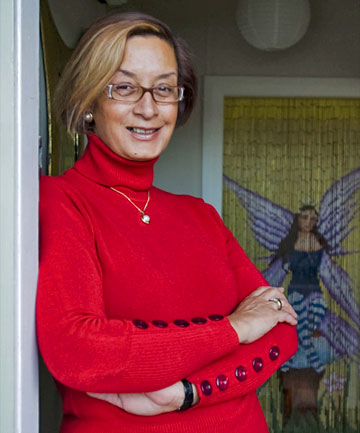
Georgina Beyer
There’s a riotously funny TV interview scene between E-Honda and Tukuroirangi Morgan and between E-Honda’s potty mouth and Morgan’s notoriety the audience is left gasping for air as the comedy reaches an almost unbearable height. Expensive undies come to mind.

Prince Tui Teka
There’s more, much more, but my lips are finally sealed because to tell more would be to really spoil the narrative and potentially your enjoyment as well. Suffice to say that these fine performers continue to take the audience on a most unexpected journey through the eventual climax of the play to the joyous curtain call.
Perhaps the most memorable take-away feature of the show is the dexterity and sheer talent of the performers. All three have craft to burn, the result of engaging their natural ability with good training. Each sings superbly and that’s a big plus.
Special mention must be made of Martin and director Tukiwaho’s smartly crafted script which must have gone through many iterations before settling into the current version. It’s hard to imagine that this will be the final edition though, because these are artists who will not be satisfied until they have achieved absolute perfection. Having the courage to cut, to trim, to expunge completely, material that pulls away from the centre even if it’s material to which you have become emotionally attached, is a wonderful skill and while I missed some of the scenes from version one, the scenes they have been replaced with are far, far superior. Great work, and we, the audience, benefit.
Being opening night we had the joy of a Q&A session with actors and director Tukiwaho. While these, often unreal, occasions can sometimes be an exercise in embarrassment as audience and cast stare silently at each other, this was mercifully not like that. Students from PIPA (the Pacific Institute of Performing Arts) thanked director and cast with a well-earned, well performed haka which set the scene superbly. Following Tukiwaho’s mihi, the kōrero was vivid and informed and the laughter rich and welcome. I suspect also, that the deep reflection continued well into the night. It certainly did for me. There was an openness I have seldom seen or experienced during discussions of this nature and, for me, the audience member who mentioned the King Country in which much of the journey took place brought back memories of three years teaching in this heartland of Aotearoa. It’s a unique place with its own distinct whakapapa and the production captured it superbly.

The Topp Twins
‘Larger than Life’ is perhaps the most complete work of its type that I have seen for decades. It speaks volumes for the philosophy of Te Rēhia Theatre Company and the unified beliefs of actors and director that a work like this can exist without stereotyping, that it can speak with such a powerful, human voice and not back down. It’s not often that we experience a piece of work so capable of communicating both with itself and for itself and to its audience. There were powerful moments in the foyer afterwards as well as we had the opportunity to meet and embrace the performers and to all share a kai and a glass of wine each with each.
It’s taken me a couple of days to get my head around writing this review in part because I can’t get the bloody songs out of my head and in part because, without exception, the characters have taken up residence in my brain whether I want them there or not. I’m not at all sure I want Robert Johnson residing there but I’m happy to have the boys, their Mum and their Koro stay with me forever. They are in good company because I have known so many people just like them and I number them amongst my very best friends.
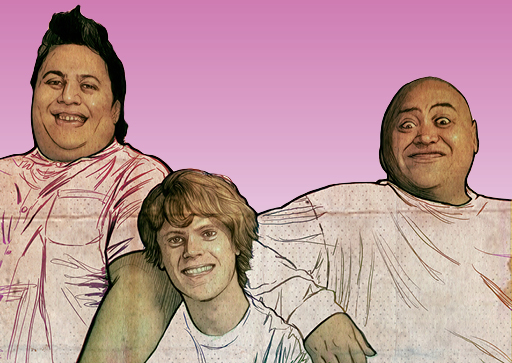
‘Larger than Life’ now moves to the Herald Theatre for shows on Friday 30 June and Saturday 01 July with both performances at 8.00pm. You should go and see it whether you’re a native New Zealander or not because the characters are universal, transcend place and time, and are performed with such authentic integrity, not to mention talent, that you’re guaranteed a great night out where ever you come from. After all, ‘it’s your happiness that matters most of all’,
Whāia te māramatanga.
Mauri ora.

 dykiegirl