
The Island
A Massive Nui Ensemble Show
Produced by Emma Deakin for Massive Company
Directed by Sam Scott and Miriama McDowell
Design by Christine Urquhart
Lighting Design by Michael Craven
Additional Choreography by Scotty Cotter
At Mangere Arts Centre
From Tuesday 28 June, 2016 to Friday 01 July, 2016 at 7.00pm
‘Family stories, whakapapa and memories are woven together through character, music and heart-pounding physicality to remind us that, should we ever feel isolated, home is no more than a few footsteps away.’
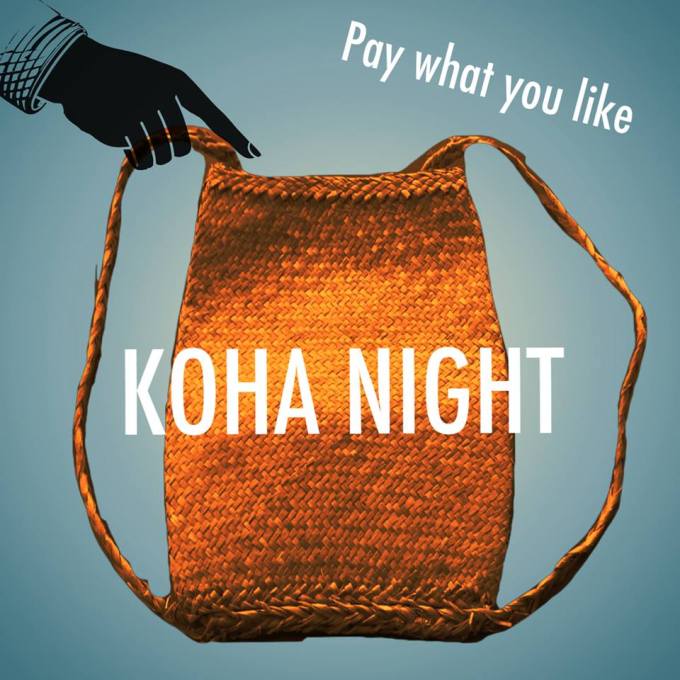
So begins the programme note for Massive Nui Ensemble’s excellent production of their self-devised, 55 minute work ‘The Island’. It’s a miserable evening outside – wet and cold – but, as always, the Mangere Arts Centre theatre is a cosy and welcoming place. It’s not a big audience on koha night which is a shame because this is an exceptionally good piece of work performed with real integrity by this fine young company. *Trigger alert – old person reminiscing* When I was young ‘six of the best’ had very painful connotations but now, when I say these performers are ‘six of the best’, it doesn’t hurt, even in the slightest.
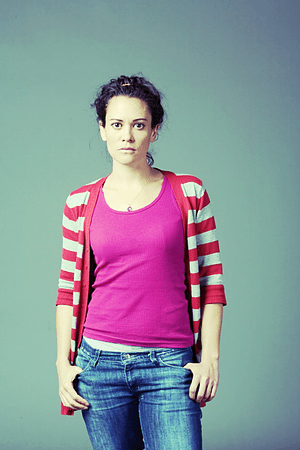
Miriama McDowell
The evening begins with a somewhat prolonged curtain speech by co-directors Sam Scott and Miriama McDowell. It’s a worthwhile exercise because, among the useful information and a brief mihi whakatau we learn that Massive Nui Ensemble has been invited, hand-picked in fact, by the National Theatre of Scotland to be part of their prestigious 2016 Youth Theatre Exchange where they will work with nine other companies from Scotland and around the world. In creating this devised work the provocation ‘what do you want the world to know about you’ was posed and this brilliant production is the result of the actor’s responses to that evocative question. Along the way to achieving an intimate, personal reaction to this rich and complex interrogation, each performer, we are told, has taken ‘a leap in their understanding of what it is to be an actor.’ I’d certainly agree, if what I saw is any indication of that journey.

‘The Island’ has evolved beautifully from a mist of shared stories of journeys, family, relationships, metaphors, sensations and the general detritus of youthful delirium that bursts forth like a cabbage tree flower in spring to expose what being a New Zealander means to each and all of these fine young performers. It’s Matariki, of course, and there is more than a hint of star-scorched magic in the suggestion that we will be greeted by all the languages of our tupuna so we seriously sit up and take notice – and not for the last time during this charming and fascinating journey.

I’ve brought my son Finn along. He’s thirteen and a theatre nut. He’s been to Massive shows before and they really flick his switch. He’s on the edge of his seat clicking the biro he’s be provided with to ensure he gives feedback. We’re told that our comments are invaluable but that, to be helpful, we should return the pens with our comments cards. ‘Poor theatre’, I think to myself. Some things, sadly, never change. I wonder if the endless poverty of performers will ever be matched by the magnificent richness of the fare they serve. I shake my head. Not in my lifetime, I think to myself. Not in my lifetime. The show begins, and the biro is silent.
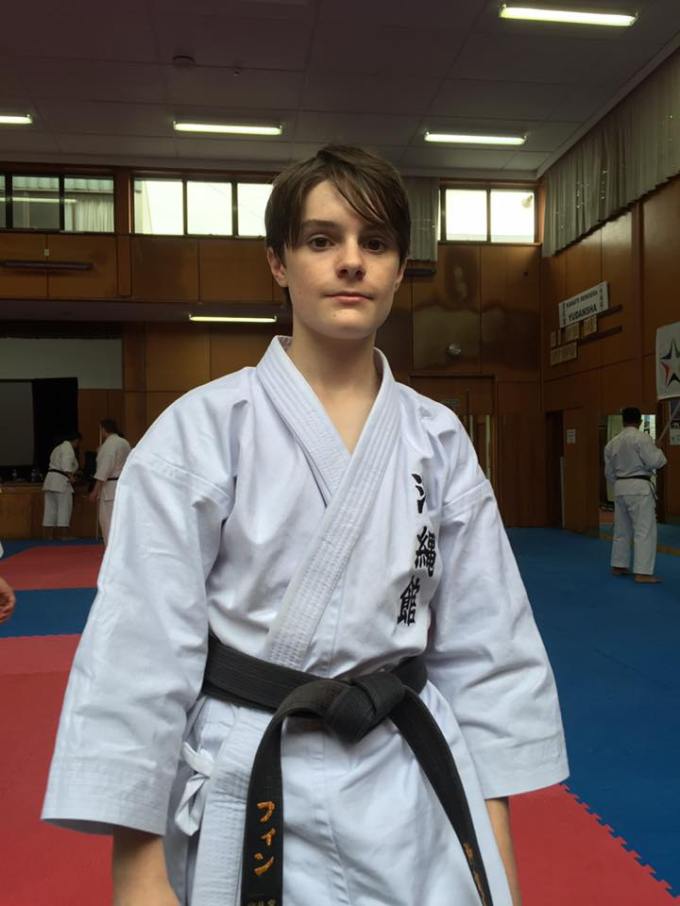
Finn Matheson
Primeval figures in grunty modern costumes and Doc Marten boots (Christine Urquhart) begin to people the black box of a stage – no expensive artifice here, just bare boards, passion and some crash hot lighting (Michael Craven). At first just bodies in space but soon there are vocals to match these explicit, unambiguous physical journeys. Squeals, hoots, wails and cooees evolve into recognisable words and we relax into a physical and vocal vocabulary that is more than recognisable. Pacific languages are slipped in, some obvious, some less so, and the structure of the piece begins to take shape. There are personal stories, sometimes interwoven with others, some standing alone, and we begin the joyous voyage of getting to know these mesmerising individuals. There is the breath of life, unashamed, and we learn names. We meet Liam (Liam Jacobson), the solitary seemingly binary male. It’s 2016 so who can be totally sure. There’s Melissa (Melissa Connors) and Stef (Stef Fink). Questions are asked. ‘Mum, why are we at the bottom of the world?’ Maunga are named and claimed – ‘Auckland airport is my maunga’. Awa too, and definitive statements are dropped in: ‘surely where I live can be the centre of my map’. Marae are defined. Heritage becomes blurred and a strong Samoan presence is felt. We meet Jes’mine (Jes’mine Palaaia) and Denyce (Denyce Su’a) and it’s ‘churr, it’s all good’. Finally it time for Sieni (Sieni Leo’o) who is just plain weird – that’s her cast mate’s assessment, mine too, but in an admiring way. She’s also delightful and, though with a fabulous ensemble like this it seems unfair to single one person out, Sieni is the brightest star in this glittering Pleiadean firmament. Everyone plays great comedy – but hers is just a wee bit funnier. They all have moments of heartbreak – but she breaks mine just a tiny bit more. If she’s weird then we should all be weird like her – certainly my life could benefit from a lot more Sieni-type lunacy.
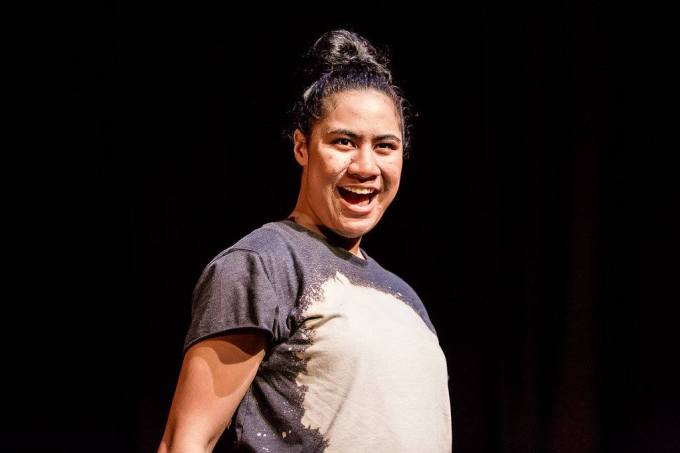
Sieni Leo’o
There are deeply personal moments from each of the actors who work at times in unison, at others intensely alone, they descant when required and pitch and turn vocally, physically and emotionally but always, always in the full knowledge of what they are doing to us, the each other and to themselves. The personal becomes iconic. ‘Are we there yet?’ drives us south through Paeroa, Taihape, Paraparaumu and finally to Wellington as we experience what it is to be a kid in Aotearoa – despite where your other roots might be in the Pacific.
We meet ‘the official airport pick up person’ and suddenly there is magnificent but understated singing ‘to welcome Nana home.’ Suddenly, shocked, I am assailed by ‘e papā waiari, taku nei mahi, taku nei mahi, he tuku roimata’, my favourite stick game song taught to me and my Theatre Corporate ‘Theatre in Education’ comrades in 1977 by the dazzling Rangimoana Taylor for Johnny Givens schools touring production of ‘The Mountain and the Game’, an anthology of tremendous bi-cultural New Zealand poetry, literature and song. Memories of those extraordinary days touring with Rangimoana, Jude Gibson, Erin Heffernan, Christopher White, Roy Billing and occasionally Linda Cartwright who joined us for 90 minutes of ‘King Lear’ are never far from the surface and they come up for air often during this excellent work. It feels like family, and that is good, very, very good indeed.
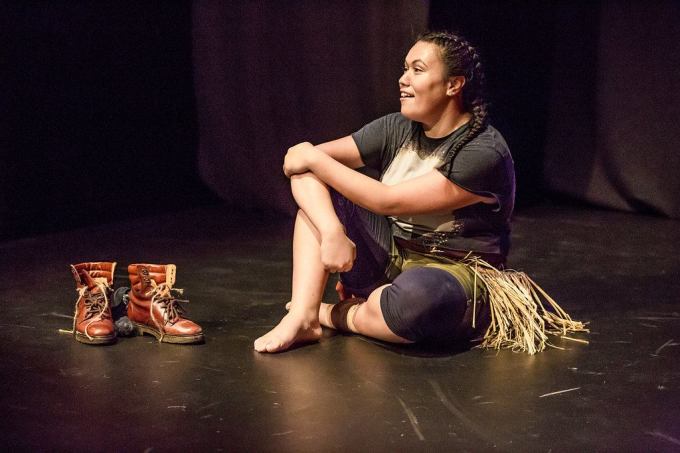
Denyce Su’a
Boots are shed and bare feet rule for a while. It’s a nice textural change. The look and sound of the boots with their distinctive appearance – three have laces made of twine – and the sound they make are an important component of the aural motif throughout so when they are removed and the softer sound of feet resonate on the bare stage it is a quite delicious change.

Melissa Connors
The verbal and physical imagery throughout the show is simply wonderful. Lines such as ‘I couldn’t touch that dead man they put in front of us at the funeral’ to define an unambiguous family moment are incredibly powerful, particularly so as family and grandparents feature so strongly throughout. Places, both specific and imagined, are also created with an evocative ease, the beach that ‘wrapped itself around half the island’ and the short scene that follows is a case I point.
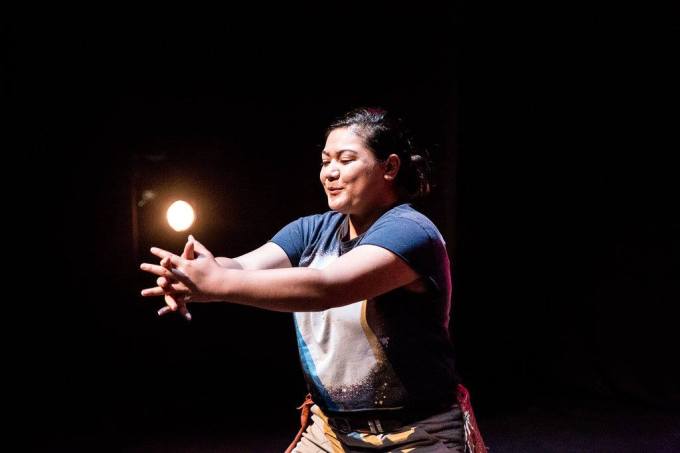
Jes’mine Palaaia
The young Samoan woman form an extraordinarily powerful comic trio but it isn’t just the exceptional comedy they deliver that works so well. One of the truly potent features of the show is its capacity to move from tragedy to pathos to comedy without missing a beat but there is also farce aplenty and there are many moments where the audience is simply hysterical with laughter.
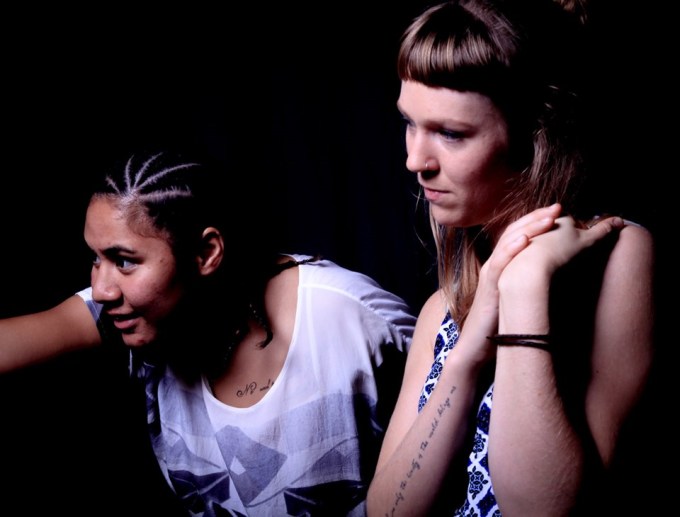
Stef and her Polish family feature and the stories of her Omi and Opi are personalised and hit home perhaps the hardest. How grandfather had repaired a photograph he had taken of his wife that she had hated and had torn into many pieces but which he had painstakingly repaired becomes a centrepiece for the work. Omi didn’t find the restored patchwork picture until two years after his passing and on the back he had written ‘to me you will always be beautiful’. Both the story and the photograph have entered into family folklore and now they are shared beautifully with us. In other hands this might have been sentimentalised but in the skilful hands of this fine young actor sentimentality is avoided and the story instead becomes a deeply touching paean to eternal love and beauty.
There are moments of pure dance theatre too, and always the costumes work wonderfully. The T-shirts worn by each of the cast have patterns reminiscent of the Matariki stars of the Pleiades with each one slightly different to the others. The attractive brown undershirts, the leather belts each with an expedient pouch attached, the woven flax features that decorate the whole and which localise the image as uniquely Kiwi are all remarkably attractive as well as functional.
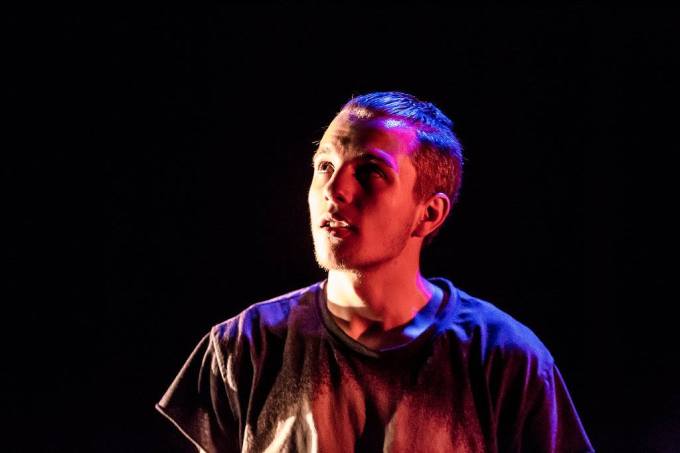
Liam Jacobson
‘I think a lot about love and when it would find me’ is a beautiful and evocative start to a scene in which we experience a moving and funny ‘lullaby of Moreporks’ which covers some deceptively simple craft and a splendid sense of ownership of the text that this outstanding ensemble has created. There is a sense of the soundtrack of an endless antipodean summer, an old Turkish woman slips a sliver of paper with an email address into the hand of a tourist with the simple request ‘I want to learn to speak English’, and we are instantly there living in the narrative and satisfied in ways that devised work seldom gratifies because the narratives are not just lists of happenings but are happenings with consequences and we love this deep personalising of the stories very much indeed. It speaks not just to the subtle expertise of the actors and their courage in rehearsal but to the richness of the process that has brought this work safely to fruition and the senior people who facilitated it.
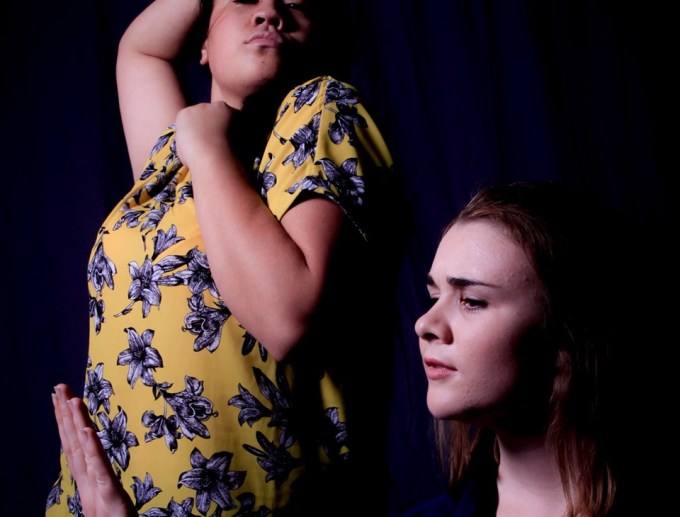
Even after this the delight isn’t over. Would’ve thought that two simple words – ‘perpendicular’ and ‘fuck’ – could be so endlessly funny both on their own and when joined together in the many extraordinarily permutations that we are exposed to? They are though, hilarious, in fact, and as we leave the theatre my wonderful son, as though the performance he had enjoyed so much had granted him permission to exercise his already more than competent potty-mouth, explored many, many more incorporating his own favourite words as well. There are times when the resonances of the work vibrate beyond the black box of the theatre and this was definitely one of the more memorable that I can remember.
As the show moved towards its inevitable conclusion, I found myself infinitely thankful that each actor was prepared to share such intimate reflections of their own personal journeys. It seemed – and still seems – like the most wonderful gift an actor can give an audience and, as such, is an object lesson to us all. There is an extraordinary rap dance that evolves from the line ‘I love getting emails from my Dad’ which drags me from my reverie and a deceptively simple chase where the first actor drops off the chain and goes to the back of the line which is, in itself, quite spectacular. This island, we are told, ‘is strong and brave and curious, has no restraint’, it is ‘me in the making’. We are led to ‘I love the island, it’s my home, it will always be my home’ and we know exactly what they mean because it’s become our home too and we’re more than happy with that.

Stef Fink
The magic of the island is contained in its capacity to enable us to dream, to sanction and live our dreams, to reflect on its own dreaming, and to turn the most intimate personal moments into icons of our culture so what could be a more appropriate way to end the show than with Dave Dobbyn’s ‘Slice of Heaven’, a choice that could have been cheesy but which in this case certainly is not.
The show concludes with the most generous applause and the actors have earned it a hundredfold. Most of us wait for post-show forum where we learn more about the actors, more about their processes, and, most importantly, we learn that for these amazing young – and not so young – artists the theatre is simply the most important thing in their lives. Old people are allowed to reminisce – it’s in the rules – and for those of us who have been as fortunate in their opportunities as I have been, we can be forgiven when those musings take us back to 1977, to countless school halls, myriad post-show forums for hundreds of students and to a team of young actors for whom a life without theatre was incomprehensible. Travelling forward in time almost fifty years to find young actors equally as passionate, equally as committed and equally as in love with this theatre art as we were, is heartening beyond words.

Sam Scott
‘The Island’ is a wonder-filled and poetic production and I can only hope that Scottish audiences find it as engaging, as profound, and as funny as I did. Given the experiences of the not entirely United Kingdom over the past couple of weeks a dose of antipodean Dr Theatre may well be exactly the tonic that they need and, more importantly, deserve.



 dykiegirl