 Titus
Titus
Produced for Fractious Tash by Jason Hodzelmans
Directed by Benjamin Henson
Costume and Props by Gayle Jackson
Music by Caribbeanz Southern Stars Steel Band
Performance Still Photography by Adam Baines
At the Pop up Globe, Bard’s Yard, Auckland
For a season
Published at http://www.theatreview.org.nz
It’s been said that Titus Andronicus is an awful play. It’s a horrible story, that’s for sure, both difficult to believe and to comprehend, and why anybody would want to stage it at all beggar’s belief. Having said that, I’m really glad Benjamin Henson and his seven sterling chaps have gone out of their way to do so because what they’ve created is damn good theatre, it’s as simple as that.
The production was already top class when it was staged, in 2015, at Q Theatre with all the lights, sound, bells and whistles that are available in a state-of-the-art indoor space but if anything it’s even better in the raw, urbanesque surroundings of Miles Gregory’s extraordinary Pop-up Globe.
To the hugely successful seasons performed so far in this dazzling facsimile of Shakespeare’s ‘Wooden O’ include an all-male ‘Twelfth Night’, a mixed gender ‘Romeo and Juliet’, a cross gendered ‘Much Adoe about Nothing’, an all-female ‘Henry V’, and Benjamin Henson’s earlier offering, the University of Auckland’s highly acclaimed Summer Shakespeare production of an also mixed gendered ‘The Tempest’, we can now add to the earlier quintet, a small cast’ all male ‘Titus’ based, most effectively indeed, on Shakespeare’s grand guignol, revenge tragedy horrorshow that is ‘Titus Andronicus’.
‘Titus Andronicus’ is presumed to have been written between 1588 and 1593 possibly in collaboration with a contemporary of Shakespeare’s George Peele.
Believed to be Shakespeare’s first tragedy, ‘Titus Andronicus’ is often seen as an attempt to surpass the violent and gruesome revenge plays of his contemporaries, which were popular throughout the 16th century. The term ‘revenge tragedy’ first appeared in the literature at the turn of the 20th century and was coined by A.H. Thorndike to describe a genre of plays written from the late Elizabethan and early Jacobean periods. These plays themselves, it is posited, aimed to emulate the Roman tragedies of Seneca (‘Thyestes’) and more recently Thomas Kyd’s ‘The Spanish Tragedy’ of 1587. In “Antonio’s Revenge’, John Marston most closely follows Kyd with a character based on what can only be a Seneca-like stoic, a man not governed by emotions but instead one who follows ‘a balance of cosmic determinism and human freedom to avoid misfortune’.
Thomas Middleton, from whom Shakespeare borrowed swathes of ‘Macbeth’, was responsible for one of the better revenge tragedies called, ironically, ‘The Revenger’s Tragedy’ and Cyril Tourneur who, for reasons beyond my comprehension, wrote ‘The Atheist’s Tragedy’ with its bizarre anti-revenge plot where he has Montferrer’s ghost order his son not to seek revenge in order to avoid malevolence and brutishness.
Francis Bacon, in his essay ‘Of Revenge’ suggests that ‘the first wrong, it doth but offend the law; but the revenge of that wrong, putteth the Law out of Office. Certainly, in taking revenge, a man is but even with his Enemy. But in passing it over, he is Superior: For it is a prince’s part to Pardon.’ It seems a slight argument to base decades of writing on but I guess there wasn’t that much to do on the long summer (and winter) evenings otherwise.
Henson’s ‘Titus’ is set during the final days of the Roman Empire as is Shakespeare’s original. It tells the fictional story of Titus, a general in the Roman military, who is locked in a cycle of retribution with Tamora, Queen of the Goths. It’s Shakespeare’s goriest and most violent play and, until recently, was one of the least valued. It was, however, tremendously popular during Shakespeare’s lifetime but by the late 17th century it had fallen out of favour. The Victorians disapproved of the play principally because of what was seen to be an unacceptable emphasis on explicit violence but from around the middle of the 20th century, possibly as a direct response to the attitudes of the straitlaced Victorians but also because of a liberalising of the law, its standing was greatly enhanced.
The earliest known performance of ‘Titus Andronicus’ is recorded in Philip Henslowe’s diary on 24 January 1594, where he lists a performance of a play titled ‘Titus Andronicus’ by Sussex’s Men probably staged at The Rose.
On 6 February of that year printer John Danter wrote in the ‘Stationers’ Register’ of ‘a booke intitled a Noble Roman Historye of Tytus Andronicus’ and later in 1594 he published the play under the title ‘The Most Lamentable Romaine Tragedie of Titus Andronicus’ for booksellers Edward White and Thomas Millington, making it the first of Shakespeare’s plays to be printed’ confirming that the latest possible date of authorship being late 1593. It could however have been written earlier, evidence that is supported by a comment in Ben Johnson’s ‘Bartholomew Fair’ (1614) where the author speaks of ‘Titus Andronicus’ and Kyd’s ‘The Spanish Tragedy’ (1587) as being contemporaneous.
Henson’s ‘Titus’ is singularly appropriate in that it sits somewhere between ‘Game of Thrones’ at its most blood-spattered and a nightmarish parody of ‘The Bachelor’ sans anything vaguely resembling a rose. It’s a love story, you see, of the very worst sort.
The setting itself can loosely be described as ‘apocalyptic’ with a hint of urban brutalism and it all weds beautifully with the scaffolding and roughhewn timbers of the Globe facsimile particularly when you embrace the unwavering probability that there will be sirens, circling helicopters and grunty V8’s on the roads nearby. These aural commotions, traditionally unwelcome in live performance, seem, in the case of ‘Titus’, to provide a perfectly aligned auditory distraction and we’re not bothered by them at all, quite the reverse, we simply incorporate them into the texture of the work.
Henson’s concept takes us to what looks like an abandoned construction site with two worn, sloping builders planks centre, a couple of aluminium ladders and an expanse of see-through, close-weave garden netting torn irregularly asunder to create cave like entrances where we can, intentionally, witness the beginnings of what might happen next. As is always the case with a Henson production nothing – and I mean nothing – is as it might be, and thank the heavens for that, as it keeps us ever on our toes while never deviating too much from Hamlet’s ‘purpose of playing’.

We enter the theatre 10 minutes before the advertised start time and the actors are already on stage engaged in big-boy play. In a seemingly perverse burlesque of the game of rugby where the ball is a much maligned toy bear violently competed for by these fine young rugger-buggers we immediately become engrossed, almost hypnotically, with the actions of these perfectly proportioned, fine young men.
Outfitted in a variety of black singlet’s (some torn), black shorts, shin and knee pads attached to powerful masculine legs with duct tape, these young athletes take no prisoners in their various attempts to win this seemingly never-ending game. Between the two planks towards the rear of the stage one player is physically restrained by two of his colleagues. He breaks free and makes an attempt to snatch the bear but is stoutly set upon by his fellow actors thereby setting in concrete a threatening physicality that permeates the entire rest of the evening. As if this isn’t sinister enough, the actors wear black eye makeup in a range of clown like forms and the whole thing feels as in tune with its core as ‘Mad Max’ did the first time round.
At the conclusion of this belligerent entr’acte one of the men (Cole Jenkins) morphs, by means of some carefully attached gaffer tape, into the character of Tamora and the terrifying Queen of the Goths is born.
All of the above, and indeed most of the ensuing two hours, is played out to the fluid accompanying sounds of the Caribbeanz Southern Stars Steel Band whose contribution to the evening, a backing track to the life of the play, is quite superb.
By the time we meet Tamora, the almost full seating and an excellent smattering of groundlings are fully engaged.
We meet Titus (an impressive Paul Lewis) and note that a unique item of wrist armour separates him from the rest. In the type of obdurate gesture that only Shakespeare could magic up, Titus names Saturninus (James Roque), the son of an earlier ruler of Rome, as Emperor. Saturninus, not to be outdone in the weird decision stakes, chooses Tamora and not Titus’ daughter Lavinia to be his queen and we have the doubtful pleasure of witnessing the consummation of their marriage at the back of the stage while the essential action continues at the front. It’s worth noting that all the sexual activity between the characters is immediate and uncensored which pleases the groundlings greatly (and the rest of us too, if I’m honest).
We are then entertained by a handsomely staged holiday song and dance full of gold chains and spectacles with flashing lights, and for the very first time, we meet Tamora’s secret lover, the Moor Aaron (a thoroughly excellent Jason Hodzelmans).
Sticks serve as swords and, boys being boys, there is some very funny action where sticks double as penises, some of which are snapped off and broken to the extreme mirth of the groundlings. In one of those transcendent moments that only happen when things are going seriously well, a snapped off penis is thrown into the audience where a male groundling nonchalantly catches it and throws it back, only to have it caught, as though it had been perfectly rehearsed, by the actor who originally threw it. The audience erupts with pleasure and I couldn’t help thinking that this could only happen in a configuration such as the Pop-up Globe and in a production so magnificently rehearsed, so again, well done Miles G and many high fives to Mr Henson!.
Prior to the entrance of Aaron the Moor the production had been more than engaging but Hodzelmans arrival, bedecked with bright scarlet horns shooting from either side of his head, saw the whole thing shift upwards into another gear from which it never deviated.

The Pop-up Globe is a unique space where actors often find playing the five vertical levels while working concurrently in-the-round more than a trifle challenging, but this cast succeeds far better than any other so far in connecting with each and every audience member no matter where in the theatre they might happen to be sitting – or standing. It’s an extremely important skill and these actors manage it splendidly.
Some very funny dog racing featuring small stuffed animals on sticks is followed, almost immediately, by Tamora leaping, legs apart, full frontal, onto Aaron’s shoulders with her groin right in his face. What follows is some extremely explicit (and seemingly expert) cunnilingus which reduces the audience (and Tamora) to near hysteria in what is a perfect example of how the theatrically audacious can, simultaneously, be in the best of all possible taste. During this overt sexual workout I sneaked a glance sideways at my thirteen year old son who, at that moment, looked for all the world as though he was about to claw his own eyes out.
Tamora instructs her none too bright sons Demetrius (David Sutherland) and Chiron (Jason Wu) to kidnap Lavinia (Eli Matthewson), daughter of Titus, and to ‘away with her and use her as you will’ and these two heavies need no second invitation. How they interpret their mother’s instruction opens the door to the atrocities and carnage that pepper the rest of the play – Bassianus is murdered, his body dumped unceremoniously through the open trapdoor centre stage into the pit below and Lavinia’s dreadful fate is sealed. A shopping trolley with Lavinia in it is wheeled in and tipped on its end and we experience the horror first hand of what has been done to her. She has been repeatedly raped and, to ensure that she does not communicate the names of her attackers, her hands have been cut off and her tongue cut out.

As if the plot was not bizarre enough three tiger masked, white boiler suited personas trip onto the stage displaying signs reading ‘time out’ heralding a fifteen minute interval before, equally delicately and in perfect time, tripping off again.
After the break, in which wine, beer and ice creams were consumed in abundance and during which I am reminded that Shakespeare’s cockpit was also used for bear baiting and cock fighting, Lavinia, her mouth gagged with silver duct tape, black blood running down the inside of her legs, her wrists now black-wrapped stumps, crashes us back to the reality of the horror of the plot.
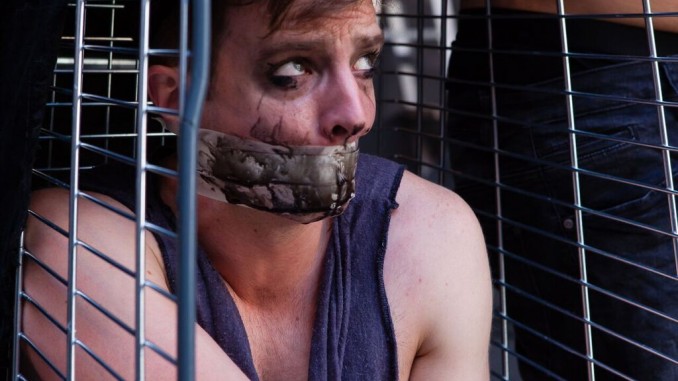
It’s a production that features some extraordinary highs and none powerful than Titus’ discovery of his mutilated daughter. A second occurs in the moment Titus sacrifices a hand – an ‘ahh’ moment when we discover what the wrist armour represents – in a futile attempt to save the lives of his already dead sons, a pitiless act carried out with a small eroded fretsaw to the accompanying sound of rusty saw blade on human wrist bone, an act which clearly proved too much for one audience member standing close to the stage who fainted. Until then the audience had found the mayhem surprisingly funny but the awfulness of the amputation and the subsequent arrival of bags containing the heads of Titus’ sons was sufficient to mute the laughter, and, when a second groundling fainted and required assistance to leave the auditorium, it ceased altogether.
The sound of the siren and the flashing lights that could be seen throughout the theatre when the ambulance arrived, were strangely appropriate and, while the production never missed a beat, the groundlings were speedily joined by two highly skilled paramedics who effectively removed the first causality, still distressed, on a wheeled gurney.

Titus and Lavinia, in a moment of genius, produce a large stick of chalk which Lavinia clasps between her teeth and etches the names of her attackers on the Wooden O stage floor. Actor Lewis is at his out-and-out best when he informs us ‘I have no more tears to shed’ and we realise in this lightbulb moment that whatever happens next is going to be horrifying beyond belief. As if this isn’t enough to turn the stomach of the hardiest spectator, Tamora gives birth to Aaron’s mixed race son, a devil with red hair, a banner saying ‘Fuck You’ is dropped from one of the Lord’s Rooms by two masked characters, and the whole shemozzle takes on the air of a Circus of the Grotesque. Small toy planes are launched, the Goths arrive at the gate and the new born baby is callously hung from the scaffolding.
Titus, no fool despite what he’s been through, is aware of the identities of a disguised Tamora and her masked sons as he sets about hatching a plot to kill them both and to have their ground up bones baked into cupcakes which, in a grisly banquet scene, he force-feeds to their mother Tamora and to husband Saturninus before he kills them too.

The end of the narrative sees the stage, as with all such ‘lamentable tragedies’, strewn liberally with bodies. After a perfunctory speech to explain all, the actors rise, pre rigor mortis, to perform a charming, if short, burgamasque dance which is, in turn, followed immediately by a curtain call and thoroughly earned riotous applause.
Henson’s production of ‘Titus’ is simply a tour de force. Paul Lewis as Titus makes a success of one of Shakespeare’s most thankless roles and Jason Wu (Chiron) and David Sutherland (Lucius/Demetrius) do everything that is asked of them – and more. They’re physical, intelligible and articulate. The ‘women’, Eli Matthewson as an excellent Lavinia and Cole Jenkins as an horrific Tamora, are simply magnificent. They make no attempt, beyond a certain satisfying campery, to represent real women, and considering the nature of the narrative, this is an important choice. James Roque as Saturninus sustains the narrative effectively but, for me, the star of the evening was Jason Hodzelmans in the twin roles of Bassianus and Aaron. As Aaron in particular, Hodzelmans excels and his physicality and magnificent delivery of the text see him shine even above the surrounding excellence. It matters not one single damn that he is the lightest skinned Moor in the history of the English speaking stage, we accept everything at face value because his commitment to what he does is so wholly without compromise.

It’s not unreasonable to suggest that ‘Titus Andronicus’ is an impossible play to stage in 2016 with any degree of credibility, but Henson, with his magnificent seven, his brilliant concept and his smart adaptation, has managed it with seeming ease. It’s as though this production was born to be seen on this stage, at this time, and in this place so perfect is its execution.
You would be wise to book now for ‘Titus’ or you will be forever disappointed that you did not engage with this outstanding production in this exceptional venue. It’s complete in ways that are immensely satisfying and fully transcends its gruesome content with consummate ease.

 dykiegirl