
Duck, Death and the Tulip
By Wolf Erlbruch
Adapted by Peter Wilson
Produced by Little Dog Barking Theatre Company
For Auckland Arts Festival
Directed by Nina Nawalowalo
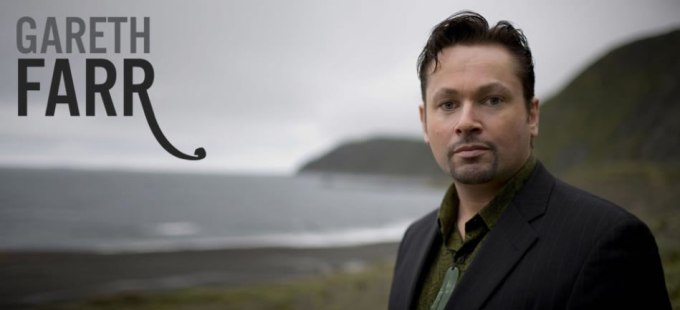
Composer Gareth Farr
At The Pumphouse Theatre
Saturday 05 March, 2016 at 1.00pm
The Auckland Arts Festival plays a very special role in the cultural milieu that is the diverse and ever-evolving city of Auckland. Once almost exclusively the domain of international acts visiting our shores, it has rapidly become a far more egalitarian event with New Zealand productions reaching, and sometime exceeding, the excellence of those from overseas.
Auckland is rich with performing arts diversity this early in 2016 with the venue du jour being Dr Miles Gregory’s extraordinary Pop-up Globe and the glut of Shakespeare productions on offer in that extraordinary venue unquestionably the hot ticket items. It’s certainly hard for Joe and Josephine Publique to fathom why the Pop-up Globe, with its unanticipated blend of novelty seated alongside a plethora of unique home grown productions of Shakespeare’s finest works, isn’t itself included in the festival but I’m guessing that there are politics involved and the solution to this conundrum sits, as is so often inferred, well above my pay grade. There can be no doubt, however, that the night-after-night full houses that flock to the cockpit in Bard’s Yard must be affecting the audiences for festival shows and some fusion of these projects would seem to have been obvious, wise and prudent. From Joe and Jo’s perspective, though, it’s very exciting because traditionally the more events taking place in town the more people choose to go out.

Nina Nawalowalo
It‘s also exciting to note that the festival hasn’t forgotten its younger audience with a number of shows targeted at families and the little ones who will make up the audiences of tomorrow. One such show is Little Dog Barking Theatre Company’s charming work for the under ten’s, ‘Duck, Death and the Tulip.’ Based on a children’s book by German illustrator and writer Wolf Erlbruch and adapted with great authenticity for the stage by Peter Wilson, ‘Duck, Death and the Tulip’ has already had an extensive performance history having had a season at the Edinburgh Festival, toured the South of England and even ventured as far afield as China.
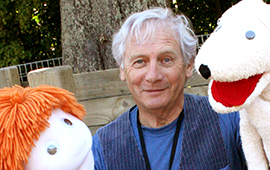
Peter Wilson, director of the company, established Little Dog Barking in 2010 with the aim of creating innovative and original theatre for preschool and early school age audiences. Much of the company’s work is performed in community centres and schools ensuring that the child audiences are housed in an environment they are comfortable with when first experiencing the magic of live theatre.
Peter Wilson
The audience that gathered at The Pumphouse Theatre early on a Saturday afternoon were a disparate bunch made up mostly of Pakeha New Zealanders the majority of whom were under ten and chaperoned, with a couple of notable exceptions, by Mums and Nanas. Perhaps it was the beautiful weather that saw the auditorium only two thirds filled by a show that my thirteen year old son assured me, without hesitation, ‘certainly deserved full houses.’ I agree, equally wholeheartedly.
The stage that greets us is in darkness with the exception of two book-end, hinged screens, one of either side of the stage, that look like many-paned windows. It doesn’t seem to bother the audience that there is no programme with most parents and grandparents arriving armed with the excellent arts festival brochure which informs us that the key creatives involved in making this delightful work are New Zealand performing arts royalty with director Nina Nawalowalo and composer Gareth Farr being responsible for much of the magic.
Kenny King
As the house lights go down in the auditorium a welcoming sun appears in the sky above a black draped two level platform centre stage. A wistful solo piano plays and Duck, long neck first, appears on the top level. The first non-musical sound we hear is a fantastic quack which comes from Duck and which causes great mirth among the littlies who fall in love with this magical – and magically manipulated – puppet immediately.
The puppets that people this narrative are uniformly splendid and they include among their number a fish, a butterfly, a fox, a short-lived snail and, of course, the imposing figure of Death himself.
The story line is simple. Duck lives happily by his pond. Death appears and we know immediately that Duck is not long for this world. Beside the pond Tulip happily waves in the breeze until Death arbitrarily uproots him. That’s life, after all.
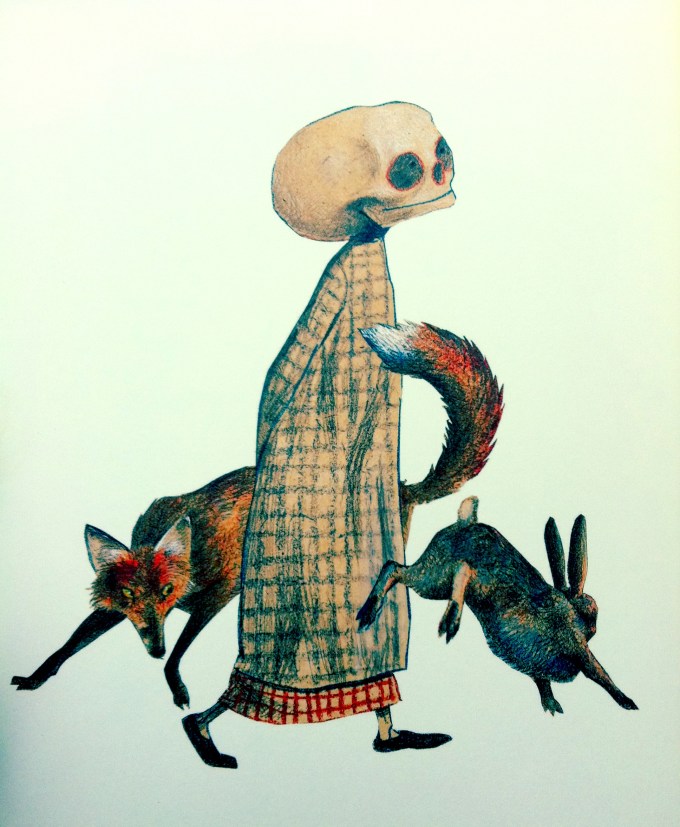
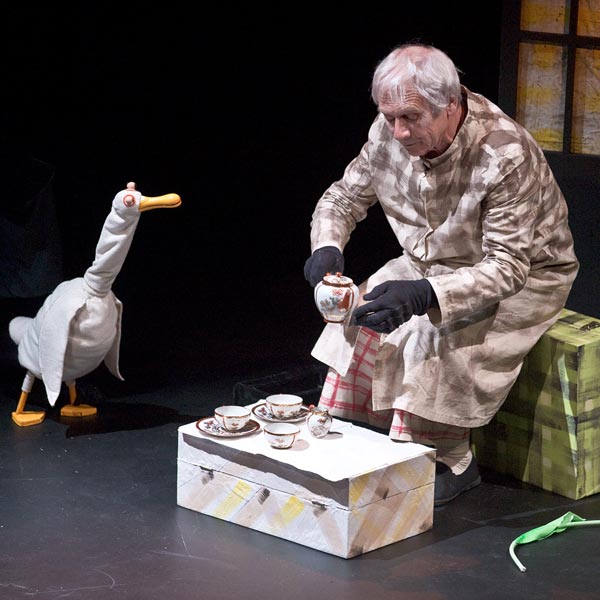
The puppet Death, as might be expected, is a skull beautifully dressed in a long coat faithfully replicating Erlbruch’s illustrations from the original book as indeed do all the characters. Duck asks Death if he has come to take him away and Death, ever the philosopher, replies enigmatically ‘I’ve been with you always.’ A good lesson there for the kids: you never get a straight answer from Death, but the message hits home that death – real death – strolls at our side from the first moment of our conception. The relationship between Death and Duck is amiable and charming and, just when we think we’ve got a handle on the whole puppet thing, the puppet Death is replaced by the full-sized man Death and an entirely new relationship begins to evolve.
Peter Wilson
Death invites Duck to have a cup of tea and the ceremonials and ritual that accompany this charming rite firmly cement the bond between the two. Duck, initially reticent, accepts the offer and discovers that the tea is ‘really quite nice’ and the two chatter away like the life-long chums they truly are. By this point in the show the parable is deeply embedded in our understanding and we know that soon Duck will be taken by Death and we are resigned to this.
Duck invites Death to come and explore his pond and, despite his own reservations, – ‘I really don’t like water’ – Death obliges, When he finally leaves the pond he is freezing and shivering uncontrollably on the ground. Duck kindly offers to warm Death up which causes a serious ripple of mirth.

There are moments where the unhurried and measured pace of the piece allows us time to ask the deeper questions posed by Wilson’s narrative such as ‘how does Death get cold’ but such metaphysical ponderings are quickly supplanted by comedy with Duck suggesting that Death will ‘catch his death’ and, having aced that laugh even with the wee ones, he caps it by adding that Death looks like ‘death warmed up.’
Death has a sleep as the moon waxes and wanes and on waking there is a charming discussion about heaven – the place of the angels – and ‘that hot place the other ducks have spoken of, hell. Death replies that he doesn’t know what happens after people pass away and the topic is immediately changed to ‘what shall we do today?’ The answer is, as it is with all good answers, simple: ‘let’s climb a tree.’ From the top of the tree, topical local references have been inserted, and Duck and Death acknowledge the Sky Tower, the Bombay Hills and, in the distance, the mighty Waikato River.
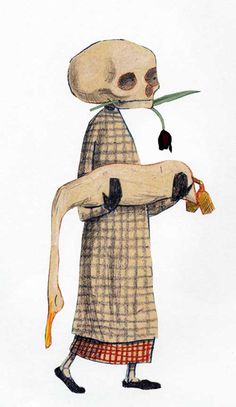
Duck is cold and Death suggests they dance to warm him up. By now the audience is fully engaged with both the narrative and the parable as Death sits with Duck in his arms and it begins to snow. When the snow stops Duck has quietly passed away. We notice it, cherish the moment, but there is no big fuss and the silence in the theatre, while profound, isn’t maudlin in any way. As if by magic a river of silk appears, Death lays Duck on the river and his body is enchantingly returned to his beloved pond – but not before Death has placed Tulip, who we have almost forgotten, on Ducks cold body.
This delightful parable delicately exposes children to the concept of death and opens up opportunities for discussion within families. Possibly the most poignant moment occurs, as perhaps it should, at the very end of the play when Death tweaks the one hour performance into even sharper focus when he breaks the fourth wall delivering his final line ‘that’s life’ directly to the audience.

Almost as a coda, as Death leaves the stage a new Tulip rises in place of the old one and life goes on.
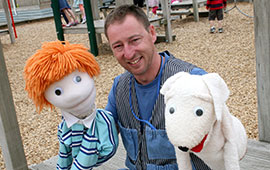
The actor/puppeteers Peter Wilson and Kenny King are quite exceptional and, along with director Nawalowalo and composer Farr, they have crafted a beautiful narrative around a very tricky subject. My family was noticeably quiet for some time following the performance and this speaks silent volumes for the success of the work.
The actors returned to the stage following the performance and were available to those who wished to stay to discuss the piece. Hosted with warmth and care by TAPAC Artistic Director Margaret-Mary Hollins, the discussion would seem to be a vital part of the process of resolving any questions, the children in particular, might have after a work of this nature.
From a simple theatrical perspective the work is faultless, enjoyable, challenging and expertly made.
Check it out – it moves to the city during the week and details can be found online on the festival website.

 dykiegirl