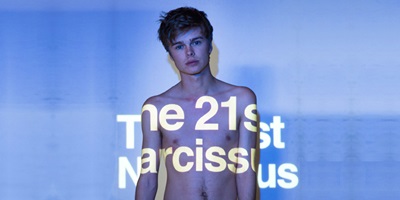
The 21st Narcissus
By Sam Brooks
Produced for The Young and Hungry Arts Trust
Directed by Anapela Polataivao
AV Design by Stephen Bain
Costume Design by Fraser Mildon
Set Design by Christine Urquhart
Lighting Design by Jack Dryden
Sound Design by Oswald Didsbury
The Basement Theatre
Saturday 10 October, 2015 to Saturday 24 October, 2015 at 7.00pm
Latecomers cannot be admitted
Published at http://www.theatreview.org.nz
The Young and Hungry Arts Trust has as its mission ‘empowering young people through mentoring to appreciate, create and participate in New Zealand Theatre.’ It’s a charitable organisation, founded in 1994, which arose ‘out of a need to provide young people, aged 15-25 years, with opportunities to gain hands-on theatre experience within a professional structure.’ The Young and Hungry Arts Trust also hosts an annual Festival of New Theatre which is made up of new scripts written specifically for young people by New Zealand writers and commissioned through the Playwrights’ Initiative and an Ambassadors’ Programme which introduces young people to a diverse range of live performing arts and provides students with the opportunity to find out what happens behind the scenes. Both ‘The 21st Narcissus’ and ‘The Presentation of Findings from the Scientific Survey of the First 7500 Days of My Life Done in the Interest of Showing You How to Live Better Lives’ are products of this excellent process and they play, one after another, at the Basement until 24 October, 2015.

Anapela Polataivao
A new play by Sam Brooks is something to anticipate and celebrate. It’s also something to appreciate and enjoy. ‘The 21st Narcissus’ holds a mirror up to modern nature and takes both a gleeful and a sardonic look at the social media habits of Generation Y.

Sam Brooks
Generation Y, otherwise known as Millennials, Generation Me or the Peter Pan Generation, were born in the late 20th century and have traits of confidence and tolerance but also a sense of entitlement and narcissism. They consider wealth important, are less interested in politics or environmental programmes than previous generations and resist developing a meaningful philosophy of life.

Georgie Holibar
Author Ron Alsop calls them ‘Trophy Kids’ because of a heightened sense of competition while educational sociologist Andy Furlong describes them as optimistic, engaged, and team players whose approach to social change is ‘pragmatic idealism’. They exhibit a deep desire to make the world a better place and are less likely to be religious than their predecessors. Millennials have increasingly liberal attitudes to social and cultural issues such as same sex marriage and decriminalising marijuana as well as higher overall support for classical liberal economic policies. Unemployment levels are high for this demographic sitting around 20% in the US and Europe. They have Peter Pan-like tendencies to delay some rites of passage into adulthood which explains the use of that somewhat eccentric appellation.

Natalie Maria Clark
Millennials use technology at higher rates than previous generations earning themselves the title of ‘digital natives’, were the first to grow up with computers in their homes and with the Internet. They use social media to establish a different sense of belonging, to make acquaintances and to remain connected with friends. They are the most ethnically and racially diverse of all generations and assert the ideal that all their heritages should be respected.
Why do you need to know that? Because it’s critical to an understanding of the play and its characters who, in turn, owe their personality quirks, language and traits, overwhelmingly to their date of manufacture. The text is pure Brooks, witty, satiric and surprisingly deep in all the right places, and the opening night full house love it to bits. Few playwrights interlace text, characters and plot as adroitly as Brooks and ‘The 21st Narcissus’ is a wee classic of its genre. It’s extremely funny, delicately venomous and surprisingly moving considering the nature of the overall themes presented – social media is supposed to be deeply shallow, after all – though it must be admitted that a considerable amount of piss is also taken.
Reaching deep into the promotional material we find the following:
‘Three girls form a bond through their mutual love of a #popstar on Twitter.
A boy and a girl accidentally meet on Facebook and form a friendship.
On Tumblr, a boy with an infatuation for Greek myths and cats, uploads pictures of himself.
In ‘The 21st Narcissus’, friendship exists between screens.
‘The 21st Narcissus’ is about learning to #loveyourself.
The 21st Narcissus is about us.’
It’s more than that, of course, because there are also fabulous costumes (Fraser Mildon), some fantastic digital images (Stephen Bain) and a delightfully evocative set (Christine Urquhart) that consists of a wide, white, frequently backlit cyclorama (Jack Dryden), three Perspex swings suspended from screens and a single rectangular mirrored cube centre stage. It’s clean, exact, attractive, and provides a wonderful milieu for the playing out of the action of the play. Director Anapela Polataivao has worked her particular magic on the actors and the show and the whole thing is sixty minutes of extremely satisfying theatre. In fact, as has become the norm at The Basement, the entire evening was a treat from Box Office staff issuing tickets to the polite and efficient ushers to the bar staff – or ‘actor’s resting’ as they are often known – everything was great.
The acting is top quality too. The structure of the work allows for three central characters, three more who carry the witty Twitter thread, one who plays the superstar Amber Smence (an energetic ) and a fantastically disciplined chorus. Kyle (Georgie Holibar) is a newby at this social media business and his journey into the multifarious world of Tumblr is almost frightening. He seems to attract every type of ghastly internet troll it’s possible to attract. We follow him as he moves from being a quiet, self-protective boy to one manipulated by others into posting increasingly dodgy selfies both shirtless and in his undies. Holibar is charming and likeable and convinces easily with his naiveté.

Kelly Taylor
Facebook takes centre stage (well, lightly left and slightly right of centre to be exact because Kyle has the prime location) and we meet Jordan (Jacob Pitcher) and Julia (Kelly Taylor) who have just become FB friends. Each is still at school and working part time. Both are nervous, anxious, as they manoeuvre themselves safely in the direction of a date. They exchange increasingly intimate details – ‘who was your first crush’, ‘what’s the worst thing you’ve ever done’, ‘what’s something you’ve never told anyone else’ – and their friendship is affectionate and fun. When asked ‘how was your day’, Jordan tells more than all in blow-by-blow detail – ‘yesterday a kid pee’d on me’ – while Julia cleverly evades every innocent attempt by Kyle to find out where she lives and works. We hear all the standard lololols, *sighs*, and weird web rhetoric that pepper Brooks’ text and it’s all very courteous and tantalising. Jordan is less mature than Julia and the interplay that results is both sweetly appealing and very, very funny. Jordan asks Julia ‘do you have a boyfriend?’ She replies ‘no, you?’ to which he replies ‘no, still not gay’. The relationship built between Pitcher and Taylor is delightfully subtle, oddly erotic and intensely satisfying.

Jacob Pitcher
Acting like a commentary, Jean (Faith Tapsell), Freya (Chika Adeosun) and Harriet (Abigail Laurent) spend much of the show on the swings, represent the Twittersphere in a riotously comical way, and play the comedy with real panache. Tapsell, Adeosun and Laurent link a brace of clear celebrity threads through Kyle’s love for Cheryl Cole and Avril Lavigne and their own obsession with superstar Amber #amberalert Smence with hilarious results. Each of these actors exudes bravura confidence and real class.
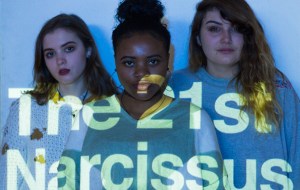
Abigail Laurent, Chika Adeosun and Faith Tapsell
Add a seven-strong, genderless, burlesque-like chorus who provide yet another layer of commentary and all of the major social media forms get a thorough going over as do the modes of behaviour of many of its participants. Don’t get me wrong, these characters are far from stereotypical but they are recognisable and we love them for it. They’re us, and we recognise that.

Finn Matheson
In an impressive final stanza the relationships become confused and, while there is a momentary bleak sadness before the finale, Kyle’s final unequivocal ‘I love you. I love me’ takes us into the interval with more than a modicum of hope. He does, after all, represent the most optimistic generation of the past two hundred years.

William Schroer, ‘The Social Librarian’, tells us that the next generation, Generation Z and the one my thirteen year old son Finn was born into, ‘will grow up in a highly sophisticated media and computer environment and will be more Internet savvy and expert than their Generation Y forerunners’ and this might explain the absolute joy my son got from the show. The appearance of Pokemon in the digital visuals and the absolutely authentic dialogue were sufficient to enable him to fill the entire interval with his unbridled praise and textual recollections, so much so that I don’t recall having the opportunity to totally agree with him. ‘The 21st Narcissus’ is aptly named, deceptively subtle, finely directed and wonderfully acted. It’s an excellent example of just what a huge contribution The Young and Hungry Arts Trust has already made to our performing arts environment and long may this influence continue to be felt nationwide.
‘Like’
‘Like’
‘Like’

 dykiegirl