
If There’s Not Dancing at the Revolution, I’m Not Coming
Created and Performed by Julia Croft
Directed by Virginia Frankovich
Lighting Design by Calvin Hudson
Audio Visual and Graphic Design by Stephanie Croft
In The Basement Studio
Wednesday 02 to Friday 05 September, 2015 at 7.00pm
Published at http://www.theatreview.org.nz
Julia Croft, artiste extraordinaire, describes her new, hour-long, chamber work thus: ‘a rich contemporary performance collage of film scripts, pop songs, elaborate costumes and dance all stretched, teased, shattered, and reassembled to challenge the treatment of women’s bodies as spectacle in popular culture. ‘If There’s Not Dancing’ uncovers the collective fantasies underneath these bodies, intervenes and explodes them into feminist confetti.’ She adds ‘contains nudity’ and there is, ‘and adult themes’ which there are.
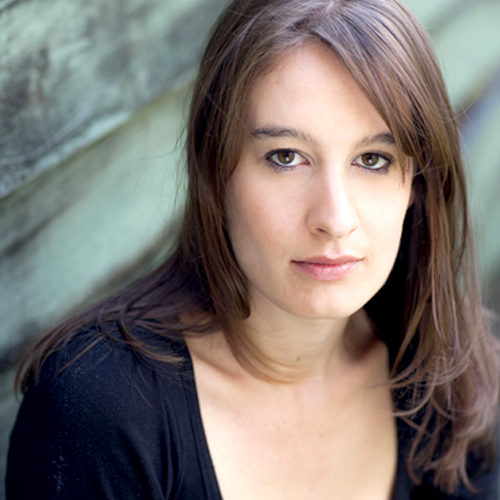
Julia Croft
Artists, in describing their own work, sometimes miss the point of what they themselves have created but not so Croft, she’s right on the button! So much so that I could stop right now, leave you with Croft’s own words, and say no more but I won’t because I want to write about this extraordinary and passionate piece because it’s the best 60 minutes I’ve spent for quite some time. It’s intellectually challenging, the imagery is rich and expansive, the literacy is exact and the performance, while loose and engaging, is also smart, smart, very, very smart.
When I arrived it was raining and had been for some time. I was wet and to say I was not in good humour could well qualify as the understatement of the year. I’d had a right day of it and I’d had enough! I’d read Croft’s ambitious description of her work, read the quote so often attributed to anarchist Emma Goldman that Croft had purloined for her title –
If I can’t dance, it’s not my revolution!
If I can’t dance, I don’t want your revolution!
If I can’t dance, I don’t want to be part of your revolution.
A revolution without dancing is not a revolution worth having.
If there won’t be dancing at the revolution, I’m not coming.
and I was ready to do battle. I sat on a low seat next to the piano by the box office and was surrounded by the hoots and howls of the hoi polloi above me, a roar that I have to say never let up until well after the performance was over. I needed, I decided, to experience some vision, some passion and, please god, more than a little imagination.
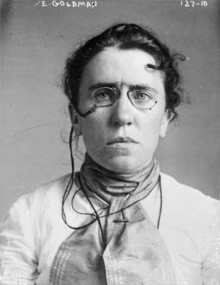
Emma Goldman
It didn’t start well. The show was going to go up late. I’d been told it started in the foyer. Had it already started and I hadn’t noticed?
I reflected on director Frankovich’s work. I like it a lot. And Crofts, even more so.
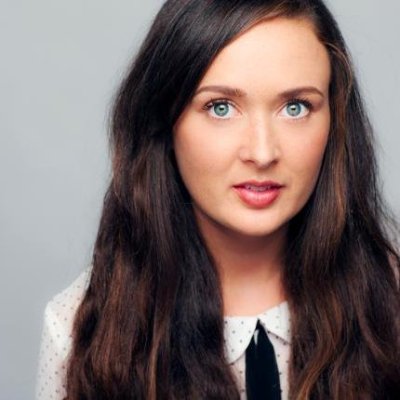
Virginia Frankovich
Suddenly there’s the sound of the 20th Century Fox movie theme, anthem-like, all drum rolls and blasting horns, and when I stand up there’s an almost unrecognisable Croft with a megaphone surrounded, as any young starlet might be, by her adoring fans. It’s all illusion of course, as it’s really just the audience – a full house – gathered around her in a small space with nowhere else to go but it’s a more than effective metaphor for what’s to come. My intimate personal space was, I suspected, about to be invaded. Nice though, because these are two artists whose work I trust. Frankovich is clever, I remember thinking, and Croft, well she, it seems, can make anything work. We were, I imagined, in safe hands.
I’d read that there were great costumes – and there are – I just didn’t expect the actor to be wearing them all at once! It was a shock. An unexpected, and unconventional, body-image jolt can do that, and it occurs and occurs and reoccurs endlessly throughout the evening right up until the final delicious frame.
Croft leads us, like some ragamuffin, street-urchin Pied Piper up the red-lit stairs to the theatre space where we seat ourselves on cushions or on the shelf-like steps and prepare ourselves for goodness only knows what. It’s a super feeling when expectation departs taking with it the day’s stresses and leaves only joyous anticipation. I like that more than anything.
The set is mirrors, many mirrors, lots of mirrors, in all shapes and sizes so that whatever the actor is doing is visible in a kaleidoscope of fractured images and there is no escape, no hiding place, for her or for us. Everything is fragmented, disengaged, detached. Croft is wearing a white ostrich feather in her hair, a blingy pink dress with oodles of tulle and, underneath, what looks like a green shirt thingie. There’s obviously more clothing to come but just exactly what is still not visible and Californian film maker James Broughton’s ‘A Long Undressing’ comes to mind along with his advice to movie makers that they should ‘follow their own weird’. I’m not finding Croft’s ‘weird’ particularly peculiar but it’s certainly different and in a very good way, and this is just the beginning.
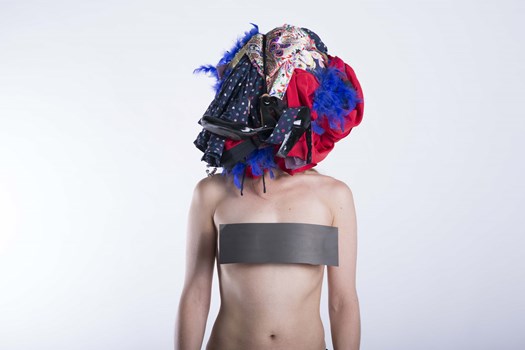
Croft in the final scene of the work. She can see the audience through the knot of garments and shoes on the head but we cannot see her face. A brilliant image to take away from a night of examining how we look at women’s bodies.
There’s some pre-recorded stuff through the megaphone which is clever and a whole lot of shtick with a shoe and suddenly she’s among us, dressing, and I’m holding her arm – ‘it’s a good arm’ – while she slips her foot into a shiny black shoe with a ribbon tie that the man behind me is securing for her. It’s wonderfully intimate and more than a little disturbing because I’m loving it all and I’m not sure whether I’m supposed to be loving it or not. Laura Mulvey is screaming at me in one ear and Andrea Dworkin in the other while Sir Lawrence Alma-Tadema is whispering ‘just lie back and love this languid daughter of Eve’ and, frankly, I don’t give a damn. Croft has broken the fourth wall and not for the last time either. She’s invaded our ‘sit in the dark and gaze’ space and it disconcerting and arousing at the self-same time. Certainly all vestiges of my crappy day have melted into the mists of actor-induced pleasure and I’d pay big bucks to be able to replicate that whenever I wanted.

Andrea Dworkin
Then it’s drinkies time and a sweet young thing in the front row gets a glass of effervescence from a bottle secreted somewhere around Crofts person. It looks like tonic and the bottle is as shaken up as the audience is. It fizzes in a somewhat ejaculatory fashion and dribbles and drips down the glass in a way that has the audience in fits. Croft next produces a tiny bottle of gin from somewhere in her knickers and slops that into the glass to the sounds of unabashed hysteria. But wait, there’s more, and the coup de grâce is delivered when the actor produces a lemon from her bra, squeezes it liberally into the glass and stirs the concoction sensuously with her ostrich feather. It’s fantastic stuff, and we all feel just a trifle over-exposed.


The languid women of Lawrence Alma-Tadema. At top Tepidarium (1881) and below Women of Amphissa, (1887)
Soon she’s against the wall beside me, languid in her spotlight, talking to herself, to the audience. She is object, we are subject, Mulvey lives. There is a soundtrack. I feel her spit on my cheek, visceral, appropriate, and she moves on again, never settled, never still.
There is a scene where Croft draws the outline of her body in thick white chalk three times on the black walls of the space and another where, to the accompaniment of the CSI television theme, she is suddenly dead on the floor in a brilliant red dress, again with the tell-tale chalk body shape around her, and these images are left to haunt us for the duration of the evening while she again moves rapidly on.
The music throughout is carefully chosen, evocative, often in spontaneous snatches. It underpins everything. Then there are the film clips. There’s a voice over of Norman the voyeur and the hole in the wall – always there is the voyeur and the gaze – but also there is the never-ending piss-take humour. It’s wry, droll, self-effacing and as cutting as the slashing moves in Croft’s first dervish-like, dance-like, movement piece.
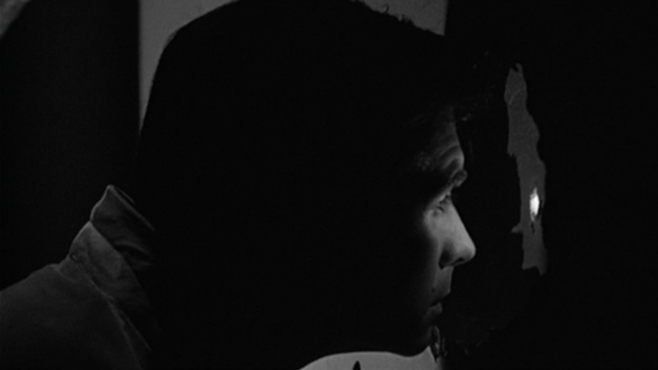
Anthony Perkins as Norman Bates in Alfred Hitchcock’s ‘Psycho’ (1960)
There’s the classic scene from ‘Basic Instinct’ flickering on the back wall where Sharon Stone turns the Mulvey gaze right back on her interrogators and all the while Croft is shedding garments like confetti while we get the picture.
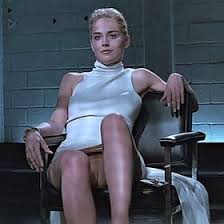
Sharon Stone as Catherine Tramell in Paul Verhoeven‘s ‘Basic Instinct’ (1992)
Croft has crafted an elegant text, a snapdragon of a thing that whips, flashes, cuts and burns like a lightsabre. As well as her own words, it’s peppered with intelligent quotes and none is better, nor more appropriate, than Margo Channing’s classic from ‘All About Eve’ (1950). ‘Funny business’, she says, ‘a woman’s career. The things you drop on your way up the ladder so you can move faster. You forget you’ll need them again when you get back to being a woman.’ Croft makes it her own with a worrisome and effective repetition of Bette Davis’ evocative conclusion ‘slow curtain, the end’. It’s a special moment.

Bette Davis in Joseph Leo Mankiewicz‘ ‘All About Eve’ (1952)
‘If There’s Not Dancing at the Revolution, I’m not Coming’ is a work that goes beyond the thoughtful into the sublime and occasionally to the surreal. There’s all the rhetoric of cheap sex. Phrases like ‘spread your legs’, ‘Daddy’s coming home’, and ‘don’t you fucking look at me!’ pepper the evening along with the food and drink and the shedding, always the shedding, of clothing.
There is so much to talk about that would border on spoiling so I won’t go on any further but say that beyond what I’ve told you there are many treats aplenty. There’s great fun with glitter and confetti cannons and a giant vagina or two but you’ll really have to take the time to experience the show yourself to find out just what. Suffice to say I’m still laughing, but I’m a tad troubled too. Not an issue though, feminism can have that effect on transgender women. We love it, commit to it, but do we really belong?
It’s a big work with loads to say and Croft doesn’t hold back. She says in her programme notes that she wants to engage with questions about how we look, how we look at women, how women are often reduced to bodies and how looking is a political act. She nails that totally. She also says that she wants to add her voice to the feminist conversation and she’s there with Eve Ensler, banners aloft, shouting to the stars.
Croft also says that she wants me to have a good time. I did. I had a great time, and I’ve been raving to anyone who’ll listen to me ever since. I wrote and created a work once that ended with the woman protagonist naked having stripped away all the vestiges of her sexual abuse. At the final dress rehearsal the actress told me that whether she stripped completely would depend on how she felt the audience had received the work. They had, she said, to earn the right to that level of intimacy. It was an extraordinary statement and we agreed that that’s what she should do. The nudity in ‘If There’s Not Dancing at the Revolution, I’m not Coming’ is on the same level. Anything less gratuitous you will never experience. Anything more beautifully integrated is hard to imagine.

That haunting final image again … ‘slow curtain, the end’
It is a party, Ms Croft. Thank you.
It is a poem, Julia. We loved it.
And it’s much more than a tiny call to arms. It’s audacious writing, liberating direction and all embodied in a simply outstanding performance.
Slow curtain, the end.
Applause.
 dykiegirl