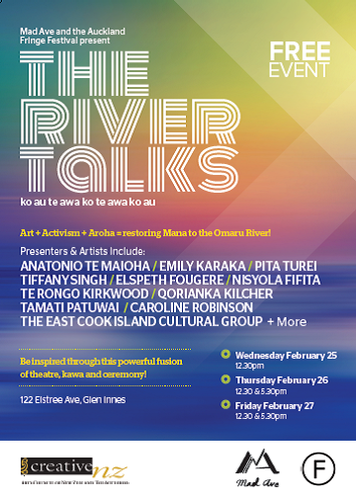
The River Talks
Produced by Mad Ave Studios
Pt England Reserve, Omaru River, 122 Elstree Avenue, Auckland
Wed 25 Feb 2015, 12:30pm–2:00pm
Thu 26 Feb 2015, 5:30pm–7:00pm
Fri 27 Feb 2015, 5:30pm–7:00pm
‘Ko au te awa, ko te awa ko au’.
The whakatauki above, translated into English, says ‘I am the river and the river is me’ and it underpins this highly effective promenade-style environmental journey.
The performance I attended was on Thursday 26 February, 2015 at 12.30pm on a beautiful sunny afternoon and I was part of a large audience of both primary and secondary school students as well as a good smattering of general public. I add this because it’s my understanding that evening shows are a bit different so, if you plan to go, your experience may be different to mine. For example, I won’t mention Marama Davidson in this review because she didn’t perform in the afternoon show – damn, I just mentioned her, didn’t I? Oh well, I’m sad to have missed her because she’s such a good performer and her messages are always such good ones.

Marama Davidson ~ activist and poet
Produced by Mad Ave Studios who stand for ‘authentic communication and storytelling through innovative transmedia and marketing technology’ and whose ‘primary focus is to support the transformation of communities at risk to becoming communities of abundance and contribution, to inspire communities to learn, to transform and to prosper’ and they do this by ‘delivering storytelling, creative arts facilitation and distribution services within the community. They are, they say, ‘all about transforming communities’. If ‘The River Talks’ is any indication, they’re doing an awesome job.

‘The River Talks’ is performed on the banks of the Omaru River in Glen Innes and ‘asks the audience to confront the reality of a dying and polluted river that was once the lifeline of this community.’ It’s pretty much a mess when we arrive, that’s for sure.
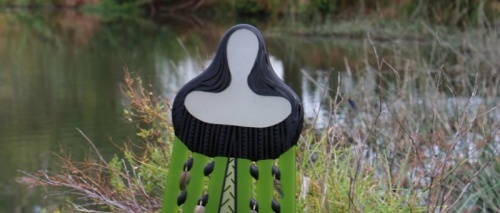
We’re early – not unusual – so get to potter about on the river bank for a bit before the influx of audience and there are some fascinating art works dotted along the path, in the trees, and even in the water. There are a number of tables with posters on streams, stream life, and urban pollution and they’re filled will informative material. Water testing is quietly happening and it’s hard to know if this is part of the show or just life imitating art.
A man in an impressive cloak is walking towards us on the path. He has a feather in his hair and whero coloured streaks of paint on his cheeks. He says ‘hello Lexie, you don’t remember me, do you?’ For a moment I don’t but recollection kicks in and I realise this is Matua Pita Turei with whom I worked as an actor at Theatre Corporate in the mid ‘70’s. We hongi, and I am deeply touched. The universe gives us such powerful signs when things are right.
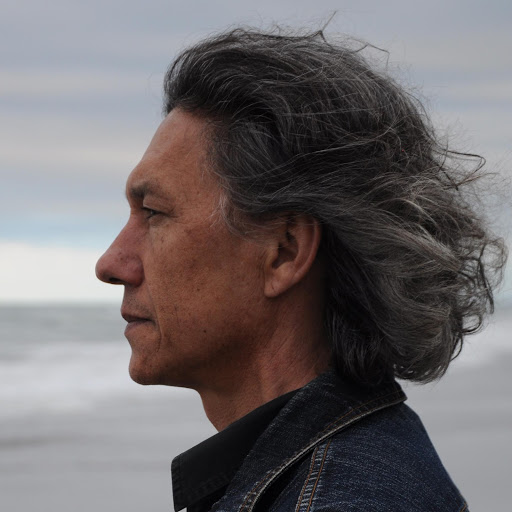
Matua Pita Turei
For the ensuing 20 minutes I meet a number of Facebook friends I’ve never met in person before and the korero is sweet.
The show starts with a warrior appearing in the distance making a rasping, coughing sound and carrying a bizarre weapon. It’s not a taiaha but one of those metal implements for picking up rubbish. He is the whenua, he’s cantankerous about the trash, and in particular the plastic. As he gets closer we see his clothing is made from black polythene, his ankle is shackled and a chain is attached to the manacle. The chain has a number a bags of trash attached and the message is quite clear, rubbish ain’t good for the land. Wordlessly, he challenges the children with a wonderful pukana until one of them picks up the bags of rubbish – yes, and they’re McDonalds takeaway bags.
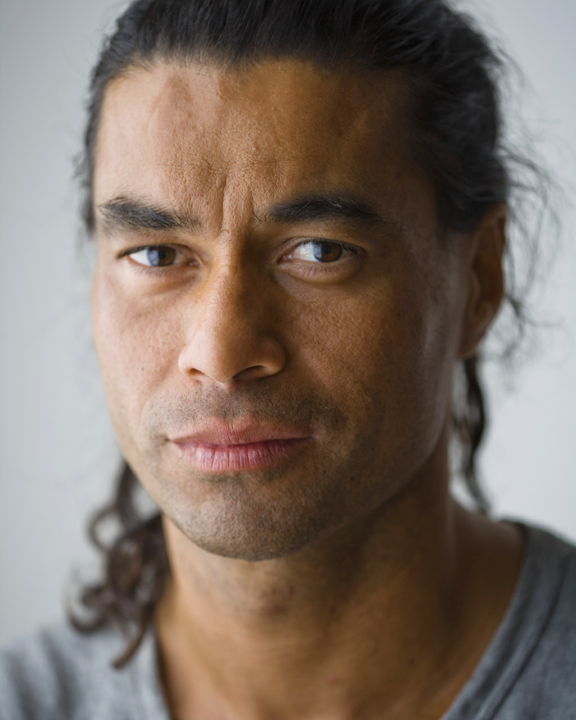
Anatonio Te Maioha
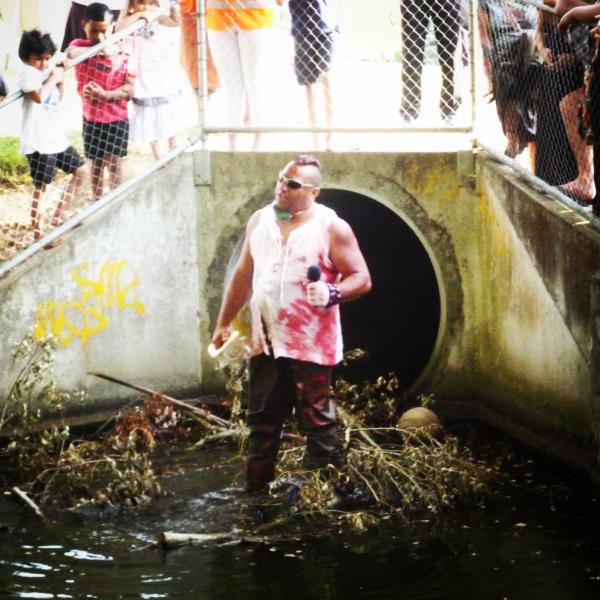
Then we hear a voice from deep on the river bank by the entrance to a culvert close to the road. There’s a haka – te waka. Kids from Pt England School line the bridge and the banks and they’re fully engaged throughout. Matua Pita is on the other bank and the sounds of flute snake across the water. Our welcome is performed by an impressive Tamati Patuwai. He introduces us to the whakatauki and I sense an innate understanding and commitment by the audience to ‘the river is you’. It’s a very special moment.

Tamati Patuwai ~ here greeting Julia Gillard, then PM of Australia
The water is blessed but everyone seems to agree it’s pretty shitty. If we are the river, Patuwai asks, what does this say about us? The kids suggest it makes us ugly, dirty, smelly, paruparu. There’s a sense of shame among the adults, There are tinkling wind chimes called ‘healing waters’ and made by artist Tiffany Singh. They’re delicate and attractive. At Patuwai’s request there is silence while we listen to the sounds.
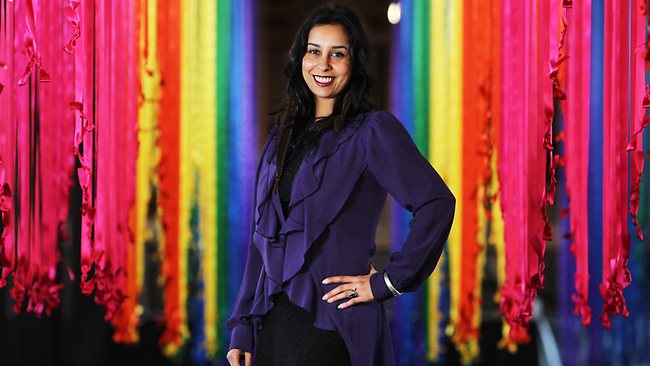
Tiffany Singh ~ artist
The stage managers shift us. Now we’re facing the grass sward and Matua Pita addresses us. He’s charismatic, He talks about memories and introduces us to his tūpuna. He tells us the river has memories and that they’re our memories, that we can find the solution to anything if we open our hearts to all the voices and inhale the magic.
We move again, further along the river bank to meet Rata of Wai Care. It’s a council project, she tells us, to find out what’s going on in our rivers. She talks about colour, about stormwater drains and how this affects the Omaru. It’s interesting stuff, but on we go, this time to meet Isaac and his young sister who have made some beautiful figures that rest in the water. Isaac talks about his glass characters, how he made them and what they mean then hands over to Te Rangihuamau who must only be about 8 or 9 years old. She talks about the bird she’s made that hangs in the tree. It’s beautiful, and doubly so considering her age.

Omaru Creek
Patuwai then introduces us to Gandalf Mike, a bearded pakeha man, who rips into a couple of poems about Maui dolphins. The first is called ‘100% Pure’ and attacks Tourism New Zealand’s bogus advertising campaign about clean, green New Zealand. We find out in his second piece, ‘Tamariki Te Moana’, that Maui’s Dolphin are unique to New Zealand waters and that there are only 57 left. There’s silence as it sinks in. Patuwai invokes paki paki and invites us to ‘pick up that waka.’

In the same space Nisyola Fifita, a young Tongan dancer in black, summons the river in movement and presents a vision of hope. She moves lyrically like an exotic sea creature and reflects what the water would be like if we could resolve the stagnant state it currently languishes in.
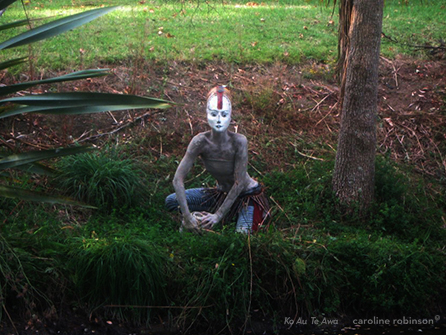
Caroline Robinson ~ artist
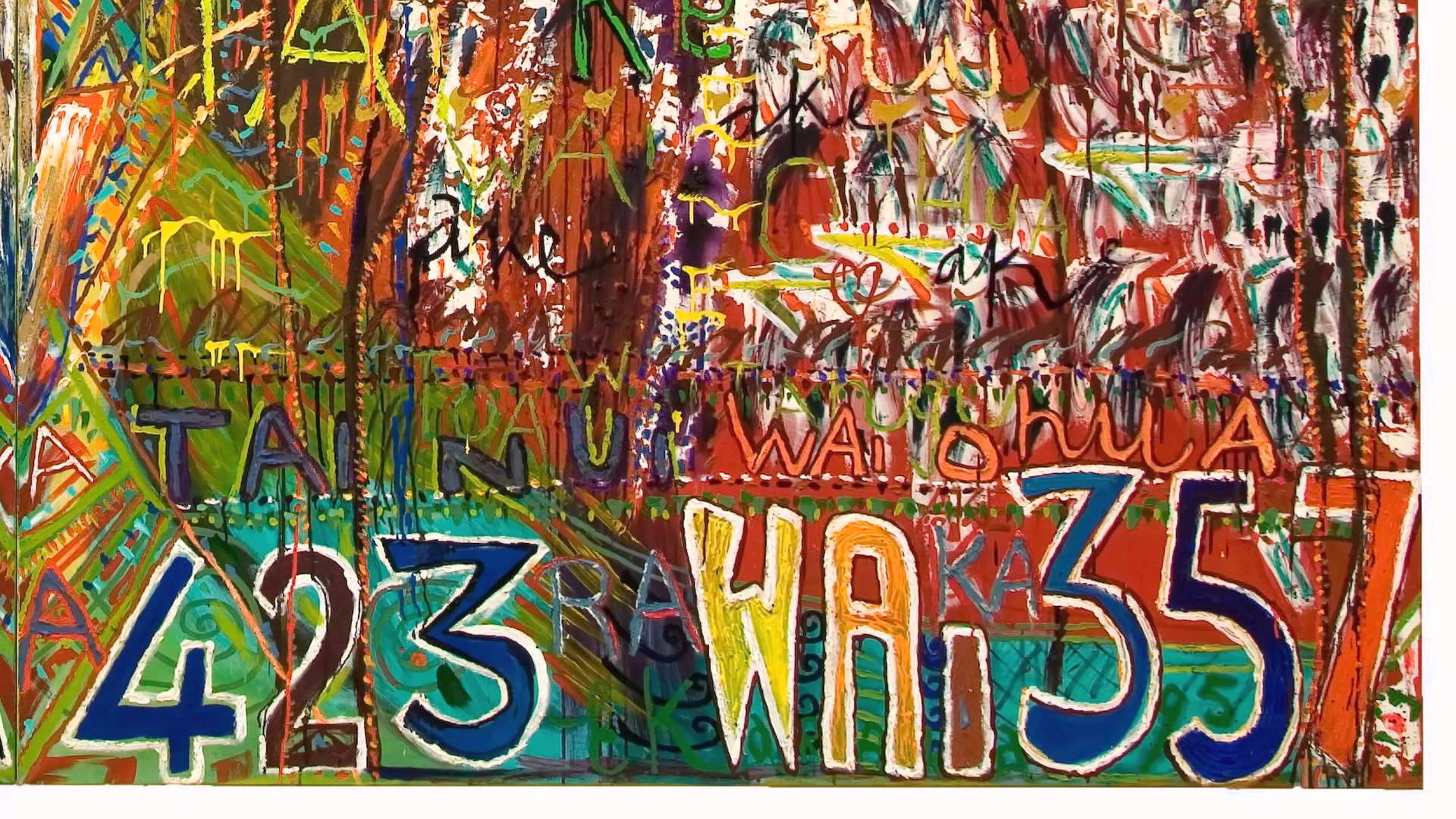
Artist Emily Karaka presents a large, stylised painting and talks of her childhood in the area. Brought up by the awa, she swum in it, but kids can’t now, she says. It’s too toxic. It’s not safe. Whaea Emily goes on to talk about the importance of the ancestral take of kai moana, the kai gardens of her childhood and admits that her generation, my generation, ‘mucked up, but,’ to the kids she says ‘you’re not going to.’ It’s not an invitation or a suggestion, more an instruction from a loved auntie that you know you have to obey. It’s an amazing painting and the kids are transfixed.

Whaea Emily Karaka ~ artist
A few steps further and there are a number of sheets hanging on the barrier rope. They’re discoloured, brackish brown at the bottom, lighter above. We’re told that Whaea Elspeth Fougere has soaked the canvases in beeswax and put them in the river. What we see is the outcome and it’s not a nice picture. She’s titled her works ‘herskin’ and I found them profoundly affecting.
We walk a few metres further to a bend in the Omaru where we’re met by the East Cook Island Cultural Group resplendent in purple. The beats created are hypnotic and reggae-like and the kids are excited by them. I am too. It’s a nice interlude before we move to the most formal structure so far, a stage with seating, technical equipment and a canvas sail-like roof. We’re introduced to Sam Judd of Sustainable Coastlines who talks mostly about the dangers of plastic in the sea and how we all need to work together to return the sea to something approaching its pristine state. He has some sad stories pitched perfectly to touch the hearts of his young audience and he introduces us to y et another whakatauki, this time ‘naku te rourou nau te rourou ka ora ai te iwi’ which means ‘with your basket and my basket the people will live’. It’s a mighty powerful message to end on and I get the impression that everyone understands.
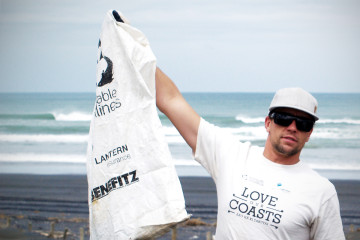
Sam Judd of Sustainable Coastlines
‘The River Talks’ is unashamedly political, it’s theatre with a message, and it’s unique and fascinating stuff. The multi-media artists are expert in their fields and to have them interact so well with promenade theatre is an excellent double-edged sword. It’s great for the kids too and, left up to me, I would have bussed every kid in the region to see the show, for the messages, yes, but also because it’s damn good theatre. Washing it up, it’s the message that, if we all work together, we can do this – no matter what it is. I concur, and will end with my own choice of whakatauki. It’s the well-known proverb ‘he waka eke noa’ which means ‘a canoe which we are all in with no exception’. It’s how we make theatre after all, and the better we do it the better the outcome.
Mad Ave Studios are committed to this community so expect more. Support it, and we’ll all learn the lesson.
Paki paki mai!
 dykiegirl