Shakespeare’s Rebels
Produced by Shakeitup!
Directed by Grae Burton
Performed at Pah Homestead
10 – 15 February, 2015 at 7pm
Performed at Rannoch, 77 Almorah Rd, Auckland
19 – 22 February, 2015 at 7:00pm.
It’s now accepted that William Shakespeare had his fingers in the ink of 38 plays and some rollicking good poems. Some he wrote parts of, some the whole lot, some we’re not sure about, but one thing no-one argues is that they’re all ripper yarns especially if they’re staged well. Grae Burton certainly knows how to stage a play and Shakespeare seems to be his specialty, so no surprise that ‘Shakespeare’s Rebels’ is a fine conception and a beautifully crafted show. He’s also a dab hand at casting, as he proved with last year’s outing entitled ‘Passionate Acts’. This year’s assemblage of professional heavyweights includes Simon Prast and Jennifer Freed – this reviewer would crawl over hot coals to get to anything this pair play in – and the others (Catherine Boniface, Sam Mannering, Paul Trimmer, Moana McArtney) are no slouches either.
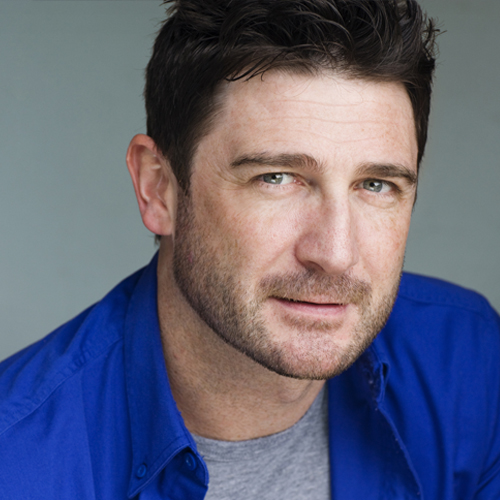
Grae Burton
Putting together a pastiche of scenes around a theme is always going to be a vexed exercise, you won’t please everyone, and it’s my view that this is a classy collection so I’ll leave it at that. No explanation, nothing. The theme of rebellion is loosely construed but I think The Bard, well known for suiting the word to the actor, would certainly approve. The selections in themselves represent a sort of rebellion, a trivial agitation in the atmosphere well representative of Burton’s own droll humour and his quite astonishing courage as an actor/director/producer.
Arriving at the venue, which is a delicious experience in itself, was propitious in that the first soul I laid eyes on was Katherine Kennard, quite the star of last year’s outing, looking ravishing but as ‘audience’ on this occasion and not as ‘player.’ Chats over and seats taken it was time to do that awful ‘actor at a play’ thing and peruse the audience. A good age range and not the exclusive domain of the goldcardians for once, the older chaps picking post-dinner teeth while the younger women natter and sip the house Sav Blanc courtesy of a pre-show fine dining experience available via Dawson’s Café (please phone to book). It was all très lovely indeed.

Katherine Kennard
For us groundlings, and the hoi polloi who chose not to dine (and probably wished they had), there were comfy seats for the two hours of fretting and strutting ahead and we sank happily into these and enjoyed the ambiance of what must be one of the most beautiful places in the region to quietly watch the sun go down.
The free programme – not much more than a cast list and scene order but totally adequate to the needs of the audience – gave me my first goosebumpy moment of the evening when I read director Burton’s favourite speech from ‘The Tempest’ which just happens to include the mystical Prospero’s dazzling depiction of actors as ‘such stuff as dreams are made on’. At that moment the stars aligned and I knew I was in for a very special night indeed.
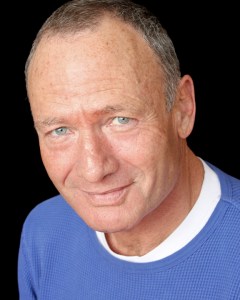
Simon Prast
After an amiable ‘no phones, no pics’ tête-à-tête from Burton we settled in for the first slice of this rebellious miscellany, Act 1 Scene 1 from ‘King Lear’, with Prast as the irascible king, If a measure of the success of a production like this is a desire on the part of the audience to see the whole play, cast as it is in this brief sojourn, then this was prodigiously successful. In the first of a number of towering characterisations, Prast’s command of space and language was exquisite. Zapping from command to hurt to anger and back to command again, he oscillated between vengeful monarch, rancorous father and spiteful neighbour in the flick of an eye. As an introduction to the cast it couldn’t have been better with Paul Trimmer an empathic King of France and Sam Mannering a finely tuned Kent. As the daughter/sisters, Moana McArtney as Cordelia, Catherine Boniface as Goneril and Jennifer Freed as Regan really impressed. I’ve always thought that the greatest danger with these characters is to have them play the end of the play at the beginning – the personification of good and evil – and the choices made by this cast vindicated that view. While conventionally the rebel might seem to be Cordelia resisting as she does her father’s sycophantic desire for emotional validation with her ‘Nothing, my lord’, it is actually Goneril and Regan who turn the scene on its head when we find that they’ve been observing Lear’s advancing senility for some time – ‘he hath ever but slenderly known himself’ – and preparing for it. I’ve always wondered what the relationship between these familials, these sisters, is actually like and this brief work clarified that immeasurably.

Jennifer Freed
Immediately we burst into Act II Scene 2 of ‘The Tempest’ with Moana McArtney an excellent, gauze-clad monster Caliban, Sam Mannering a staunch and surprisingly sexy Trinculo and Paul Trimmer the drunken Stephano. There’s slapstick galore and the absolute most is gotten from Shakespeare’s olfactory rudeness including, but not limited to, the inserting of a bottle in the botty – and all in the best possible, riotously funny, almost good taste.
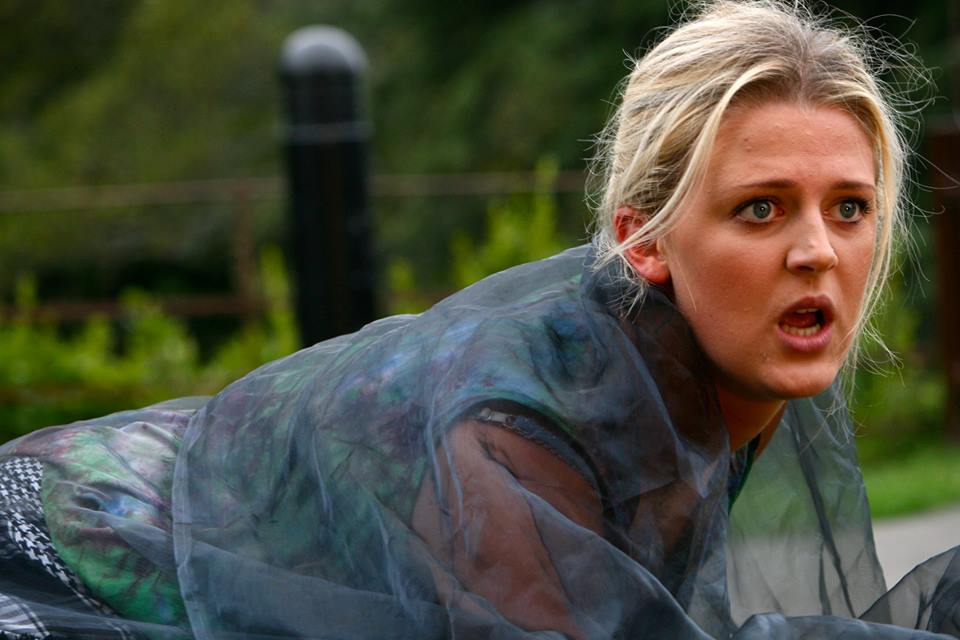
Moana McArtny as Caliban
Hot, sloshed and comical is watchfully replaced by composed, dangerous and cryptic, an angular Act IV Scene 5 of ‘Coriolanus’, with Boniface as Caius Martius Coriolanus and Freed as Tullus Aufidius. In general the cross-gendering of characters, a feature of this production, works really well and never more so than in this excellent scene. It was particularly exciting to see cross-gendering engaged as a casting choice and not simply because there weren’t enough chaps to fill all the bloke parts. Both Boniface and Freed have magnificent voices and a capacity to make the language sing but they are more than just sound and fury. These women worked the scene with a subtlety that drew us in and enabled them to play, and the audience receive, performances of an emotional range seldom achievable in the outdoors. Each actor has real stature, and Freed in particular, by making her character choices late, enabled a reflux-like tension to be built that was profound and never better than when she made us wait, seemingly forever, before uttering ‘therefore, most absolute sir, if thou wilt have the leading of thine own revenges … ‘ Damn fine stuff, I say.

Jennifer Freed as Tullus Aufidius
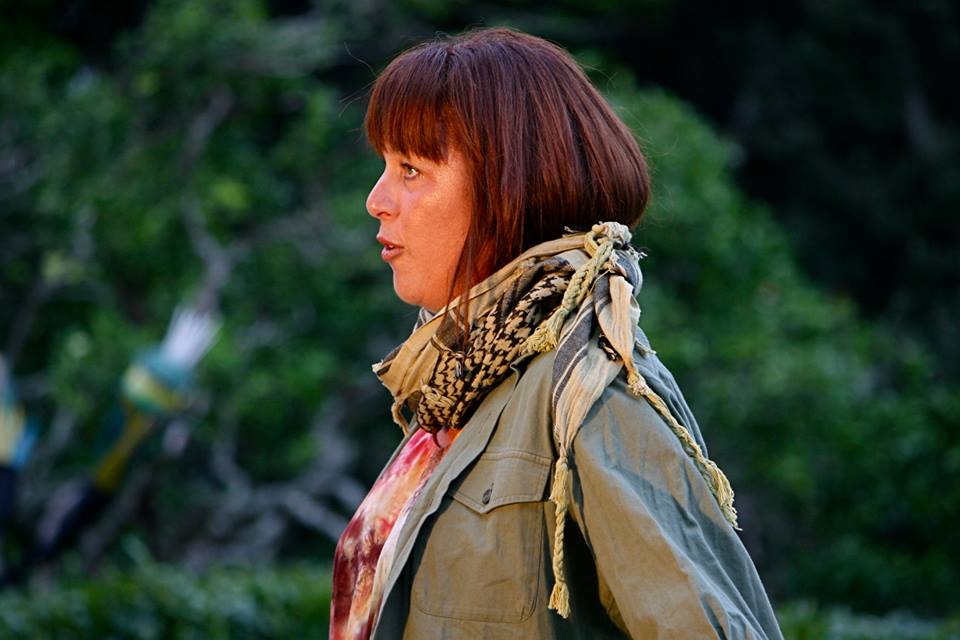
Catherine Boniface as Caius Martius Coriolanus
The first half ended with Act I Scene 5 of ‘Twelfth Night’, an extraordinary mishmash of misshapen mishaps that, in the wash-up, was sublime in so many ways. I won’t pretend to have fully known what was going on while it was happening – there was so much to watch and take in – but I knew it was extraordinary work and that all would become clear, which it did. It was a performance hodgepodge embedded in which was some truly fantastical work. Moana McArtney’s fine Feste making such good sense of the bad marriage and Madonna themes, Catherine Boniface’s sternly rigid and rigidly stern Malvolio – such intelligent naiveté (and nail polish), Paul Trimmer’s stoic refusal to play Viola with even a vestige of femininity, Grae Burton’s totally trashed Sir Toby, and all the while, Simon Prast’s exquisitely astonishing Olivia, in sunnies and head scarf, reminiscent of Rupert Everett’s strangely dangerous Flora Goforth in Tennessee Williams’ ‘The Milk Train Doesn’t Stop Here Anymore’ at the Lyric Hammersmith in 1998 – and with all the inherent risks entailed in embarking on such a bizarre journey. Mrs Prast was absolutely majestic and her final lines were an absolute tour de force.
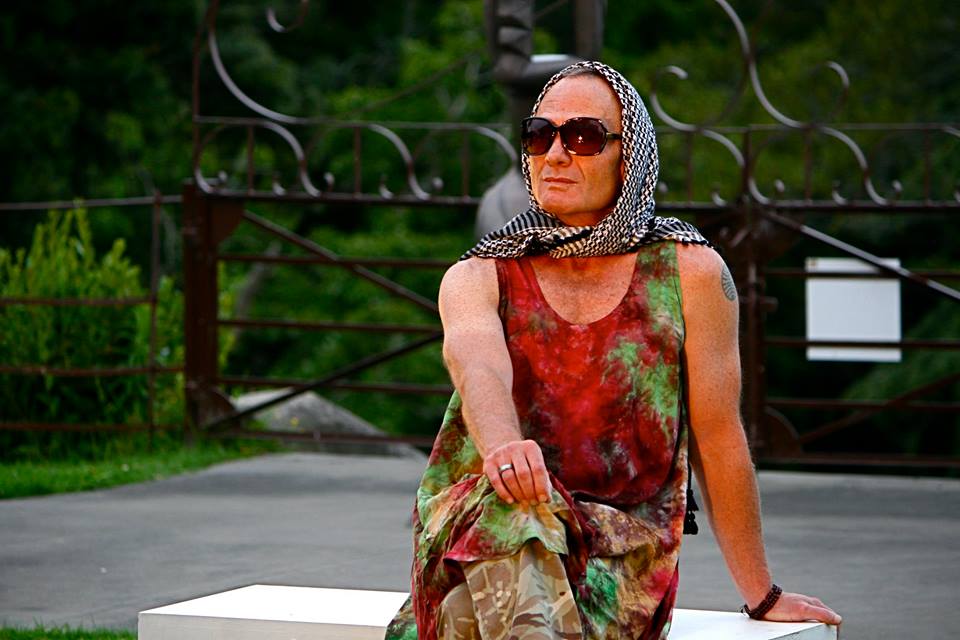
Simon Prast as Olivia
I went to the break contemplating the difference between ‘complex’ – which is how I viewed this piece having experienced more than a dozen stage and screen versions and directing it once – and ‘complicated’, which is how an audience member meeting this snippet of the full work for the first time, might receive it. It raises the issue of relevance and asks ‘is work of this nature only for the aficionado or will the generalist audience member with no experience of Shakespeare have an equally good, if dissimilar, experience, and is this in any way authentic? I reached for my ‘constructivist’ hat and decided that, because we all bring a diverse experience of life and the theatre to the audience/actor engagement then, as I’m sure Burton had already concluded, there’s benefit in providing something for everyone.
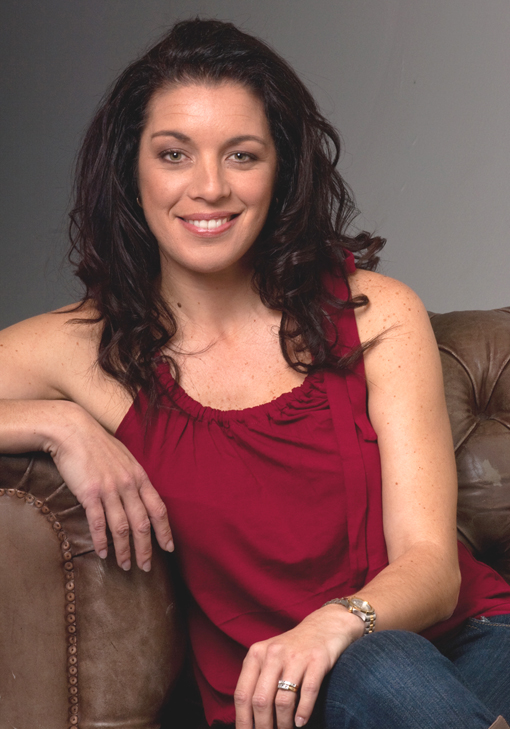
Catherine Boniface
Interval, as I recall, was warmed by a natty merlot and a chatty friend, both most welcome – and I stopped intellectualising a particularly visceral first half and began to simply look forward to the second.

Paul Trimmer
Part two erupted onto the green with the assassination of Julius Caesar and subsequent scenes of riot and rebellion. In my view the least successful of the selections, it did contain some fantastic work from the men. Prast, again magnificent this time as Marcius Junius Brutus, slayer of Caesar, fed his followers superbly with ‘Romans, countrymen, and lovers!’ – a speech I’ve always thought undervalued and which now has echoes of Je Suis Charlie especially in the line ‘Had you rather Caesar were living and die all slaves, than that Caesar were dead, to live all free men?’
Sam Mannering
Brutus is, of course, followed in the speaking order by a more than cynical Marcus Antonius (Sam Mannering) working the room until he has completely turned the tables on the assassins, and how could he not with lines like ‘Cry ‘Havoc!’, and let slip the dogs of war.’ We know the rest, of course, from 4th form history (and English) if we went to a half decent school and it doesn’t end nicely. The selfless Freed also serves the scene splendidly – albeit briefly – with a rather excellent Gaius Cassius.

The Henry IV histories, seldom performed until recently, have gained a currency at least in part because the Royal Shakespeare Company has recently produced both parts, two beauties, with Sir Antony Sher as a predatory Sir John Falstaff and Jasper Britton as the tormented usurper king. Almost out of left field the merit of these plays is being recognised, and not before time. Described in The Guardian, by that doyen of reviewers Michael Billington, as ‘Shakespeare’s two greatest plays’ it’s really rather exciting to revisit Act V Scene 4 of Part 1 here in Auckland, New Zealand on a balmy summer’s night. It’s an exercise in deceit with more counterfeit deaths than you can shake a halberd at and, while cast and director cock an appropriately Blackadderish snook at the thing, the stale stench of corruption lurks in the air. Freed plays Henry IV dead straight leaving the lunacy, the wonderfully silly swordplay and the kid-like horse-riding that the audience adore to Mannering, Prast and Trimmer. Prast delights in his own treachery as Jack Falstaff and the whole thing rollicks along to its unexpected, and almost unanticipated, end. It’s self-interest personified and, with New Zealand about to send troops to Iraq against the popular wish, our own Prime Minister may well be underpinning his government’s foreign policy with advice given by a dying Henry to Hal, the future king ‘to busy giddy minds with foreign quarrels’. We seem to be getting a bit of that, so – clever, contemporary Mr Shakespeare!

The penultimate scene – Act IV Scene 3 of Macbeth – is a real challenge and shows the degree of courage, not to mention integrity, that Shakeitup! is becoming known for. We see McArtny as Malcolm and Freed as Macduff quietly determining the downfall of the horrorshow that is Macbeth. It all makes perfect sense until Ross (Boniface) arrives. Those of us who know the play quake at the knowledge that Macduff is about to learn his family has been slaughtered, not just killed but slaughtered, with all that this implies. The text in this scene is minimal, the action inward, the emotions generated beyond mere speech, the imagery essentially male – Macduff asks ‘My wife kill’d too?’ Ross replies ‘I have said’. Macduff, incredulous, questions ‘All my pretty ones? Did you say all? O hell-kite! All? What, all my pretty chickens and their dam at one fell swoop?’ ‘Dispute it like a man’ says Malcolm. Macduff replies ‘I shall do so; but I must also feel it as a man: … O, I could play the woman with mine eyes and braggart with my tongue’ to which Malcolm replies ‘This tune goes manly.’ Burton has cast this heavily gendered, film-like scene across the gender divide and, in my view it worked superbly well to have women play these roles. They’re all outstanding with Freed simply magnificent. What can you say, or do, when you discover your spouse and children have been massacred? The truth is, nothing. So what does Freed do? On the surface, nothing, but what is happening inside this exceptional actor is as palpable as can be imagined. She cleverly allows us to experience her horror through the words and through our own experiences, and Boniface and McArtny do the same. It’s rich and gutsy work and I, for one, loved it. Yes, it’s a bit hard to hear at times and, yes, you have to concentrate, but it’s there for you, and it’s accessible, magnificent theatre if you want it badly enough – and I did. It’s classically Greek at its core, and I loved that, too.
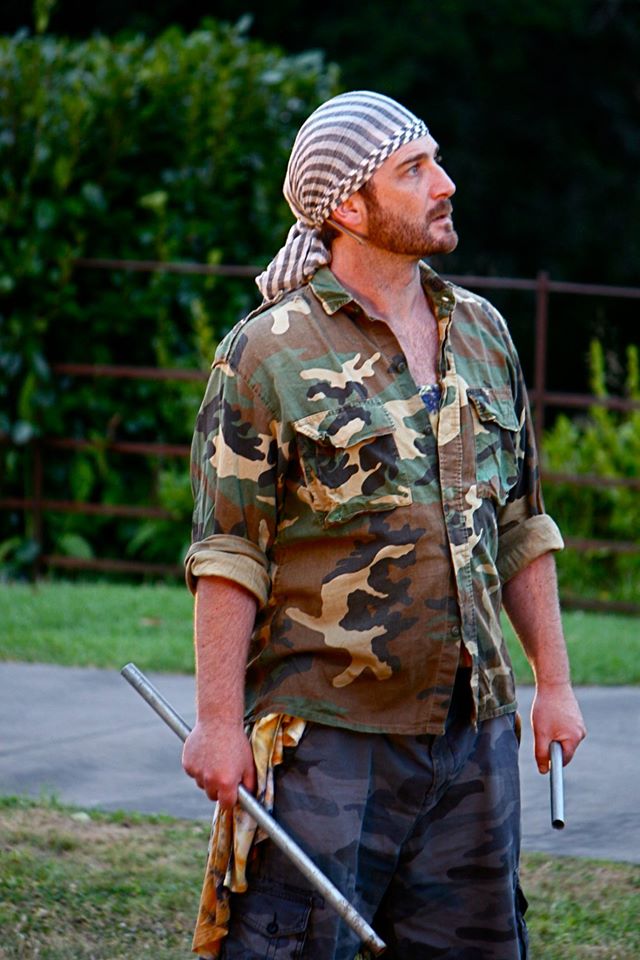
Grae Burton
We end our evening on a grassy bank in Belmont at night and, with the first line, my son, age 12, leaned into me and said ‘I know this, I love this one.’ He’s seen 17 different full-length Shakespeare plays and he’s loved them all, how cool is that?

Moana McArtny
This time we get the full cast with birth genders intact – in my community that’s a big call, outing cis-gendered people – and in this production probably equally so. Paul Trimmer is Lorenzo, Moana McArtny is Jessica, Burton himself is Gratiano, Catherine Boniface is Portia, Jennifer Freed is Nerissa, Sam Mannering is Bassanio and Simon Prast is Antonio, the titular character from ‘The Merchant of Venice’, and they’re all just great. It’s magical, and the unraveling of the rings plot is clear, incredibly affectionate and gently funny. It’s also a learning curve for the dudes and Burton doesn’t shy away from teaching them the lesson. It’s a grand way to end a wonderfully diverse evening, peppered with fine performances, subtle ensemble playing and all dressed to contemporary perfection.

‘Shakespeare’s Rebels’ is ultimately a spectacular tribute to the bard himself, actors, rebellion and love, yes, most of all, love. Love of the work and love for us, the audience. I’m happy to announce, too, that there’s much more to come, this time at Rannoch, 77 Almorah Rd, Auckland from Thursday 19 February 2015 to Sunday 22 February 2015 each night at 7:00pm. Experience it, whether you’re a Shakespeare nut or not, you’ll not be disappointed.
 dykiegirl