
Pūtōrino Hill
By Chris Malloy
Director – Te Kohe Tuhaka
Kaiarataki Mangairua – Tainui Tukiwaho & Puti Lancaster
Kaitiaki/Producer – Esther Roberts & Taki Rua
Set and Costume Design – Brian King
Lighting design – Nick Zwart
The Loft at Q Theatre
15 – 19 July, 2014 at 7.30pm
Published at http://www.theatreview.org.nz
Mā te rongo, ka mōhio; Mā te mōhio, ka mārama; Mā te mārama, ka mātau; Mā te mātau, ka ora.
(Through resonance comes cognisance; through cognisance comes understanding; through understanding comes knowledge; through knowledge comes life and well-being.)
Taki Rua seems to have been around forever.
It’s not true, of course, it’s less than 40 years old but it has a substantial history that belies it’s relative youth.
Taki Rua was spawned in the early 1980’s with productions such as Greg McGee’s ‘Out in the Cold’ (1983), Mervyn Thompson’s ‘The New Zealand Truth Show’ (1983) and Hone Tuwhare’s ‘In the Wilderness Without a Hat’ (1989).
Good though those productions were, the organisation followed them with even more refined work including Briar Grace-Smith’s ‘Purapurawhetu’ (2000), Witi Ihimaera’s ‘Woman Far Walking’ (2000), Hone Hurihanganui’s ‘Awhina’ (2003), Hone Kouka’s ‘Ngā Tangata Toa’ (2006), Albert Betz’s ‘Te Karakia’ (2008) and ‘Awhi Tapu’ (2009), ‘Mark Twain & Me in Maoriland’ (2010) written by David Geary and the company, Paolo Rotondo and Rob Mokaraka’s ‘Strange Resting Places’ (2011), John Broughton’s ‘Michael James Manaia’ (2012) and, adapted from David Ballantyne’s classic novel, ‘Sydney Bridge Upside Down (2013).
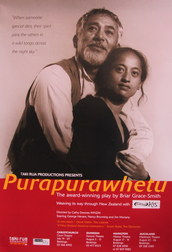
Among the artists who have worked with Taki Rua are James Ashcroft, John Gibson, Mervyn Thompson, Ngapaki Emery, Timothy Bartlett, Nathaniel Lees, John Bolton, David O’Donnell, Gary Henderson, Donogh Rees, Rangimoana Taylor, Colin McColl, Dorita Hannah and the wonderful composer/performer Gareth Farr.
They’ve done radio plays, held Maori and Polynesian playwrights workshops, launched books, toured productions to the four winds, created countless new works and graced more stages than you can shake a taiaha at and, in so doing, have become an institution within the arts in Aotearoa New Zealand.
More than that, Taki Rua is an undoubted cultural icon without which we would be much worse off . Their work resonates with us by bringing cognisance, understanding, knowledge and well-being.
Te Kohe Tuhaka’s excellent production of Chris Malloy’s stunning new play ‘Pūtōrino Hill’ further enriches the legacy of Taki Rua and provides us with a magnificent example of what a top quality theatre experience should be. From the moment we entered the Q Theatre Loft to the instant I nicked five grapes from the table of kai in the foyer before descending the stairs to a freezing Queen Street I was in another world, a world of mystery, enigma, anger and enchantment.

Te Kohe Tuhaka
In fact, this exceptional experience started even before that. It started when we were greeted by stage manager Olivia Kelsey in the foyer before the show and welcomed with charm and warmth. Stage managers seldom get mentioned in reviews but Ms Kelsey is worthy of more than a programme note for her informative and enlightening preshow tête-à-tête, not just with my family and myself, but with all the attendees at Thursday evening’s performance. Ka pai, Olivia, and thanks.
The Q Loft is a wonderful deep space and admirably suited to this disconcerting and challenging chamber work. On the surface ‘Pūtōrino Hill’ is a charming, somewhat folksy tale of fairies, culture and the good old days while, in reality, it defies definition. Locked away behind the seemingly straight forward, homespun characters and the whimsy is a far darker tale, a clandestine story that borders on being a horror story.

Chris Molloy
Brian King’s excellent set consists of a boardwalk of angled golden planks emerging from a free standing doorway which replicates a church entryway, a family home and a wharenui.
To the left of the boardwalk hang a number of firefly-like single bulbs suspended in a deep and otherwise empty space which serves both as a brooding, misty, mountainous bush area inhabited by the sinister patupairehe (fairies) and the essence of the curse on the town.
To the right of the central structure the depth of The Loft allows for quite a number of multi-shaped, antique wood picture frames suspended in surreal fashion seemingly in space that are used evocatively throughout the evening.
The only hint of realism sits to the right of the boardwalk, a simple interior consisting of a comfortable armchair, a jacket draped across the back, and a circular side table underneath which rests a transistor radio. A single wooden chair completes the solitary domestic picture and the whole has a somewhat rustic 1960’s feel.
From the moment of entry into the performance space we are exposed to the sound of a religious programme coming from the radio. The subject of the radio talk is appropriately enough St Paul’s vision on the road to Damascus and this, along with Matthew Eller’s rich sound scape which peppers the following 75 minutes, contributes substantially to the success of this evocative production and makes for a satisfying and complete sensory experience. Checking out St Paul’s vision in advance of seeing the production will greatly inform the play.
There is a resonance in the deep bass notes of the wonderful Lemi Ponifasio’s Mau Dance Company. The similarity to Ponifasio’s venue-quaking, butoh sound overlays plus the addition of the sounds of smashing glass feed beautifully into the text particularly in places where it relates to the surreal, episodic and picturesque nature of the narrative.
As the performance begins and we are introduced to the characters there is a sense of walking through an existential gallery rich in memories, not all of them pleasant.
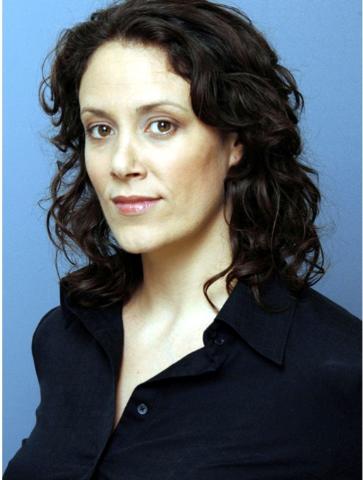
From the outset ‘Pūtōrino Hill’ is informed almost as much by its silences as it is by Chris Malloy’s excellent text. There is an ongoing sense of discomfort and a delicately balanced tension throughout and this is perhaps best illustrated by the seemingly endless stillness of the first meeting of Sarah the researcher (Lana Garland) and Old Whiti (Rob Mokaraka) and the subsequent awkward hongi.

Rob Mokaraka
We discover almost immediately that Old Whiti has no kids, ‘he is no spring kumera’ he tells us, and he needs to ‘get a few things’ off his chest. There is conversation, albeit brief, about myths and legends which gives the audience something of a signal of what is to come.
Lana Garland
We are lead, in the culture of the story, to mention of the great prophet Rua Kenana, and through this we meet the character of Koro, Whiti’s grandfather, also played by Mokaraka. Koro is a charismatic preacher and a man whose character is the subject of gossip and innuendo in the town. Kenena’s mix of traditional old testament Christianity and Maori spirituality is also mooted as a possible cause of the underlying tension within the community.
We are introduced, through a series of flash backs, to Hana (Kim Garrett) and Koro’s son Young Whiti (Jade Daniels). Young Whiti is ‘the chosen one’, a young man to whom God speaks directly. He is Koro’s selected successor and, it seems, the person chosen to remove the makutu (curse) that infects the town. Molloy’s text is peppered with tantalising threads that lead into this unspoken world, lines like ‘has he hurt you again’ and ‘with so much evil in the world I know there must be a God’ are like signposts on the journey of the play. There is even talk that Tu Matuaenga himself has cast the Pūtōrino (flute) into the surrounding hills and that, if the curse is to be lifted, it must be done by an innocent child who is spiritually aware and young Whiti seems the obvious choice. We hear both Koro and young Whiti assume the preachers mantel, and the latter does an excellent job of leading us through his vision, a vision that informs us that it is he who will lift the tapu on the town. ‘God speaks to me’ he tells us as though in explanation.

Jade Daniels
There is also more than a hint that young Whiti does not actually wish to be the next preacher and around this there are moments of delicious tension as his relationship with Hana deepens.
While ‘Pūtōrino Hill’ is a big play with powerful consequences the story is told as a deceptively simple narrative and acted out in story theatre style. We hear that ‘fairies are everywhere’ and, of young Whiti, we discover that ‘it’s always been you’. Even more enigmatic – and telling – is the phrase ‘I want to smash your Dad’.
We find out that Sarah was adopted out at birth which leads us to ask ‘why has old Whiti chosen to share his story with her?’ We learn that Koro was removed as preacher and that he faced charges, charges that were later withdrawn, and the question is asked ‘why was he not reinstated’ but at this point in the play we receive no answer.
There is a beautiful scene that takes place at the end of the jetty between Hana and Young Whiti which ends with Young Whiti on his knees proposing marriage, giving Hana a ring and her accepting. The honeymoon was short lived, however, because Whiti’s Mum caught up with them before they got to the marae and, presumably, adult sanity prevailed. The scene is as charming as a puppy and performed to perfection.
The oppressive presence of Pūtōrino Hill is dark, pervasive and brooding so its comes as little surprise that, while Hana stays in the town, young Whiti moves to the city with his Mum. On his return we find he has been to a flash school, gone to university, graduated with a PhD and moved to Ecuador. The reconciliation of Hana and Young Whiti is beautifully enacted and we are left in no doubt that, while the chosen one has returned, his guilt at having left the town and Hana at risk sits heavily on his spirit.
Kim Garrett
To tell you more at this point is to potentially spoil what is a magnificent journey through this extraordinary play. Suffice to say we find that Hana has been beaten at home and at school and that her anger and madness – the community consider her porangi – as a result of her treatment has been the cause of lifelong problems, issues that Young Whiti could have helped avoid. They had each other’s backs, after all.
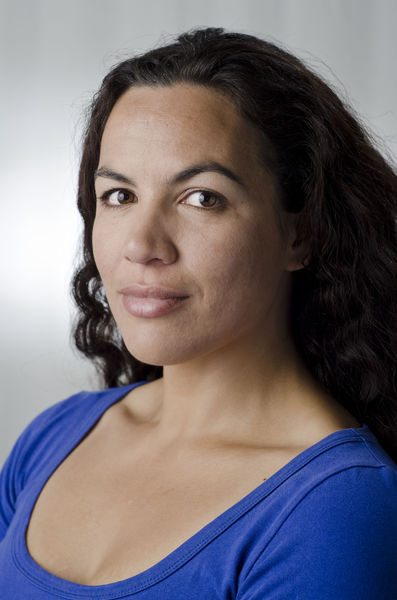
In the scene that forms the climax of the play Garrett and Mokaraka are quite magnificent. This is the ultimate scene of confrontation and resolution and, as such, is deeply satisfying. The actors are at the top of their game and Garrett is quite outstanding.
As Sarah the researcher – and in her own way a ‘chosen one’ – Lana Garland does all that is required of her. In the early scenes her performance is quite mannered but she succeeds in both carrying the plot and bringing a feeling of a larger world to this insular community. Jade Daniels as the Young Whiti traverses the generations exceptionally well and his evolution from innocent boy to mature man is subtly managed.
As Hana, Kim Garret is wonderful. Hana’s journey, also from innocent child but, in her case, to seriously damaged adult requires a deep understanding of life at its most challenging. Her passion and incredible anger are immensely believable.

Kim Garrett & Jade Daniels
Rob Mokuraka has always been one of my favourite actors. He creates in Koro a credible charismatic preacher, a man of immense charm and presence who, against our better nature, we are drawn to. On these occasions we see a Mokoraka of great physical dexterity and he and Daniels each create believable older and younger male selves .
As Old Whiti, Mokoraka aches with age and wisdom. He is charming, evasive, funny and full of cultural quirks. His is a masterful performance, a superb exercise in control and understatement. He glues the play together and has a clear understanding of every aspect of this complex journey.
Pūtōrino Hill, while essentially a play about the secrets that exist within a family, is played out on an epic canvas. As an exercise in cause, effect and consequence it should take a well-earned place in the theatre literature of Aotearoa New Zealand. Malloy’ carefully crafted text is multilayered and delicately leads us into the deepest, darkest reaches of the human spirit.
As a piece of modern theatre, director Te Kohe Tuhuka and his team have created a profound work of considerable theatrical dexterity in which both Mokoraka and Garrett are able to fully exercise their exceptional skills.
In short, this is a magnificent work that deserves to be seen, and supported, by discerning audiences everywhere.
‘Pūtōrino Hill’ is the outcome of the 2013 Taki Rua and Court Theatre Maori Writers Residency and owes much to the contribution of the late Elizabeth O’Connor who sadly passed away at the weekend. Elizabeth’s legacy to live theatre in Aotearoa New Zealand, particularly in the areas of theatre literature and scholarship, is substantial and I will value her memory as a friend, a colleague and an all-round top person for as long as I live.
Mā te Atua me te wāhi ngaro tātou e tiaki e manaaki.

Elizabeth O’Connor

 dykiegirl