
Tuesdays With Morrie
By Mitch Albom
Produced by Adey Ramsel & Sharu Delilkan for Newmarket Stage Company
Costume Design by Rowena Smith
Directed and Designed by Adey Ramsel
Lighting & Sound Design by Scott Thomas
Factory Theatre, 7 Eden Street, Newmarket, Auckland
Friday 06 June, 2014 to Saturday 21 June, 2014 (check media for times)
Reviewed on Saturday 07 June, 2014
The great Simon Callow vividly recalls his earliest drama teachers Christopher Fettes and Yat Malmgren, co-founders of the Drama Centre in London, and their unbending view of the purpose of theatre. He reminds us, sagely, that ‘to them, theatre was a crucial mechanism within human society. A ritual re-enactment of the lessons mankind has learnt about itself, a way of restoring the spectators to their full human experience after the routine alienations of daily life, and a celebration of desire.’
That’s a pretty cool definition in itself but, perhaps unsatisfied by the somewhat clinical definition, Callow adds his own, more impassioned and personalised, version. The purpose of theatre he says is for ‘melting the ice within, of awakening dormant cells, of making us more fully alive, more fully human, at once more individual and more connected to each other’. (1)
Remember the human connections, because they’ll come up again later.
Who could disagree with either, and collectively they’re a wonderful doorway to understanding this complex art form and what is has been designed to achieve over the last 2,600 years.
The word theatre, of course, can be traced back to Ancient Greece 600BCE where ‘théatron’ was ‘a place for viewing’ and ‘theáomai’ meant ‘to see, to watch, and to observe’. (2), (3)
‘Tuesdays With Morrie’ is a great example of watchable theatre where the emotions are cranked up by the senses and the visuals deliver a separate but interconnected sub-textual narrative that supports the spoken word every step of the way.
So, why the lecture?
The answer lies in the ‘Tuesdays With Morrie’ experience which is essentially a traditional one – raked auditorium, proscenium arch mode, occasionally broken fourth wall style, a set, a narrative, and a couple of actors. It’s not an experience that could in anyway be described as ground-breaking and one of its great strengths is that it doesn’t try to be. It’s conventional, but what of that? It forced me to go back to basics and to remind myself what it is we try to do when we make a theatre work because ‘Tuesdays With Morrie’ doesn’t seem to put a single foot wrong at any time. It melts ‘the ice within’ in no short order and, on leaving the theatre and for the 24 hours following right up until I sat down to write this piece, the resonances of the production have worked their magic.
Mitch Albom is a sports columnist, broadcaster and alumnus of Brandeis University which is where he first comes under the influence of gregarious sociology professor Morris ‘Morrie’ Schwartz who, in turn, quickly becomes his mentor. The relationship the two men develop through the tutorials and personal meetings have a profound effect on the younger man. Yes, it’s a man’s play about men but the universal elements will appeal to everyone.

On leaving Brandeis, Alborn cuts all ties with Schwartz and, while the older man writes letters, Alborn ignores them until, after 16 years, he witnesses Morrie interviewed on Ted Koppel’s ‘Nightline’ programme. Morrie is dying of the most common of the 5 motor neurone diseases, amyotrophic lateral sclerosis (ALS), sometimes known as Charcot disease, and, in the United States and in the play, Lou Gehrig’s disease. Albom is moved by the television interview, decides to visit his old teacher to pay his respects, and so begins a sequence of the fourteen or so Tuesday visits that make up the content of the play.
Charlie Schwartz, Morrie’s Jewish father, was a Russian immigrant who abandoned his native country to evade military service, traveling instead to America where he settled and raised a family. Morrie’s mother passed away when the boy was eight and this was perhaps the most influential event in the young boy’s life. Morrie married Charlotte and they remained together until his death in the summer of 1995. He fathered two boys, all of which – plus the family’s Jewish faith – equipped him admirably to become the wry commentator on life who we meet in the play.
Charlotte, and the caregiver Connie, though never seen, play pivotal roles in Morrie’s story.
Also pivotal is Morrie’s Jewish history. It permeates everything.
In the Hebrew tongue, ‘Morrie’, ironically – or perhaps not so – means ‘my teacher’ and, thanks in part to Albom having the somewhat bizarre presence of mind to record the Tuesday meetings, we can all benefit from Schwartz’ aphorisms, sardonic one-liners and insightful homespun wisdom on almost any subject imaginable. Each audience member would have at least one favourite that particularly hits home and for me it is Schwartz’ paraphrasing of WH Auden’s famous line ‘we must love one another or die’ and turning it into ‘we must love each other or perish’. Paradoxically, Auden himself spent his later years endeavouring to have that line changed in all his published works, changed to read ‘we must love one another and die’.
I suspect Morrie Schwartz would have thoroughly approved of the change.
The set (Adey Ramsel) is a standard proscenium arch separated into three distinct parts – a grand piano at left, an outdoor area with autumnal tree at the rear yet detached from the undemonstrative apartment lounge interior by the tobacco-coloured, wooden veins of a conservatory-like, slope-roofed dividing wall.
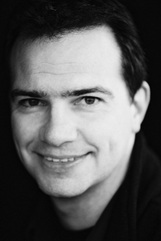
Adey Ramsel
The interior has a comfortable chair, a chaise longue, a radiogram, a side table and the tidy bric-a-brac of decades of habitation. It’s largely functional and supports and sustains the action beautifully.
The key scenes of the work are taken largely verbatim from the Albom tapes and lifted almost directly from the book so each is configured as dialogue between Albom and Schwartz. Secondary, and interlocking, scenes enable Albom to speak directly to the audience and contextualise the back-story where this is required. As a device it works extremely well.
The text is tight, economical, and we’re swiftly drawn into the narrative and mostly forget that this is a simple memoir such is the level of reality engendered by the two actors. There’s a sense of a ‘70’s ‘well-made play’ about proceedings and this is no bad thing. I’m reminded of J.P. Donleavy’s ‘Fairy Tales of New York’ (1961) in both wistful tone and nostalgic style and it’s no surprise that each involved a play script and a book though, in Donleavy’s case, the play came first.
We hear that Mitch (the extraordinary Jason Te Mete) had aspired to being a jazz pianist and was taught, in secret, by his Uncle Mike, in secret because his parents wanted him to become a lawyer. It all seems to be heading in the right direction when Mitch goes to live in his uncle’s house but when, at the age of 42, Mike dies of pancreatic cancer, Mitch’s world falls apart. He gives up his dream, his first love, the piano, and never plays again.
He is twenty one years old.
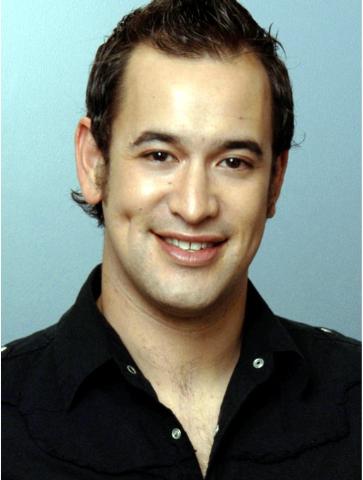
Jason Te Mete
Instead, he goes to Columbia University and gains a second degree, this time in sports and begins work as a multi-media sports journalist and becomes, in his own eyes, successful. He ignores letters from Schwartz for reasons that seem clear from the outset – he knows the older man will challenge his life’s course which, of course, is exactly what happens. As we journey with the actors through to the moment of Schwartz’ passing – and beyond – we experience some of the most powerful and most subtle changes in personality it’s ever been my pleasure to witness on the stage. As Schwartz works his magic on the man he calls ‘Mr Impulsive’ so the younger man works his wiles on Schwartz. There’s no cathartic moment, no big epiphany, and life seems to just meander on, but each man is inexorably changed by the other.
The rhetoric is crisp, the text often cryptic, leaving the actors and director to do the work. In less capable hands the play could have lurched from the maudlin to the mundane but it never did. There was not one moment when the actors weren’t in complete control of the task, and of us, not one moment when an actor choice jarred against the play or our sensitivities.
Moments abound – ‘are you at peace with yourself?’ Schwartz asks Albom. ‘Dying is one thing, living unhappily is something else’, ‘Why should I cry?’ Albom asks, ‘Poets, philosophers and professors can cry – what if we all did that? Nothing would ever get done’, ‘I forgave you long ago, it’s what you do for those you love’ and the sight of Schwartz attempting to eat his favourite egg salad is heart-wrenching indeed without ever being set up to be so.
It’s a play that tracks a man’s last few months on this earth so it’s hard to escape the mortality theme but it’s also a play about courage, living fully, loving well, and acceptance. It’s about being able to touch and feel and the moment when Albom finally bends and kisses the old man on the forehead is seriously one to treasure.
Morrie Schwartz (George Henare) covers some ground – he dances, he talks liberally about needing someone to ‘wipe his arse’, he laughs, he cries and, as we witness the devastation of his body as Lou Gehrig’s disease kicks in, we celebrate joyfully the power of Morrie’s brain and his incorrigible lip.
‘Tuesdays With Morrie’ is a tour de force for the actors and director. It’s a treacherous play but you’d never know it in these sure hands.
Jason Te Mete is a magnificent pianist and, while I’d have loved to have heard more, the play denied me that opportunity but I’ll be following it up, you can bet on that. He has all the tools necessary to play Mitch. He looks good, has a great voice, accesses the subtlest of emotions and I never for a moment doubted that he was Mitch Albom. Break out narrative isn’t easy to carry either, especially when it‘s liberally interspersed with linear dialogue, but Te Mete manages this seamlessly.
George Henare is … well, he’s George Henare and what can be said that hasn’t been said about this wonderful actor is barely worth saying. He makes playing Morrie Schwartz seem like a walk in the park which it simply isn’t. The play opens with flash back scenes that require a bit of dancing and some physical stuff that presents Morrie as a much younger man and this Henare does with ease. Morrie’s physical deterioration happens almost imperceptibly and we have to pinch ourselves at the end of the play to remember the charming, erudite and physically articulate character we meet at the beginning of the performance. There are minor crisis moments that are handled with economy and beauty – the eating of the egg salad is a prime example, there’s nothing rushed and director and actor allow the moment to exist in the time it takes to play the action – and there’s the breathing and the associated tragic countdown. It’s as though, by undertaking this breathing exercise, Morrie is measuring how much time he has left. He mentions getting to 93 but we only see him achieve 18 and, by the end, he struggles to even get to 2. By the final metaphorical curtain both characters are changed utterly yet we barely saw it happen.

George Henare
I first saw George Henare in a play in Whangarei on tour with the Mercury Theatre in 1976. I had brought 40 kids from my small school 35kms east of Kaitaia to see ‘Toad of Toad Hall’ and stole the opportunity to see the Mercury’s amalgam of Henry’s presented as ‘Agincourt’. I’ll take the memory of Henare’s stunningly good ‘St. Crispin’s Day’ speech to the grave. It was superb – but, in retrospect, no surprise for this supremely good actor. Within the year I was working professionally myself and Henare, working around the corner at the Mercury, was always my hero and the actor whose work I most aspired to emulating but could never quite manage. He’s enigmatic, generous, sublimely talented and his wonderful work ethic means we all benefit from the art he creates. He built quite simply the best Polonius I’ve ever seen and managed to avoid all the silly old man pitfalls that lesser actors are drawn to. It’s been an amazing career and the exciting thing is there’s still a lot more to come.
The rapport between these two excellent actors is superb and their synchronicity is breath-taking. Often lost when actors transcend is the work of the director and Adey Ramsel is to be congratulated, slapped on the back and applauded for a job well done. He’s created the environment for success and got it. Well done, indeed.
I’d like to end by making comment on a couple of interesting aspects of the play that aren’t at first apparent.
The first relates to this being a very Jewish play, the essence of which lies in the writings of Martin Buber, a Viennese Jewish philosopher best known for his text ‘I and Thou’ in which he expounds his philosophy of dialogue. Schwartz quotes him in the play and there’s little doubt in my mind that Albom had the concept of human life finding its meaningfulness in relationships – with God being the ultimate ‘thou’ – in the back of his mind while he was writing the book. (5)
Buber also has plenty to say about the importance of commentary, the sharing of food as an affirmation of life and health and the need we all have for heroes and heroines in our lives in the form of our teachers and mentors. These factors are of critical importance in the work as well, so much so that they appear repeatedly in the text and in the action.
Newmarket Stage Company is on a roll and long may it continue. They seem to have the mix right with the venue, the type of play and the way they think about and present the work. Theirs is a loyal but not necessarily traditional theatre audience and the fact that they’ve had the sense to appoint an intern makes the best of good sense, to me, at least.
I often leave the last word to my son Finn who we take to almost all the shows I review. He’s a perceptive eleven year old and his concern for Henare as we left the theatre was palpable. I’m not surprised as this was a most complete journey and we had all bought a ticket to the end of the line. No surprise then that many of the Saturday night audience rose as one to salute this excellent work. I reinforced to Finn that Mr Henare would be fine and that what he’d seen was performance art of the best sort. His response was to say that he liked the theatre best when you couldn’t really tell what was real and what wasn’t. I had to agree totally with that.
It was good, however, to see Henare outside the theatre after the show generously signing a few autographs before starting on his journey home. I must say he looked well, as fit as a fiddle in fact, and in sparkling good health.
I admit to breathing a sigh of relief myself as I pointed this out to my son.

Sharu Delilkan
References
2) M. Carlson, Journal of Dramatic Theory and Criticism, [1], 2011
3) Pavis, Patrice. 1998. Dictionary of the Theatre: Terms, Concepts, and Analysis. Trans. Christine Shantz. Toronto and Buffalo: U of Toronto P. (p345). ISBN 978-0-8020-8163-6.
4) Auden, WH, ‘September 1, 1939’
5) Buber, M, I and Thou. Charles Scribner’s Sons. 1937. Reprint Continuum International Publishing Group, 2004, ISBN 978-0-8264-7693-7
 dykiegirl
A brilliant review, in fact we have bought tickets to go next Sunday! I have read the book and was very moved by it, so look forward to seeing it in theatre. I have a great deal of respect and admiration for George Henare as an actor and a man.