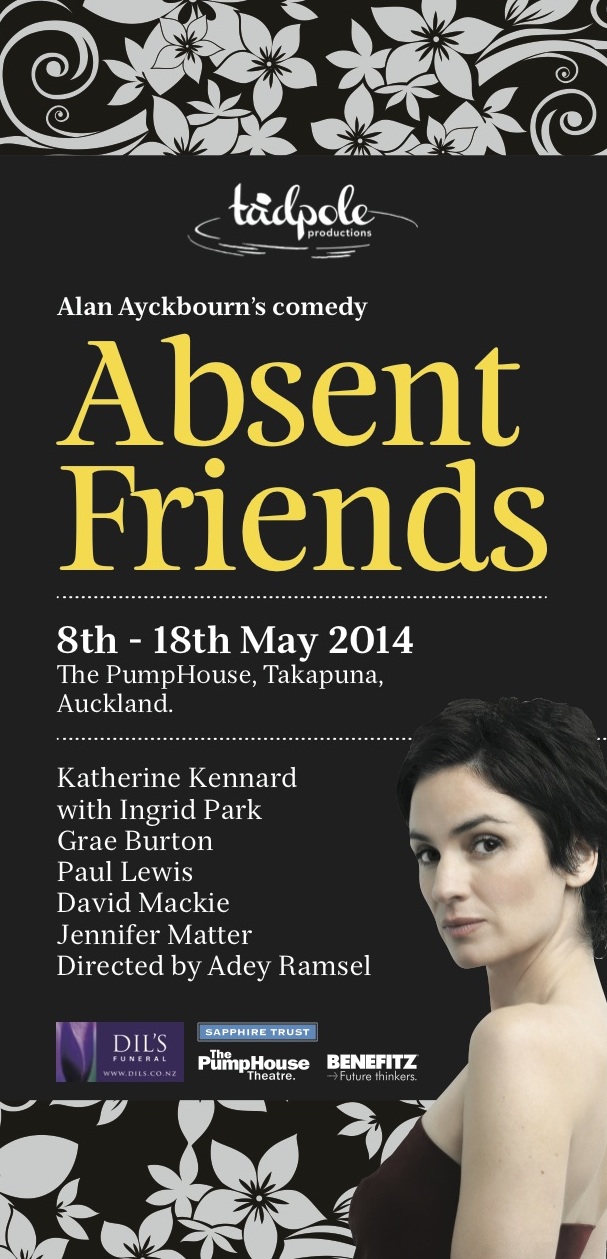
Absent Friends
By Alan Ayckbourn
Produced by Tadpole Productions
Directed by Adey Ramsel
Lighting and Sound by Scott Thomas and Simon Woodard
Set by Nick Greer and John Antony
Wardrobe by Robyn Fleming
At the Pumphouse Theatre, Takapuna, North Shore
From Thursday 08 May to Saturday 17 May, 2014
Reviewed on Saturday 10 May, 2014 at 7.30pm
‘My latest play, Absent Friends, contains the double theme of death and the death of love. It also has a woman having a nervous breakdown. It’s a comedy and people are laughing at it. Not I believe, in a cruel and heartless way, but with the laughter of understanding. Laughter in the theatre can be an amazing bridge. It can persuade people to keep their minds open long after their inherent prejudices have told them to close them.’
(Alan Ayckbourn, New York Times, 20 October 1974)
The best theatre headline I ever read I saw in The Independent in early January 1997 while travelling in a bus from London to Stratford to engage with The Royal Shakespeare Company and to check out what they had on offer. The headline in question read ‘The Luvvies or the Lavvies’ and told the story of Alan (later Sir Alan) Ayckbourn’s attempt to save his iconic Stephen Joseph Theatre in Scarborough, North Yorkshire from the grips of a right wing local council who wished to stop the theatre’s funding and instead build a block of public lavatories. The Stephen Joseph Theatre (then known as The Library Theatre) has been around since 1955 and is undoubtedly best known for staging the world premieres of almost all of Sir Alan’s seventy-five plus plays.
Needless to say the indefatigable Ayckbourn won, and thank goodness for that!.
Twenty four years earlier, in 1974, he opened ‘Absent Friends’ in the aforementioned Library Theatre. I say this because one of the real charms of Tadpole Productions’ staging of the play is its staunch authenticity to the timeframe in which it was written.
Ayckbourn reminds us on his website http://www.alanayckbourn.net/ that ‘”Absent Friends” is his ‘first play to be set in “real” time.’ A tea-party’, Ayckbourn tells us, ‘has been arranged for the recently bereaved Colin by “friends” and acquaintances. However, Colin’s acceptance of his situation and of his fulfilling time with his fiancée only serves to highlight and widen the rifts in the other relationships.’
I’d suggest that this is somewhat of an understatement, rather like saying that the All Blacks are not a bad rugby team or that de Niro is a pretty good actor.
The key observation in Ayckbourn’s description is, of course, that this is his first play written at the time in ‘real time’. Anyone worth their theatre chops knows what followed: an avalanche of ‘real time’ scripts that changed the nature of theatre forever – ‘Bedroom Farce’, ‘Just Between Ourselves’, ‘Sisterly Feelings’, ‘A Chorus of Disapproval’ and, of course ‘The Norman Conquests’ (‘Table Manners’, Living Together’ and ‘Round and Round the Garden’) – and Ayckbourn has even challenged the wickedly shrewd Anton Chekhov for top billing as the most perceptive of all playwrights when it comes to assessing and recording the human condition. We all know of Chekhov’s eccentrics – Natalia Ivanovna (Natasha) in ‘The Three Sisters’, Masha and Nina Zarechnaya in ‘The Seagull’, Charlotta Ivanovna and Yepikhodov in ‘The Cherry Orchard’ to name a mere handful – but we’re not so clued up when it comes to Ayckbourn’s oddballs and we certainly weren’t when he was creating them in the 1970’s. Rather than eccentrics from a distant time these were the people next door and the folks we met at dinner parties, begging the question as to whether the same could be said of Chekhov’s characters during his generation.
In ‘Absent Friends’ we meet six characters who were as real as paisley shirts and flares in the ‘70’s but now seem strangely out of date despite their individual predicaments being as fresh and tart as Judith Collins lip and equally as close to cracking. To get the most from them, best leave them in the ‘70s – and that’s what Tadpole has done.
There are plenty of other parallels, too.
Chekhov called his plays comedies yet they’re often saturated in personal tragedy – Ayckbourn’s are the same – while the narrative for both is invariably carried as much in the subtext as it is in the spoken word.
Plot, as with Chekhov, becomes a relatively minor consideration but the production still has to tell the story and so it does. Rehearsing a Chekhov or an Ayckbourn, as can be imagined, is riddled with challenges regarding pace, character and the metabolic rate at which the whole thing must move, not to mention questions as to what the thing is all about anyway. Too slow and the character becomes turgid, too fast and they can lose any sense of depth. When we laugh at Ayckbourn we laugh at ourselves – and that’s not always the easiest thing to generate, manage or enjoy.
Saturday evening’s almost full house at The Pumphouse had the pleasure of spending an enjoyable evening looking at an exceptional set created by Nick Greer and John Antony. Sure, it was a 70’s kitsch living/dining room on two levels but that’s what Ayckbourn asks for and that’s what, in this instance, he got. It was functional and attractive and when the centre back door got slammed, as it did a few times, the rest of the set didn’t move. I always consider this a plus.
All the ‘70’s features were there – ranch-sliders to the garden, a three-seater couch and matching armchair, a woven-cane snake-charmer basket, innumerable impressionist prints and lampshades, a downstage bar, three woven cane bar stools and a pouf, the whole thing seemingly in a delicate shade of peach.
The wardrobe (Robyn Fleming) adds considerably to the sense of authenticity and the actors do their bit by growing moustaches of the period and ensuring that the hair-dos have a legitimacy that ‘Charlie’s Angels’ and ‘Get Smart’ would definitely have approved of. Add to this sublimely good lighting by Scott Thomas and Simon Woodard who also created a subtle soundtrack that included popular songs from the ‘70’s such as Paper Lace’s ‘Billy, Don’t Be a Hero’ which was released in the year ‘Absent Friends’ opened at the Library Theatre in Scarborough and the Garrick Theatre in the West End. A very nice touch.
As the lights and music fade we’re left for some time watching a bored Evelyn (Jennifer Matter) sitting on a bar stool waiting, waiting, waiting. This is no surprise as she’s been waiting ever since we entered the theatre. Next to her is one of a number of characters we hear about but never meet, in this case Wayne (or Walter, if you like) happily sleeping away in his pram. Evelyn doesn’t say much over the subsequent ninety minutes but she’s an anchor for the play’s veracity – what she says is the blunt truth, like it or not, and mostly her fellow characters don’t like it one little bit. Paul (Grae Burton) especially doesn’t like it and neither does his wife Diana (Ingrid Park) because both know that Paul has been engaged in a bit of backseat dallying with Evelyn and the timer on the bomb is set.

Jennifer Matter
John (Paul Lewis), husband of Evelyn and father of Wayne, is in a business relationship with Paul but doesn’t seem to have a problem with his spouse shagging his business partner in the back of a car. Paul doesn’t seem to know why it happened, says it was a oncer, and Evelyn found the entire episode incredibly dull, distasteful, inept and boring. She is, after all much younger, the archetypal ‘new woman’ and painted from a much fresher and more vivid palette than the other characters.
Unlike Evelyn, Marge (Katherine Kennard) exists to be the good wife her mother must have been through the 1940s and ‘50s. We never meet Gordon, her other half, because he’s at home in bed sick, but he’s often on the phone listing his litany of complaints – he’s spilt his cough mixture in the bed, his water bottle has burst – and we know, we just know, he’ll be bedridden, whining and bitching for the rest of his – and her – life. He’s the dependent child they never had and they’re both going to live that made -up make-believe ‘til death do them part.

Katherine Kennard
Diana (Ingrid Park) has had a gutsful of Paul and she lets us know in no uncertain terms. In an excellent two–hander scene at the opening of the play she grills Evelyn to get to the truth about Paul and the extra-marital and Evelyn doesn’t budge. It’s the beginning of the end for Diana and we are witness to the agony of her emotional collapse for the subsequent 90 minutes until it finally transpires. Ayckbourn himself says ‘She’s reached the end of what she sees as her useful life. A life she has devoted to her husband, her home and her children. Now her children have been (in her own words) taken away from her – i.e. sent to a boarding school. Her husband is having affairs and her home, without the children and husband, is an empty monument to a suddenly empty life.’ How very mid-20th century that depiction is.
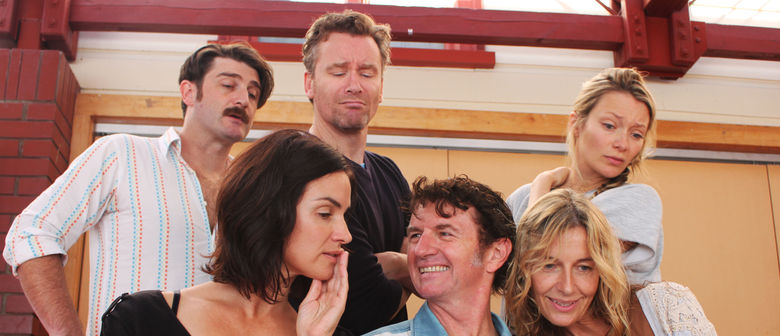
Enter Colin, fresh from the loss by drowning of his fiancée Carol. Carol, as painted by Colin, is the perfect woman, theirs was the perfect relationship and he has plenty of photographs to prove his case. This is the last thing two and a half immensely unhappy couples want to hear because it reflects on their own disastrous couplings. Colin, to clarify, has been invited, as an old ‘friend’ they haven’t seen for years, to afternoon tea and he brings his aura of death and contentment into a room where it is absolutely less than welcome. John, particularly, abhors any talk of death and the others aren’t too hot on ‘contentment’ or any close examination of their own human mortality either. It’s made abundantly clear that Gordon, sick in his soaking wet bed and surrounded by cough syrup stains, doesn’t want a bar of that debate either.
David Mackie
In short, we have an ill-assorted bunch of grown-apart, mostly middle-aged Poms dealing with emotional uncertainty and clinging to each other in the worst possible way. It’s hell-on-earth and Ayckbourn makes the absolute best of this undeniably appalling situation by recognising in it a rich vein of adult human humour. It’s not side-splitting stuff but it is still gut-wrenchingly funny and Saturday night’s audience of largely blue-rinsers didn’t miss a trick.
As Evelyn, Jennifer Matter was splendidly mono-syllabic, one of those middle class English people who call a spade a fricking shovel and make no bones about it. She represents the fresh, new scepticism that grew out of the ‘70’, the ‘make love, not war’ generation where casual sex was suddenly, and effusively, AOK and the old morality went out the window. Evelyn is a tricky role and Matter settles into it nicely.
Husband John (Paul Lewis) can’t be still. Worse, he won’t sit down and only does so when commanded. He doesn’t care that his wife shagged Paul in the backseat of the car and seems oddly disconnected emotionally from everyone. He loathes any mention of death and seems only to want to talk business with Paul, a desire that is never satisfied. Lewis’ performance has all the necessary Ayckbourn elements and, despite an early tendency to over-do the mannerisms, he fitted the complex emotional jigsaw of the play very well indeed.

Paul Lewis
Grae Burton is an extraordinary transformational actor. He makes great choices and has little apparent difficulty shifting from Elizabethan classical hero to ‘70’s porn star clone. Whether it’s a loveable, sexy hero or a loathsome and slimy villain, Burton plays them all with equal integrity. Paul is, in Burton’s hands, at times a masterful performance. His journey from confident, man-about-the-house-with-a-secret to tortured, stripped bare soul is carefully plotted and ultimately very moving. Even the bristly Ron Jeremy moustache of Part One seems to take a massive tumble and by the denouement appears, like Paul himself, to be as limp as a dishrag.
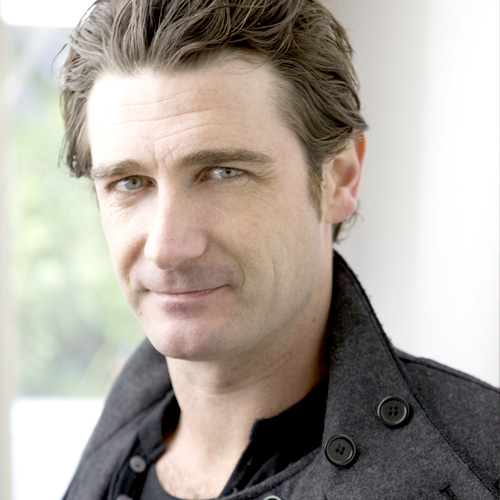
Grae Burton
David Mackie’s Colin is at the heart of the forward movement of all the other characters. His artlessness and self-absorption bursts open and out pops the amateur psychologist happy at any time to provide an unwelcome psychoanalysis which is often unwittingly perceptive. At times the character mannerisms risk swamping the performance but as we get used to them we are able to find the essence of the man Lewis has created and it’s very, very true. This is a play of silences and Lewis manages these extremely well.
Like Burton, Katherine Kennard invariably hits exactly the right pitch. As the omnipresent Gordon’s wife and co-dependant, Kennard paints Marge with multiple tints and great subtlety. Like Diana, she’s the ‘good wife’ but in Marge’s case she ain’t giving up, no way! She’s tight, decorative, a knitter, sees herself as a peacemaker – and there’s always plenty of peace to make. Marge holds the play together just long enough to make the final emotional detonation and subsequent downfall as powerful as it can possibly be. Kennard is excellent and I suspect Ayckbourn would have nodded his approval throughout this fine performance.
At the heart of the play is the emotional collapse and ultimate desolation of Ingrid Park’s Diana. Characters often end plays in profound emotional distress but Diana starts this way. She suspects, but doesn’t know for sure, that husband Paul is playing away from home and her attempt to get a confession from the taciturn Evelyn is so monumentally unsuccessful that it fully loads her emotional chambers and she comes out firing with a gusto that is understandable – and laudable. Park paces her performance beautifully and her emotional collapse is both effective and deeply moving.

Ingrid Park
Each of the characters has a rich emotional journey through the play and an eternally generous Aychbourn gives them all an opportunity to reflect and grow. They’re not a likable bunch but we recognise them as people we know and in them we also see some of the essentials of ourselves. This is Ayckborn’s particular genius, the quality he embeds in all his plays, and this cast, under the judicious direction of Adey Ramsel, has had a really good bash at it.
‘Absent Friends’ was a tricky wee number when it was produced in its own time and has become no less so when viewed after forty years have passed. I’m glad Ramsel and his cast have chosen to attempt an authentic recreation of 1974 and, in this, they’ve been very successful indeed. It allows us, in 2014, to access the emotional rollercoaster second hand, a far more palatable experience than trying to bring the play kicking and screaming into the 21st century and smacking us around the head with countless anachronisms.

Adey Ramsel ~ director
The end of the play may seem odd and Ayckbourn himself acknowledges this. He says, in personal correspondence that ‘The dying fall ending is deliberate. It seemed, when I was writing the piece, the only honest ending. It would have been possible, I suppose, to bring Diana back which would have lifted the thing to a more conventional ‘grand finish’. But I think in performance, the end is sort of inevitable, particularity if the thing is pitched on a very low key as intended.’ Tadpole Productions managed the ‘low key’ ending and it worked a treat.
I’ve used Ayckbourn’ own words frequently in this critique so it’s perhaps appropriate that I end with more of them. In summing up his achievement with ‘Absent Friends’ in a 1999 interview, he said ‘often we go on going through the motions of love, as if we loved someone, because the truth is too painful. It takes a catalyst like Colin to force us to review our lives. On the other hand, life goes on. In the face of everything, we continue to live our lives and even look forward to tomorrow.’
In the face of everything, life goes on – and the real success of this production is its adherence to this belief. It’s reminiscent of the great late 19th century playwrights Chekhov, Ibsen, Strindberg, Wedekind and Shaw, the great realists, who all said through their work ‘in the face of everything, life goes on’.
In the face of everything, life goes on.
Not a bad message, really, not a bad message at all.
 dykiegirl