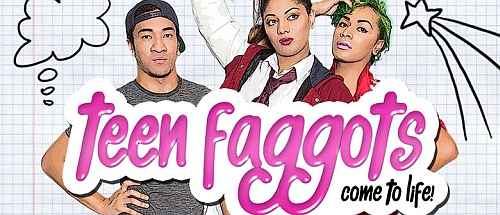
Teen Faggots Come to Life
Produced by PIPA
Created in association with Jay Tewake and the Mika Haka Foundation
Staged in the Basement Studio as part of Auckland PRIDE
13-15 February, 2014 at 7.00pm
A thousand and six years ago (early 1960’s actually) I went to the Civic Theatre in Christchurch to hear a concert by a band call The Surfaris. I was a teen faggot, I just didn’t know it then. It seems others did and I have to say not much has changed when it comes to being identified as different at a state school in Aotearoa New Zealand.
The support act was a band called The Beach Boys who, while unknown then, went on to change the face of music forever while The Surfari’s disappeared without trace. Who hasn’t drivelled out Barbara Ann or Good Vibrations at some forgotten, substance-fuelled revelry, somewhere forgettable in their drunken, fuzzy-blur of a past?
Well, I have, and many more times than just once!
I guess my point is that there are times when the support act becomes the main bill and stays there, and I’d suggest that the NZ Herald, Metro and the other mainstream media who consider themselves noteworthy commentators on the world of the arts have totally missed the boat by choosing not to discover Teen Faggots Come to Life and the multi-talented artists who make up this collective.
Yes, I’ll get to the review eventually but I need to say a few other things first.
I need to say that Mika and the Mika Haka Foundation do more for young Maori and Pasifka kids than anyone else in the country, funded or not, and have been doing so for yonks, more yonks, in fact, than I can readily recall. Anyway, it seems like forever. Big ups to Mika for doing what he does and for being who he is. He’s a true Hero of the Pacific and he deserves to be readily acknowledged as such.
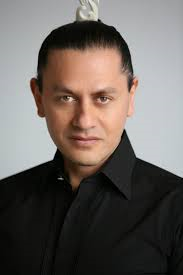
Mika
Next, there’s his right and left hand man, his wingman, often his front man and always my main man, Jay Tewake. Jay is tireless and he makes things happen like nobody else. He has all the style of an LA promoter and all that special, and inimitable, New York grit. He’s kind, respectful and he gets stuff done, more stuff that anyone can possibly imagine. He, too, deserves recognition – and the odd night off. He wouldn’t take it, mind you, he’d just find something else to do that would benefit others. He’s like that – and I love him for it.
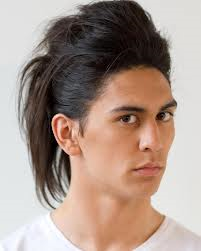
Jay Tewake
Then there’s the Pacific Institute of the Performing Arts. I get to see a lot of their work – well, the finished product anyway – in my role as a reviewer with John Smythe’s www.theatreview.org.nz. It’s always classy, polished and different. They, Mika Haka Foundation and Jay Tewake are changing the face of theatre in Aotearoa New Zealand and giving us an authenticity that is exciting enough to make me want to dance on tables to celebrate it. Note I said ‘want to’. My advanced years have, sadly, turned my ‘will’ into ‘want to’ but you’ll catch my drift.
None of this happens without extraordinary support from all over the shop and most of that support is invisible. Let’s not forget that the people you see on stage and applaud wildly are also part of the demographic that appears at the top of our most shameful statistics as a nation: poverty, prison muster, drug and alcohol issues, early death and suicide. Add to that the fact that these kids are also queer and you have a potential time bomb just waiting to go off. All the more reason to recognise the work being done on the ground by Mika, PIPA and others.
I’ll acknowledge three such supporters as representative of those ‘helpers’ who remain invisible. First there’s ‘Mum’ to the Teen Faggots, Mrs Tanuvasa, who is simply extraordinary. Tireless – as she has to be – she is at all the performances the Teens give and I can imagine her home life is a wonderful, colourful riot and not always in a good way. I can barely conceive of the number of times this outstanding woman must have picked her ‘kids’ up and dusted them off so that they can continue their exemplary work or merely survive. ‘Survive’ is one word that repeats way too often in this work. Mrs Tanuvasa is a taonga a thousand times over. The group also acknowledge the support of Maxine Kalolo and Joanna Tuala. Big ups to them too.
We ‘transpeople’ have been around forever and, often, we’re our own worst enemy. Times have changed and so has the rhetoric so those of us who are older and who should be taking a nurturing and supportive role are, all too often, seen to be fighting about who’s authentic, who’s a ‘true transsexual’ and who lives in the ‘real’ world. One such person, who should know a lot better, suggested overnight that you can’t be a ‘real’ transsexual woman and be sexually attracted to women and that the only real transsexuals are those who come out, as she did, in their mid-teens. I’d suggest to her that she should ‘zip it’ and let us all get on with being who we are and not who someone else tells us we should be.
My whanau and I saw Teen Faggots Come to Life on the final night of a three night, sold out season in the Basement upstairs studio theatre. There’s been a buzz about this show since day one of the festival and I had the privilege of having that young star Jaycee Tanuvasa perform a snippet in the Auckland Pride Gala Le Jeu de Mechant which I directed. The Faggots had already been part of Mika’s 3rd Aroha Mardi Gras the previous evening and, as it turned out, were members of a fabulous dance group Fine (fee-nay) Fatale who also performed in the Gala. I loved them in rehearsal as much for their professionalism – they arrived on time, prepared superbly, and nailed their performances – as for anything else and had anticipated their show from that moment on.
I was not disappointed on any level.
Because I’m smart – not so smart as to not start a sentence with ‘because’ (one of the few things I learned at my faggot-loathing school) – I’d figured out that there was a transgender component to this show, that the much hated and newly owned word ‘faggot’ applied to all textures of the LGBTI spectrum and not just the gay dudes (I liked that because I love words) and I couldn’t wait to how this played out because I am myself the cut sleeve’, the half-eaten peach of ancient Chinese tradition. I am also sister to those who identify as mahu in Hawai’i, fa’afafine in Samoa, Tonga’s fakaleiti, Fiji’s vaka sa Iewa Iewa, and can relate so very intimately with our own terms whakawahine, whakaaehinekiri tangata ira wahine, hinehi, hineua, and tangata ira tane. While I make no personal claim to these linguistic and deeply cultural terms and can only really claim to be transgendered or transsexual – such dull, sexualized, Eurocentric rationalizations – I embrace my sisters and brothers of the world with real affection and admiration.
We all climbed the steep stairs to the studio and, I was assured, cooling electric fans. The Basement foyer, filled with audience for two full houses, had been a hot house of bodies and mine had begun to melt – if you catch my drift – so, when the promised fans eventuated I became one very happy camper.
It’s always both a joy and a confusion being one of a small number of palangi at what can seem to be essentially a Pasifika event. I like the feeling very much. It reminds me that I embody white middle class privilege in most settings and it’s good to experience being a minority within a minority from time to time. The feeling fades as it always does with the generous and immediate acceptance by Pacific peoples of people like us.
There’s a cunningly placed soundscape pre-show and then the lights come up on narrative number one, that of the beautiful Raukawa Tuhura. It’s called Takataapui and it turns out to be quite different from those stories that follow. It’s the transition chronicle of a young Maori woman born biologically male. It tracks her story from birth to today through the eyes, mind and feelings of a complex young woman from Gisborne. Her birth narrative had me in tears, the challenges faced by her family – personally and culturally – were deeply affecting and the marriage of dance and Tuhura’s exceptional use of many voices gave us an immediate access to her that was monumentally courageous. Truth is, I’m quite accustomed to the coming out stories of transgendered people, but this one was different. It let me in but kept me at bay as well. Raukawa’s passionate ownership of her story was extraordinary – she shared it freely and willingly but there was never a moment where I felt she was entirely letting it go. I’ve seldom experienced anything quite like this in the theatre before and I loved it to bits. I’m used – as actor and audience – to seeing stories put into the ether and left there but Raukawa did something new and different with hers and I felt a new form of communication was surfacing on the four winds. On a purely practical level this woman can really act, really sing, really dance – and I’m as envious as hell of her intelligence, her actor equipment, her talent and her spunk. Watch this space!
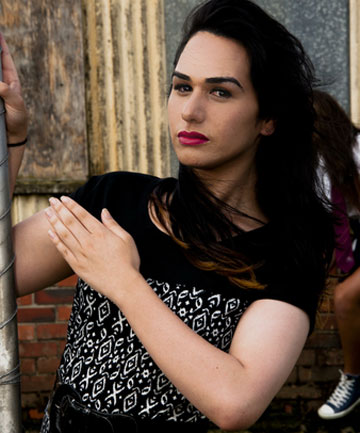
Raukawa Tuhura
Jaycee Tanuvasa performed her piece A Different Kind of Love which is about her first love, about him being her prince, she his princess, two dragons and a woman of great power who stood between them. I’ve said elsewhere that I think Tanuvasa is a star and most people who have seen her agree she’s got talent to burn. She’s immensely funny, immediate and can make you laugh or cry in an instant but she’s more than that. The depth of her writing is exceptional and is somewhat hidden by her unique performance abilities – she’s so absorbed in her material that it seems, sometimes, as though she’s just making it up (she’s not) – and the work is incredibly complete. She’s super confident it seems, and the sort of woman any young man would wish to be with – and her young man does – but the world around them, the dragons and the ‘woman of great power’, intervene with a brutality you can taste, and they screw it all up.
And why?
Tanuvasa tell us in the programme, and with every fibre of her performance being, ‘that’s right, because I’M A FAGGOT!’ It’s hard stuff to take – we want to give her a hug and make it right – but she’s on top of our getting too maudlin and she smacks us around with some of the best comic delivery I’ve experienced in a month of Sundays. Clever stuff, and I reiterate confidently, Jaycee Tanuvasa is a star?
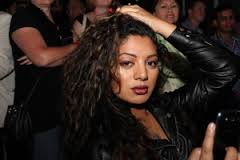
Jaycee Tanuvasa
School Ball 2014, and Michael’s World takes is immediately into the realm of hopes and dreams. Isaac Ah-Kiong is an immensely likeable performer who is in love with the school superstar jock. He invites him to the school ball and the superstar accepts. How good is that? Michael certainly thinks it’s the best thing since eggs for breakfast (I like eggs for breakfast – please replace my metaphor with one of your own choice). His absolute joy turns to abject horror when the car they are in passes the venue for the ball and Michael finds himself set-up for a beating which we get to experience first-hand. It’s the most immediate and undeniable expression of a violence that lurks beneath the surface of all the narratives and, in this case, we simply can’t laugh it off. Ah-Kiong is an excellent young performer who takes on that part of the queer journey that we don’t wish to go on, mostly because we’ve all had our beatings and all too often at the hands of those whose job or place it is to care for us, in my case NZ Police (just thought I’d drop that in).
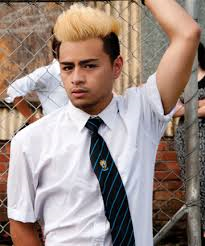
Isaac Ah-Kiong
S/He is the work of Amanaki Prescott-Faletau and it’s quite, quite different both in content and performance style. Sure, there are themes that gather themselves together throughout the evening, but each piece is unique and stand alone and this is just one of the many, many qualities of this production. Prescott-Faletau is another in this stable of fine performers. The premise for this piece is summed up in ‘when love becomes a feeling and not a rule it can be beautiful’. It’s another exposition of love requited somewhat but challenged more and with tragic outcomes. Prescott-Faletau creates a range of characters in what is a wonderfully transformative performance and we not only get to know them all but we get to see them change as well. Again, clever writing and brilliant performing with genius comedic playing not quite covering the grief that follows consummation. It’s subtle work that rides the seesaw of in-your-face confrontation and introspective pain with the greatest delicacy.
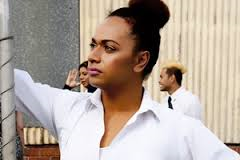
Amanaki Prescott-Faletau
By now I had begun to realize that, from a purely theatrical perspective, I was watching something as new as tomorrow, a truly Pacific voice emerging fully formed in the shape of this group of teen faggots who live in their journeys so totally but who also manage to step outside and open doors to allow us full access to their narrative. It’s totally gutsy work but I’m somehow not surprised. You still need to have incredible courage to be gay or transgendered in 2014 Aotearoa. While seeming to be able to laugh at almost everything, I’m also left with the clear impression that they’re having a damn good laugh, through the blood and tears, at society too and that society better make the right decisions on their behalf or the vice-grip they have on society’s genitals may well become quite simply unbearable.
The final offering is called Coming Home and that’s exactly what it’s about. Darren Taniue has created for himself a comedic piece that is the most complex and challenging of the night. He’s written a rich vein of actor-friendly humour based in actor craft and characterization and it’s to his immense credit that he pulls it off. It requires instant changes of focus and attitude and, by the end of Coming Home we love him to bits. He’s chosen to get into an abusive relationship with some low-life called Daniel who keeps him in the family’s home where he is nothing more than a domestic slave. We ache for him to leave because we all know relationships like this and when he does, we breathe a quiet sigh of relief. Well, some of us do. Others shout their support and cheer with gusto Darren’s decision to get out and go home to his Mum. Tanuie is another top line actor who has the benefit of being a fine dancer as well. The physicality of Coming Home is one of its finest features.
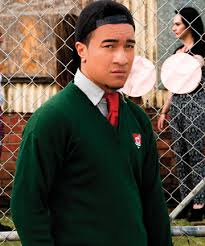
Darren Taniue
There are overall themes – conscious or otherwise – of underlying violence, beatings, emotional anguish, familial and educational homophobia and hate. There is also an overarching emphasis on courage and survival that, while laudable and essential, is ultimately sad because no human being should have to accept such horrendous behavior from their fellow human beings.
As the last curtain call is taken and I wipe the happy/sad tears from my eyes and get over just how talented and skillful these teenage faggots are, I remind myself that these are the ones who have, through humour, audacity and sheer pluck (such a wonderfully Eurocentric word ‘pluck’), have got through to where the future looks OK. What about the ones who haven’t? What happens to them? While not stated as a theme I doubt I was the only person thinking this as we trooped down the stairs and back to the ‘real’ world.
We have to remember that the beatings, the homophobia, the negativity, the confusion, the closet and the bash is the real world for these kids and they can’t walk away from it. It’s like being transgendered, or lesbian, or gay – it’s what we are and there is no holiday, no lieu time, and no place to hide.
We are what we are.
Teen Faggots Come to Life is far and away the best theatre I’ve seen ever, the performers unequalled in courage and talent. I want to take them all home and look after them but I can’t because Mrs Tanuvasa wouldn’t like that – and they don’t need it anyway.
Nurture these faggots because they’re our future!
 dykiegirl
Went to the show on Friday and my wife and I really loved the whole thing. Extremely proud of our baby Raukawa and the others.