
Passionate Acts.
Produced by Shakeitup.
Created by the company.
At Pah Homestead TSB Wallace Arts Centre, Auckland.
12 – 22 February, 2012 at 7pm.
Published at http://www.theatreview.org.nz

I’m old enough, let’s face it, to have asked myself on more one occasion ‘what the hell do we do this theatre thing for?’
The answer is always the same: because there’s invariably a gem somewhere in the offing – though the offing, love it though we do, sometimes seems tragically devoid of occurrences to treasure.
‘Passionate Acts’ is not like the others.
‘Passionate Acts’ is a doozy!.
Let me say it again because I can and I want to: ‘Passionate Acts’ is an absolute peach!
The concept isn’t new, but, as Hamlet says ‘what of that?’ It’s a few short scenes from Shakespeare’s greatest plays performed by some damnably good actors in a beautiful outdoor setting.
‘Yes’, I hear you sigh, ‘I saw something like that in the gardens in Otorohanga in 1978’.
‘But no,’ I reply with enthusiasm, ‘it’s likely you haven’t seen anything like this, ever.’
‘How so?’ you say. ‘What’s so special?’
‘Joy’ I reply. ‘It’s full of joy!’
Pah Homestead is a sublime venue for almost anything and perfect for this. On preview night it was at its Edwardian best, all glittery, starched and crisp, like the welcoming committee, the complimentary glass of bubbles and the wee snacks that seemingly appeared from nowhere. Everything pre-show was tickety-boo and everything after it was, too.
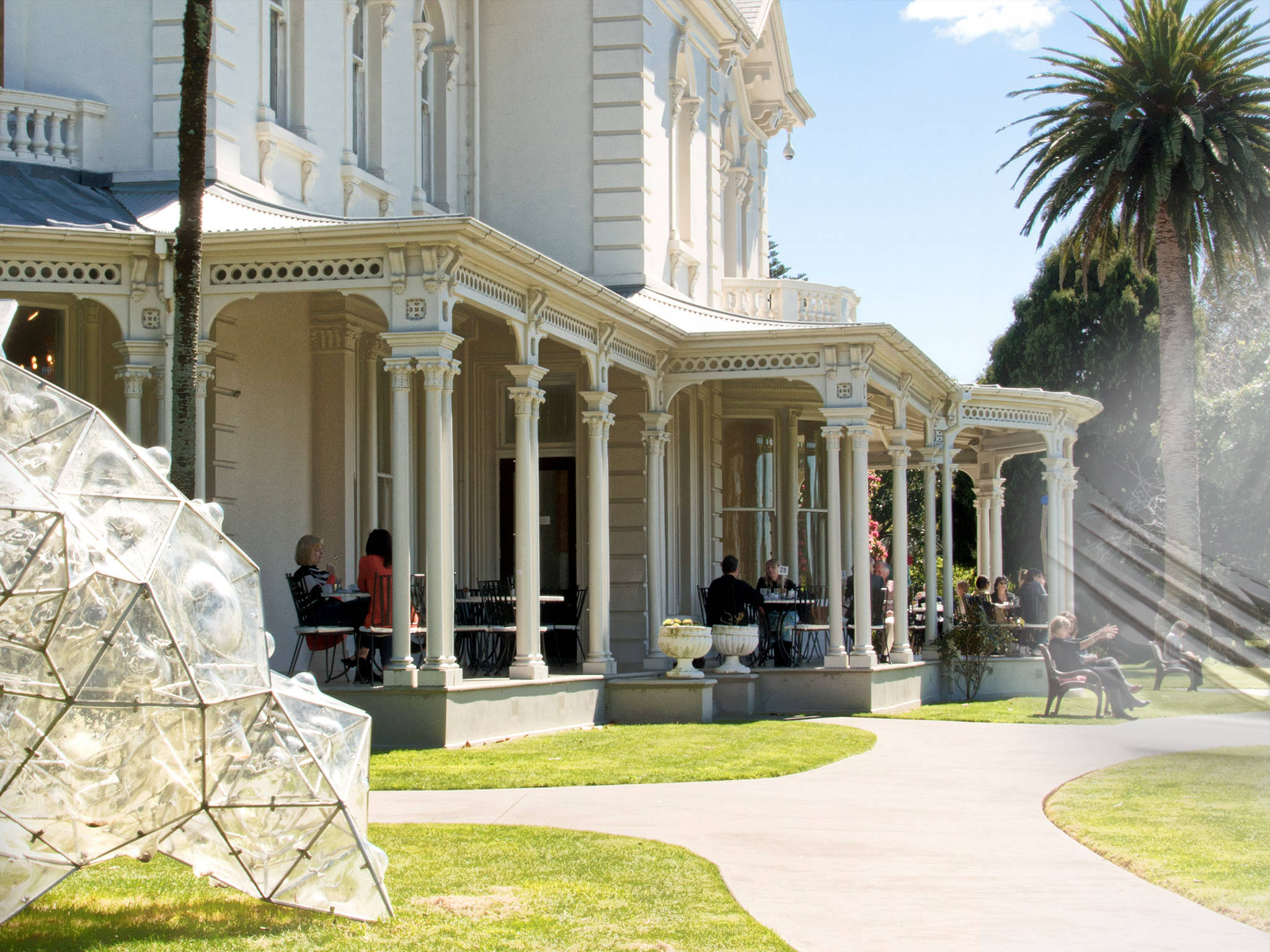
Pah Homestead, home of the Wallace Arts Trust.
Armed with vino, programme and a delicioso picnic hamper that was available for purchase we made our way through a gallery hung with Ian Scott paintings reminding us subtly that this is the home of the Wallace Arts Trust and that Sir James Wallace is that most rare of divine creatures, a patron of the arts and our greatest living arts philanthropist. His Trust financially supports many other arts organizations in New Zealand with Sir James being patron, trustee or board member of some 20 similar institutions.
Good work, Sir James! A tinkling round of applause for the great man, if you please.

Sir James Wallace, knight of the realm and all round bloody good bloke.
Seated at a round table on the verandah we looked out over farmland to One Tree Hill in the distance and – ‘still no tree’ my son observed sadly. There are plenty of others though and in the foreground of all this natural beauty lay a trimmed lawn, a rectangular raised platform skirted by a number of wonderful sculptures, some which challenged the intellect and some simply fitting in, being themselves and minding their own tastefully arty business.
Don’t be misled, I liked them all, very much indeed.
While my spouse and I savoured our champers, our son wandered around the grounds, climbed the gate into the adjacent field and checked out the statuary. ‘Cool’ was his assessment on his return, ‘way cool’. He was, he said, looking forward to the show because ‘it’s Shakespeare so it must be good’.
Good it was – again and again.
I am reliably informed that Browning and Burton were ‘the starters’ for the project, but that Burton and Wallace had, prior to that, spent two years planning and developing the idea. The admirable direction of the carefully contemplated scenes had been mainly shared between Browning, Donogh Rees and Burton who ‘focused on the sections they weren’t in’ but that the whole thing was ‘more group devised than directed.’

Grae Burton
However the whole was created, the scenes had a lightness of touch and a delicacy that was both charming and effective. Deft direction is a joy to watch as it frees the actor from all manner of restrictions and the resulting nimbleness was a fine feature of this work.
The scenes were cleverly interlinked without any heavy-handedness and all were accessible to even the least suave of audience members.
The evening began with Act II Scene 2 of Romeo and Juliet with Moana McArtney as Juliet, Jason Hodzelmans as Romeo and with a pair of precise and audible feet tapping nattily around in the house behind the audience and creating the ever-present presence of the nurse. There was no attempt made to present faux fourteen year olds (thank goodness) but the scene had a delicious innocence about it that engaged us immediately. It’s the ‘Romeo, Romeo wherefore art … ‘ scene for those of you who can’t be bothered looking it up so it’s pretty well known but this appositely matched couple still managed to find new line-readings and subtleties that I hadn’t seen – or heard – before.

Moana McArtney
Kate (the delectable Katherine Kennard) and her Petruchio (an endlessly clowning Grae Burton) carried on the eternal debate between tamed and tamer and left us none the wiser as to who was the victor and who the spoils. My son, the eleven year old ‘man of the house’ and Shakespeare aficionado, voted for Mr Burton as the winner while his two mothers took a somewhat different view, the issue to be resolved over homework somewhat later!
Some things are worth revisiting for any number of reasons and this wee stanza was exquisite – sexy as anything and as filled with innuendo as anyone could possible wish –
Petruchio: Come, come, you wasp; i’ faith, you are too angry.
Katherine: If I be waspish, best beware my sting.
Petruchio: My remedy is then, to pluck it out.
Katherine: Ay, if the fool could find where it lies.
Petruchio: Who knows not where a wasp does wear his sting? In his tail.
Katherine: In his tongue.
Petruchio: Whose tongue?
Katherine: Yours, if you talk of tails: and so farewell.
Petruchio: What, with my tongue in your tail? Nay, come again, Good Kate; I am a gentleman.
Milked it, they did, and we loved every dripping nuance.

Katherine Kennard
From there to Anthony and Cleopatra, Act 1 Scene 1, and we meet Anthony (a grizzle-bearded but still athletic Alistair Browning) and Cleopatra (the handsome Donagh Rees ‘o’er-picturing Venus’) and these great lovers add an appetizing gravitas to the R&J of a few minutes earlier. Here’s a couple who’ve been there done that in the lusting stakes but who still have more than a few good shots to fire – and do so for our benefit. I’m moved to say how fantastic it is to hear actors who not only understand what they’re saying but who can say it and be absolutely understood well beyond the words. It’s no mean feat bit this sextet moved me to the soul in every slice they served to me. I’ve had the pleasure of experiencing Browning’s Anthony from close quarters for a full season and, as in this performance, I never tired of it.

Alistair Browning
On then to a personal favourite, Act 1 Scene 2 of Richard III, and never has Richard Crookback (Grae Burton), that vile spider of Gloucester, been better portrayed by an actor who, a nanosecond before, had been amusing us with the drolleries of his Petruchio. Armed with a leg brace and all that implies and as seeming and as black as sin, Burton sets about seducing Anne whose husband’s corpse, dispatched by the toad himself, lies between them. It’s fine stuff and Anne (Katherine Kennard) gives as good as she gets but Shakespeare defeats her and won’t let her sink the dagger deep into this hedgehog’s breast as she clearly would wish to. It’s Kennard’s only defeat on a night where she shone in every scene she played and in every suit she wore.
Two scenes from the Scottish play come next, Act I Scene 3 juxtaposed against Act I Scene 7. We have two Macbeth’s, one in each, and two Lady Macbeths. Browning and Hodzelmans are the Thanes and Rees and McArtney the beastesses. In my view these scenes are the least successful of the night but they still manage to delight with exciting interpretations and McArtney showed a side of her character that I wouldn’t wish to confront in Albert Park on a squally night any time soon!

Jason Hodzelmans
Then it’s to the true, pre-interval, highlight of the night – or one of them, it’s very hard to choose. Act IV Scene 2 of A Midsummer Night’s Dream is a wondrous riot of magical silliness underlying which lurks extraordinary talent, exceptional interpretation and unbelievably good ensemble playing. It’s knicker-wettingly funny and plays like, well, like a dream. Insults are hurled – my personal favourite ‘You juggler! You canker blossom! You thief of Love!’ – and hurled right back – ‘Fie, fie! You counterfeit, you puppet, you!’ – and all directed by a magnificent masked Oberon (Browning) and Rees as the rascally Puck, Robin Goodfellow. It was such a treat to watch actors with so complete a grasp on the text that could simply play with it as though improvising Shakespeare’s prose. The first half ended even better than it had begun, again no mean feat.
Interval was … well, interval at the end of which the audience was invited inside the house to experience Juliet’s dismantling by her unreasoningly irate father. Moana McArtney is a passionate and modern Juliet and when confronted by Browning’s fiercely tribal patriarch the sparks really fly. Browning is especially magnificent as Capulet and gives full reign to his not inconsiderable vocal and emotional power. All-in-all this ‘fly on the wall’ peak at a particularly nasty example of Veronese domestic violence left the audience silent and in definite need of a top up to their interval drinks.

All ‘set’ for Juliet’s expose and Capulet’s rage.
By the time we all filed back to the verandah auditorium a vision in yellow hose, cross-gartered, had arrived. Malvolio (Grae Burton) is a treacherously difficult role for even the best of actors yet Burton ripped into the character with an ease that drew wild guffaws from the first nuanced word. Equally Malvolio’s match as Olivia, Donogh Rees played abject confusion and wretched distaste to the nth degree until we howled with laughter.
As You Like It is simply my favourite Shakespeare comedy. There’s something about the boy playing a girl (Rosalind) playing a boy (Ganymede) that is infinitely entertaining and it’s usually scenes between Orlando and his Rosalind that pepper assemblages of this nature but not so in Passionate Acts. Here an ill-assorted pair, the irascible Phoebe (Donagh Rees) and the dumb but pleasant Silvius (Alistair Browning) banter their love until the arrival of ‘a proper man’ in the form of Rosalind/Ganymede (Moana McArtney). All hell breaks loose with Rosalind’s attempt to burst Phoebe’s bubble. She tells Phoebe ‘You have no beauty. ‘Tis not your inky brows, your black silk hair, your bugle eyeballs, nor your cheek of cream, that can entame my spirits to your worship’ then caps it all by referring to Silvius and saying ‘For I must tell you friendly in your ear, sell when you can: you are not for all markets’. I was moved to remind myself – as though I needed reminding – that sweet Mr Shakespeare was a supremely clever man who knew that the best of actors can always wring something fresh and new from a great text and these thespians did exactly that.

Donogh Rees
With the end nigh Shakeitup prove that they’re not ones to shy away from the big denouement and delved straight into that nastiest of games, emotional blackmail. Born to play Beatrice – and any other role you can name – Katherine Kennard takes us down the path of ‘you dare easier be friends with me than fight with mine enemy. O God, that I were a man! I would eat his heart in the marketplace.’ Grae Burton’s excellent Benedick isn’t easily drawn but Kennard finally convinces him to show his love by causing Claudio to render him ‘a dear account’ and when he leaves the stage we are in no doubt that she has worked her woman’s magic and that he will ‘to it, straight!’
One hour forty minutes and we’re at the delicately balanced final act, a twinning in death of Romeo and Juliet and Anthony and Cleopatra. By now local children and a few more distant parents are observing the proceedings from the downside of the homestead gate. It’s charming and rustic and started, appropriately, when Phoebe began berating Browning’s silly shepherd Silvius, but these souls now evaporate like the dew in the morning as four of history’s most famous deaths are re-enacted. Each is incredibly moving with Anthony’s ‘I am dying, Egypt, dying’ smacking me right in the mortality.
As this sextet of stars take their exceptionally well-earned calls I am able, albeit momentarily, to reflect on Shakespeare’s instructions whispered to every actor worth their salt for over four hundred years and ignored at their peril:
Suit the action to the word, the word to the action, with this special observance, that you o’erstep not the modesty of nature: for anything so o’erdone is from the purpose of playing, whose end, both at the first and now, was and is, to hold as ’twere the mirror up to nature: to show virtue her feature, scorn her own image, and the very age and body of the time his form and pressure.
Well done, actors.
You held the mirror up for us and we loved what we saw because, like you, we are the age and body of our time. Thanks for the delicate – and kindly – reminder that life can be filled with joy when we take the time to look for it.
 dykiegirl