Sky Dancer
Produced by Stephen Blackburn for Capital E National Theatre for Children
Music: NZ Symphony Orchestra (Conductor: Grant Cooper)
Director: Sara Brodie
Composer: Gareth Farr
Inspired by the novel Sky Dancer by Witi Ihimaera
Set and Costumes: Penny Fitt
Projections: Johann Nortje
Auckland Town Hall
09 November, 2013 at 1pm
Published at: http://www.theatreview.org.nz

Witi Ihimaera
Whāia te iti kahurangi ki te tūohu koe me he maunga teitei.
So it is said, so it becomes.
With his 2004 novel Sky Dancer, iconic New Zealand author Witi Ihimaera aimed for the stars and tried something new and exciting. Reviews at the time were mixed but all agreed on one thing – the work was epic in proportion. Some critics said it was just too epic, some that the connection between the naturalistic world of the main character Skylark and the universal theme was too unforgiving, some just didn’t like it and some did.
Capital E National Theatre for Children has taken Ihimaera’s work and commissioned a largely expressionistic piece that, according the programme, ‘might replace Peter and the Wolf in the repertoire for New Zealand orchestras to introduce young audiences to the magic that is orchestral music’. It’s an interesting goal and I’d suggest what they’ve actually created – in wonderful collaboration with the NZSO and the ever-astonishing Gareth Farr – is an alternative rather than a replacement. Kids will be introduced to the orchestra and its machinations, certainly, but it will always be ‘the story comes first’ and in this Peter and the Wolf and Sky Dancer are, mercifully, poles apart. There’s definitely a place for both and Sky Dancer is a magnificent addition to the orchestral repertoire. No surprises there as, after all, the work is by the passionate, talented, whimsical and fanatical Gareth Farr, and I am, and have always been, an unashamed fan of everything he does.
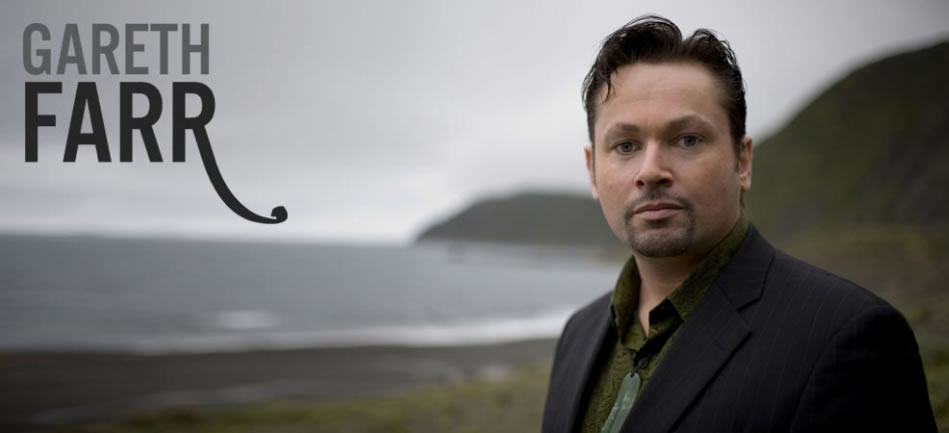
Gareth Farr
This production sees the NZSO at its spectacular best under the baton of Grant Cooper whose other job is as Artistic Director of the West Virginia Symphony in the United States. Cooper is great, the orchestra respond to him with subtlety and a delightful joie de vivre and it’s exciting that he’s back in Aotearoa New Zealand even if it’s just for quite a short time.

Grant Cooper
The interface between the actors of Capital E and the artists of the orchestra is nicely managed and warmly collaborative but, because of the nature of the staging and the venue, there is a sense that the spoken, chanted, acted and sung elements of the narrative are secondary to the music though this is clearly not the intention. I’m sure that in other venues this won’t be the case.
There is no set, per se, for this performance, simply a large, sail-like screen high at the back of the stage on which are projected many rich and varied images (Johann Nortje). There are seven raised platforms, each higher than the one before, and a set off stairs that rises from stage level to the highest possible spot and which separates the stage – and therefore the orchestra – into two equal sections. This is where the orchestra is seated and the performance begins with all the usual conventions of an orchestral concert. Conductor Cooper enters to sustained applause from an audience most of whom are under twelve years old and for whom this may well be their first such experience. The Town Hall is mostly full and there is a delicious air of expectation.
The theatre goes to black and the lights ease up like a summer sunrise accompanied by the fabulous textures of Gareth Farr’s exhilarating score. The stage is washed suddenly with blue light dotted throughout with paisley patterned gobs of white and we’re underway.
The kuia storyteller (an enigmatic Tanea Heke) appears at the top of the stairs and the central character Skylark (Chelsea Bognuda) appears at the bottom. The opening vocal soundscape is part spoken, part sung and Cooper’s subtle conducting leads the orchestra, the actors and the audience into the story. We’re in Aotearoa New Zealand of that there is no doubt as every aural and visual coding, whether overt or subliminal, screams this at us and hair stands to attention on the backs of necks.

Chelsea Bognuda (Skylark)
The Sky Dancer narrative is loosely based on Witi Ihimaera’s rhapsodic novel, a work that lends itself perfectly to adaption in exactly the manner necessary to interact with Farr’s glorious score. Heke represents all the old ways and Bognuda the contemporary and the two meld seamlessly into a whole. There’s a wee hint of Bruce Mason in the house and that’s no bad thing, no bad thing at all.
There can be no doubt that, for those who have taken the time to read and digest Ihimarea’s evocative novel, the account created by Capital E National Theatre for Children will make perfect literal sense. For those who have not – and I suspect many of the children in the audience and possibly some of their teachers will have yet to experience this pleasure – the somewhat surreal, interpretive journey, connected as it is by fantastical, haunting images will make a different, but equally satisfying, sort of sense and, of course, there is always Farr’s astounding music.
Not that making sense of the work is important, merely that reading the book and experiencing the production are – and perhaps should be – two quite different things.
The text is lyrical, suggestive, passionate and, at times, downright angry but always splendidly performed with Bognuda as Skylark being the absolute standout. She manages to present a modern girl with all the ruses that connect with her young audience while at the same time being a larger than life wahine toa, a warrior princess in red sneakers and a plaid shirt.
Heke, who initiates and drives the narrative, is a powerful and resilient environmental presence being at one moment Papatuanuku and at another owning the air. Heke, always the most empathic of actors, is absolutely perfect in this role.

Tanea Heke
All the performers use the restricted space well with musical manuscripts turned into flights of birds as actors engage with musicians and inspire their involvement to ensure that the production integrates all its component parts wonderfully. Performers – actors, puppeteers and musicians – move invisibly around the performance area in ways that guarantee the focus of the young audience is never distracted.
The on-screen images range from naturalistic feathers dropping to the ground that are ritually replaced by musical notes through to much more expressionistic shapes, suggestive patterns and expressive colours and each articulates an additional dimension of the music, the text and the performance and all work in splendid harmony.
Farr’s music ranges across the aural milieu from powerful atmospheric thunderings to the most beautifully nuanced bird song as though they had been composed by some god of the environment with powers yet to be harnessed by humankind. By this I mean it was very, very good indeed. Even his silences are textured.
Ihimaera’s cultural vision is powerful enough to enable him to credibly tear holes in the universe through which flocks of birds appear and disappear and these images are successfully reproduced in Sky Dancer by quite remarkable puppets of all types orchestrated by Chris Covich who constructed them and the splendid (but unnamed) puppeteers which included, from time to time, orchestral players.
The advent of mankind is manifest by two warriors, one armed with a taiaha and another with a musket (Manuel Solomon and Joe Dekkers-Reihana) and their coming is heralded – and accompanied – by Farr at his ominous and percussive best.
There are magnificent images worthy of mention: a broken violin handled by Bognuda with a delicacy befitting a new-born, a fantastical fantail that appears from nowhere and is ultimately dismantled, a heron-like bird engulfed fatally in shreds of yellow plastic, and all of these, and many more, explode in the brain giving birth to their own progeny.
The climax builds to a glorious chant performed by Heke and Bognuda during which the latter collects the windblown manuscripts and gently returns them to the players. During this coda Farr is at his very, very best with a haunting fragment for cellos and viola that hangs in the air like the spirits of gulls. Bells toll, Skylark collects the broken violin which has replaced the dead heron and this incredibly powerful taonga is exchanged and passed on.
Heke adorns Skylark with her korowai and it is clear that success has been achieved, duty done and that the human issues of Ihimaera’s Sky Dancer have been resolved. They don’t concern us in this production and well they might not as this work is for kids and it’s not necessary to tell all. What is told, however, is splendidly executed and Bognuda ends the work where Heke began it, the puppet birds live, mankind is beautifully lit (Jason Morphett) in two solo spots and the whole production comes to a splendid end 56 minutes after it began which is perfect timing for a young person’s concentration span. The young audience was attentive throughout and, by my estimation, excited by what they saw and engaged in a piece they intuitively knew had been created especially for them.
The nagging question, with a work largely expressionistic in nature and played outside the conventions of a standard production for children, must be did they understand what they experienced. The eleven year old young man who accompanied me to Sky Dancer certainly did and has talked about it consistently – and insistently – for the last 24 hours and affirms my belief that, when presenting performance art to children, we should never underestimate their capacity for intellectual and intuitive engagement.
Sky Dancer, in conventional terms, has a flimsy naturalistic narrative but, inside that, there is a transcendent, earthy logic that kids simply get. I guess it’s in their cultural DNA and Capital E has understood this well and capitalised on it to everyone’s benefit.
One minor niggle: the show might have been for children and there may have been a need to get them all back to their respective schools but the haste with which bussing announcements were made after the performance and before the orchestra had even left the stage failed to allow the youngsters even a moment of quiet reflection after what had been, in many ways a genuinely moving experience.

Sara Brodie
 dykiegirl