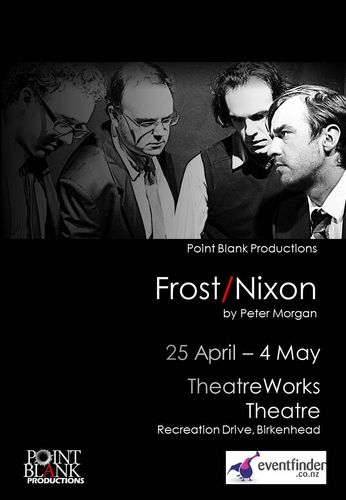
Frost/Nixon
By Peter Morgan
Produced by Point Blank Productions
Directed by Claire Buckley
Designed by Karl Buckley
Staged at TheatreWorks Theatre
Thursday 25 April, 2013 to Saturday 04 May, 2013 at 8pm
Sunday 28 April, 2013 at 2pm (no 8pm show)
Reviewed on 25 April, 2013
Published at http://www.theatreview.org.nz
A month ago, with television a blur and headaches increasingly the norm, I realized that perhaps I needed to own up and accept that my vision was deteriorating. A visit to the optometrist and $700.00 later I found that my instinct had been correct. I can see clearly now and can see all obstacles in my way just as the song predicted, something which may well be a mercy to my future fellow road users.
I was eight when Richard Milhous Nixon became the 36th Vice President of the United States of America slipping in on the Eisenhower, post-war euphoria, Norman Rockwell, apple-pie ticket.
I was twenty five in 1968 when Nixon was elected 37th President of the United States of America and things had changed. Kennedy was dead at the hands of an assassin (or assassins), the US was in the throes of an increasingly unpopular war in Vietnam and the cold war had frozen most of the planet. Nixon did much to desegregate southern schools, oversaw the devolution of power from Washington to the states and was re-elected in a landslide in 1972. His second term saw him establish détente with China and he took the credit for ending American involvement in the Vietnam conflict through the signing of the Paris Peace Accords but not all in the Nixon flowerbed was rosy. Nixon’s Vice President, Spiro Agnew, was forced to resign while facing criminal charges of extortion, tax fraud, bribery and conspiracy, charges he denied to the end accusing Nixon and Nixon’s Chief of Staff Alexander Haig of creating the issues to draw attention away from Nixon’s alleged participation in the growing Watergate scandal. (Agnew, 1980)
Facing impeachment over his knowledge of, and involvement in, Watergate Nixon resigned the office of the presidency on 09 August, 1974, the first president before or since to do so.
I was twenty nine, my spouse would not be born until October of that year and our son not for a further twenty nine years.
Sometimes there is a synergy in the spanning of history as both accompanied me to this fine performance and each, of course, had a unique and different understanding of the significance of this extraordinary event.
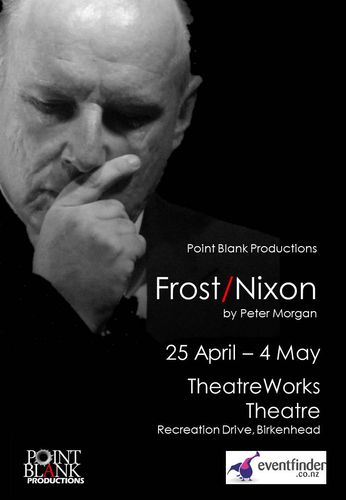
Karl Buckley as Richard M Nixon
Sir David Frost, an Englishman with multiple media personalities, was thirty five and at the height of an illustrious television career when Nixon resigned the presidency. In Aotearoa New Zealand we knew Frost well as the central character in the satiric television classics That Was the Week That Was which introduced us to the extraordinary talents of Peter Cook and Dudley Moore and The Frost Report where many of us met John Cleese, Ronnie Barker and Ronnie Corbett for the first time. We didn’t, however, see much of him in his more serious roles, those of interviewer, journalist and contemporary political commentator.
Frost, as has been noted, is much more than a satirist, and his career as a serious television journalist has seen him interview eight British Prime Ministers including Blair and Thatcher and all of the US Presidents from Nixon to George W Bush. Frost is especially known for his ability to get to the heart of his subjects and this is nowhere better exemplified than in his 1977 post-resignation, exclusive interviews with Richard M Nixon which are at the heart of this production.
Frost/Nixon is English playwright Peter Morgan’s account of the genesis, planning, making and aftermath of the Frost interviews with Nixon, in essence the back story. I have carefully chosen the word ‘account’ because the veracity of the events portrayed is still up for debate and so it will always be because if anyone polarized opinion worldwide it was Richard M Nixon. I entered the theatre with rather extreme opinions about the personalities I was about to re-examine – a loathing for ‘Tricky Dicky’ Nixon that was entrenched in my anti-Vietnam war, peacenik history which, yes, is odd for someone who at the time was also a medic in the Royal New Zealand Army Medical Corps on route to Vietnam, and a deep and abiding love for the smartarse intellectual and performance genius of David Frost.
Polarized?
You might say that.
I wondered whether, with the benefit of hindsight and with my new glasses providing a more refined focus, an additional clear-edged and precise picture, I might see things somewhat differently this time around.
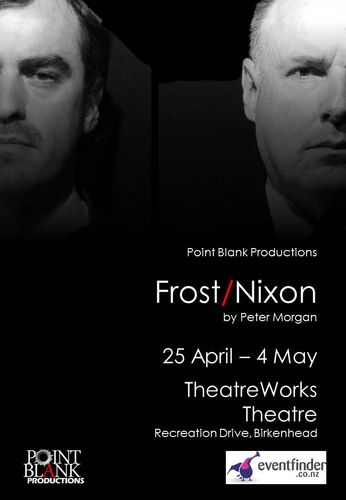
Stephen Lunt as David Frost (L) and Karl Buckley as Richard M Nixon
Morgan’s play is a relatively recent iteration having seen its first performance at the Donmar Warehouse in 2006 with Michael Sheen as Frost and Frank Langella as Nixon before moving, with the same principals, to the Gielgud Theatre in the Westend and subsequently to Broadway. By and large critics liked the play – and the performances – with that doyen of theatre reviewers – Michael Billington of The Guardian – expressing a concern that I share but could not express with half as much élan as he. ‘My only cavil’ writes Billington ‘is that almost too much stress is placed on Nixon’s vulnerability: not enough on his real crime which was a south-east Asian policy which resulted in a million Indo-Chinese deaths.’ (Billington, 2006)
It’s always satisfying to be in sync with the best while, at the same time, naughtily committing that greatest of critical crimes: that of quoting another critic!
So, am I feeling guilty?
No, not at all.
Peter Morgan’s excellent script was then made into a film featuring – you guessed it – the same key actors and it played to moderate success.
Frost/Nixon, while its content is of universal interest, is essentially an intimate chamber piece and Point Blank Productions have chosen the perfect venue – TheatreWorks Theatre – to present their excellent work. The acoustic is terrific and the sightlines and rake likewise. The effect is of sitting in someone’s lounge with the lights down – we watched TV a lot like that in the ‘60’s – and of being inexorably drawn into the drama being played out in front of us. As those who follow my reviews will know I invariably take my son, age ten, to see the plays I have the privilege of writing about. I’d given him a five minute potted history – yes, ‘potted’, I know – of the ‘60’ and ‘70’s but was still somewhat surprised when he leaned towards me 45 minutes into the 50 minute first half and whispered in my ear ‘this is such an awesome play’.
Staging docudrama featuring people from history – especially recent history – saying what they actually said, doing what they actually did, all of which can be accessed on YouTube, is a total bitch. Producers and actors can be on a hiding to nothing with the obvious criticism being he/she didn’t look/sound/smell like the real thing. Claire Buckley and her team prove that it doesn’t necessarily matter, that telling the story is still the most important quality to aspire to and in Morgan’s fine script they certainly have a story worth telling.

Richard M Nixon
The essence of Morgan’s narrative revolves around the realizing of Frost’s ambition, driven by a desire to revitalize his flagging career, to interview the notoriously secretive Nixon. Nixon, on the other hand, is down to his last $500.00 and desperately needs money to pay his doctors’ lawyers and his staff. Enter Paul Irving ‘Swifty’ Lazar, dealmaker, agent to the stars and erstwhile bankruptcy lawyer who negotiates the deal that sees Nixon earn $600.000.00 and Frost gain access to his subject.
Frost assembles a powerhouse team that consists of liberal academic Jim Reston Jr who writes a 96 page interview strategy to start the ball rolling for Frost, John (later Baron) Birt who was, at the time he took leave of absence to produce the Frost/Nixon interviews, head of current affairs at London Weekend Television and Bob Zelnick, currently professor of journalism at Boston University but who was, in 1977, executive editor of the Frost/Nixon interviews and a long time ABC News correspondent. Add Frost’s current girlfriend Caroline Cushing who buys the burgers and looks pretty and you have a gender balance – and roles – that is pretty much appropriate to the times.
On the Nixon team was only one man, Nixon’s loyal, post-resignation Chief of Staff, golfing companion and confidante ex US Marine colonel and bronze star winner Jack Brennan brilliantly played by the impressive Sam Iosefo.
The play is connected by alternate narrations by Reston and Brennan, and each threads the multi-scene structure together most effectively without sacrificing the unique thrust of their own characters. It’s a subtle balancing act for both cast and director and I have little doubt that the interpretation I witnessed was come to in a similar way to that which determined the plan that underpinned the Frost/Nixon interviews themselves: lots of talk, dispute, laughter and a final agreement on where to go and where to go after that. It holds together well and the inner logic of the performances mirror that of the playwright which is no mean feat with material like this.
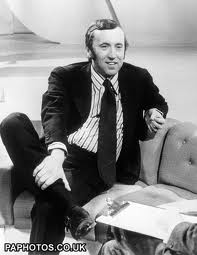
David Frost
Stephen Lunt’s Frost is played as a somewhat vainglorious man at a crossroads. Not that Lunt presents Frost in this way but the play paints him, through the mouths of others, in this vein. Lunt is a clever actor, doesn’t go for the look or soundalike but instead anchors himself in the essence of who and what Frost is – and was: the ultimate media showman, the entertainer, the opportunist who, when push comes to shove, is quite simply brilliant at what he does. The penultimate scene shows the man’s mettle and when we think he might blink, he doesn’t – and the bout is won.
Karl Buckley doesn’t go for the look and soundalike either in creating Nixon but rather anchors him in the text and the intention by building, fact on fact, observation on observation, until the most solid of characters is portrayed. While this isn’t the Nixon I remember from the media imagery and soundbites of the ‘70’s, this is exactly the Nixon I grew up with, hard, iron-willed, secretive and evasive.
Lunt and Buckley sustain fine performances from go to whoa and the penultimate scene is well worth any sacrifice you might make to experience. This is truly rivetting stuff – just as it was when I first watched it, breathless, on TV all those years ago.
Kristof Haines’ Jim Reston Jr is a classic representation of a ‘70’s shambling academic – and not much has changed. His is a subtle performance rich in nuance and fully reflects Reston’s own reasons for accepting his place on the team: ‘This would be the nation’s only chance for a no holds barred questioning of Nixon on the scandal that drove him to resign the presidency in 1974. Pardoned by his successor, Gerald Ford, Nixon could never be brought into the dock. Frost had secured the exclusive rights to interview him. Thus the prosecution of Richard Nixon would be left to a television interview by a foreigner. I took the job.’ (Reston, 2013)

Jack Brennan
Scott Hayden’s Bob Zelnick serves the production with real clarity, always knowing the pace and the reason why. Zelnick was critical to the team for his experience and you know that the images being shot are safe in this man’s hands.
Andrew Harrison’s John Birt is just like the original: clever, quirky, balanced and with integrity oozing from every pore. Take this characterization out of the play and slide it into Baron Birt’s extraordinary CV and you’d have a perfect fit.
Darren Ludlam’s ‘Swifty’ Lazar is straight from a Hollywood courtroom. He’s there to do the bizz and he does it. In lesser hands Lazar might become a caricature but Ludlam keeps him real – which is no small task.
The role of Caroline Cushing is played by Emma Service with real skill. Morgan doesn’t give her much to do but Service does it in a way that I found fascinating. The socialite ex-wife of Howard Cushing, Morgan has her meet Frost on a plane just prior to the interviews when in fact they’d been dating for three years by that time. I’m glad he did because Service’s scrumptiously sexy playing of this first meeting is a wonderful juxtaposition to the subsequent cat-and-mouse antics of Frost and Nixon when they first meet. If this is what Service can do with not much, I can’t wait to see her tackle a role with real substance.

Caroline Cushing and David Frost
I haven’t said so in as many words but have alluded to the fact that the play is peppered with examples of Morgan’s liberal use of his artistic license. I don’t have a problem with this especially since, without it, the key scene in Act 2 wouldn’t exist. In this scene Nixon and Frost speak together on the telephone late at night and it is here that the dramatically essential, but otherwise non-existent, battle between the two giants occurs
It didn’t actually happen, the real-life Brennan assures us. There was no late night, alcohol-fuelled phone call from Nixon to Frost. It’s pure fiction.
Fantastic fiction though, so thank heavens for license.
Morgan justifies this and tells us via The New York Times that ‘hearing different versions of the same events had taught him what a complete farce history is.’
Reston Jr, on the other hand and himself a playwright, disagrees and tells us ‘that in historical plays the author is on the firmest ground when he does not change known facts but goes beyond them to speculate on the emotional makeup of the historical players.’
So be it.
I like it how it is. There’s plenty of verbatim material in the interview segments and the fiction certainly holds true.
It’s all in the interpretation and Claire Buckley’s production is as full of opinion as I am and on most things we agree.
Perhaps I dislike Nixon a little less than I did, largely because I’ve been confronted with some of the pretty amazing things that he did achieve during his term and a bit in the Oval Office and not just because my new glasses give me 20/20 hindsight.

The Frost team of researchers and advisors
My opinion of Frost is unchanged, though, and it’s in this area that I disagree with the play – and the production – just a little bit. I doubt Frost was ever in any doubt as to where he was going with the interviews or what the outcome would be. It was fortuitous that Reston came up with the Chuck Colson material when he did and it fed Frost beautifully but I like to think he’d have nailed Nixon anyway. The issue isn’t with Frost himself but with how Frost’s team perceived him. They simply missed the point. Frost wasn’t, and isn’t, just a journalist and an interviewer; he’s a performer, a conjurer, a psychologist, an actor – and we never tell all we know.
Us actors.
Do we?

References
Agnew, Spiro T; Go Quietly…or Else. Morrow, 1980. ISBN 0-688-03668-6.
Billington, Michael The Guardian, Tuesday 22 August 2006 08.45 BST
http://www.smithsonianmag.com/history-archaeology/Presence-Frost-Nixon.html
 dykiegirl