
The Man Who Planted Trees
Adapted by Ailie Cohen, Richard Medrington, Rick Conte from Jean Giono’s book The Man Who Planted Trees (1953)
Directed by Ailie Cohen
Produced by the Puppet State Theatre Company (Scotland) for The Auckland Arts Festival
Presented in the Concert Chamber of the Auckland Town Hall, 303 Queen St, Auckland
08 March 2013 to 09 March, 2013
Reviewed on Saturday 09 March, 2013 at 10.30am
Published at http://www.theatreview.org.nz
I may be wrong but there seems to be a worldwide resurgence of puppet theatre, both traditional and innovatively modern, and while Puppet State Theatre Company of Edinburgh, Scotland falls into the more traditional category there are still some exciting recent innovations in their work, not the least of which is the charming, if somewhat moist, interaction between puppeteer/actors and their all-ages audience.
We are told on the company’s website that The Man Who Planted Trees,which premiered in 2006, “is the inspiring story of a shepherd who plants a forest, acorn by acorn, and shows us the difference one man (and his dog!) can make to the world.” The Guardian adds that “laughs, heartbreak, war, regeneration, scented breezes, sparkling wit and the best dog puppet ever” make experiencing this show something to remember.
I’m not sure Basil Brush would agree but then Basil was a fox after all and The Guardian is correct on all counts as this show is ‘terrific’.
Based on Jean Giono’s classic 1953 tale of many names – L’homme qui plantait des arbres, The Story of Elzéard Bouffier, The Most Extraordinary Character I Ever Met, and The Man Who Planted Hope and Reaped Happiness – we encounter, through the eyes of a young man out hiking, a shepherd who plants a forest of trees, initially acorn by acorn but in time adding birch and beech, thereby transforming a desolate wilderness into a fruitful paradise with only the help of his trusty dog Dog.
It’s not all plain sailing, however, and the 10,000 maples Bouffier plants all die because the conditions aren’t right and, with that, the story hits home another message.
It’s quite a journey, beginning as it does in 1910, traversing two world wars and a change of occupation for the shepherd who becomes a beekeeper – because his sheep keep chewing the saplings and for reasons of pollination – and ending in 1947 in a hospice in Banon where the old man passes away. In Puppet State Theatre Company’s version the dog is a constant presence right to the end, at which time he would have been 291 dog years old. We’re happy he doesn’t pass on because Dog is a very, very special character and, while we lose the old man, losing the dog would have been a step too far.
It’s a very early environmental tale. Puppet State Theatre Company has retained its blunt messages and, through Dog, ensures that it also maintains a very real modernity.
So good is Giono’s storytelling that for years his readers believed that the narrator was indeed the author and that shepherd Elzéard Bouffier was a real person but, later in his life, Giono made it clear that his was an allegorical tale and that all his characters were fictional.

The set is simple – a trio of movable structures in tans and browns that hide the puppet plumbing – and the style is direct to the audience. The actors use the set in subtle ways as the forest grows. A change in political fortunes sees a change of colour and imagery on the set – a swastika-like image appears on a blood red front banner – and at the end the land is green and pleasant.
It is invigorating to see home truths so sensibly and bluntly stated when the standard fare handed up to kids in 2013 invariably involves a Wiggle World of Jeff asleep, a big red car and Dora doing a spot of exploring. As my spouse reminds me afterwards, there were 16 million deaths and 17 million casualties in World War I, a fact we tend not to expose kids to today, as though somehow they couldn’t handle it. They can, of course. Kids are far stronger and more resilient than we ever believe.
Dog is very contemporary and there are delightful exchanges, many of which involve complex word plays that delight both adult and child audience members. Dog has trouble with his eyes so he goes to his doctor who is, of course, a vegetarian. By the time we realise that he means veterinarian his doctor has identified the problem with his eyes – they’re buttons! This delicious silliness keeps us engaged as the story works its magic.
The puppeteers offer Dog a role in the play. Dog wonders whether they mean a sausage or a spring roll – he prefers sausage – and, after much hilarious discussion about the tradition of ‘break a leg’ he accepts. He’s an experienced actor, he tells us, having played the lead in The Hound of the Basketballs, his school play, where some audience members almost stayed to the end.
The narrator takes us into some interesting metaphysical areas as he realises that the shepherd isn’t engaged in his project simply for personal pleasure but has a far greater plan and the belief that, whenever you take on a life changing project, there will always be a line-up of people finding reasons why you can’t do it. In 1939, the narrator tells us, there is “a war to be won and money to be made.”
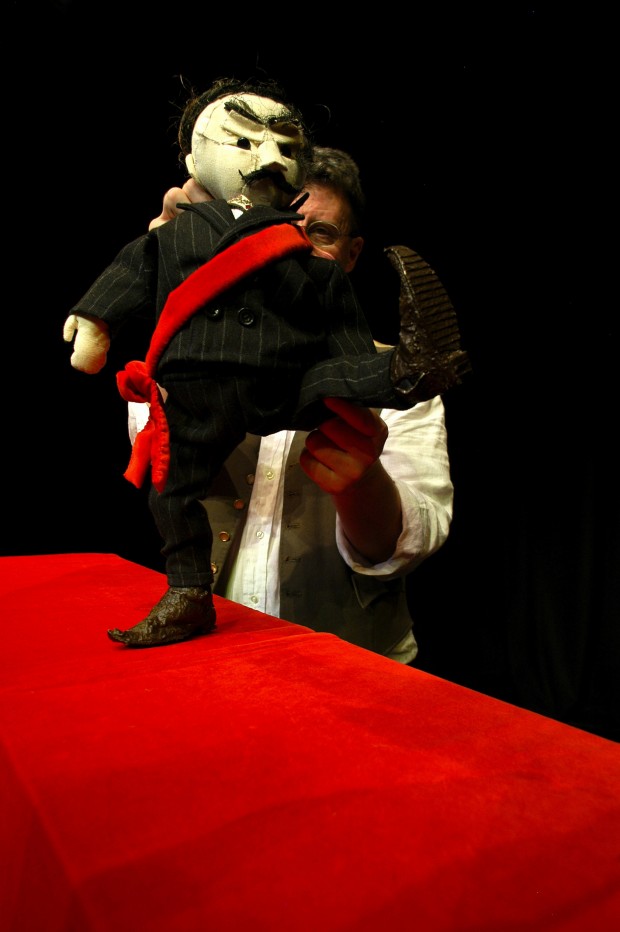
There are special moments, such as when both puppeteers take over the operation of the same puppet – a post war MP, the bad puppet in the story – and where they take collaboration to an entirely new level, and “the mists in the morning and the rain in the evening” which is so important to the story that we all have to experience it. My son whispers “hide your note pad, Mumsie” but I am too late and am happily looking at the smudged results as I type.
The show ends with a question from Dog to man: what’s the first word learned by both actors and dogs – and I’ll leave you to work that out!
While the Puppet State Theatre Company is based in Edinburgh the show doesn’t have an innately Scottish feel but retains a charming sense of its Gallic origins.
It’s been around a bit, too, this show, and in an interesting interview between Renee Liang (The Big Idea) and Puppet State Theatre Companyco-creator Richard Medrington, we learn that The Man Who Planted Trees has toured the world and been performed in tents on windswept hillsides, tiny village halls on remote Scottish islands, the Lincoln Centre and the Sydney Opera House. (Liang, 2013)
Medrington is of the opinion that the love affair people of all ages have with puppets is “a great mystery”. When pushed he suggests that “somehow we suspend our disbelief when we see what we know to be an inanimate object brought to life. As children we love to play and make-believe, and perhaps most of us never lose this ability.” The applause and engagement from the audience ‘of all ages’ in an almost-full Concert Chamber would suggest he’s right about that.
Richard Medrington founded Puppet State Theatre Company in 2003 and his collaboration with fellow performer, puppeteer and Dog wrangler Rick Conte, designer /director Ailie Cohen and tech-of-all-trades Elspeth Murray began, we are told, soon after that. Let’s hope it continues for a long time because their work is unique and entirely ideal arts festival fare.
 dykiegirl