The Ballad of Pondlife McGurk
Devised and performed by Andy Manley
Directed by Gill Robertson
Written by Rob Evans
Sound Design by Danny Krass
Produced by Catherine Wheels Theatre Company for The Auckland Arts Festival
Reviewed at Bruce Mason Centre Upstairs, Cnr Hurstmere Rd & The Promenade, North Shore
Saturday 09 March, 11:00am and reviewed at 2.00pm
Published at http://www.theatreview.org.nz
I cut my theatre teeth on bare boards and passion – and working with young people in schools. Not much set, a few carefully chosen costumes and evocative props and the rest was down to the actors. For this, and other reasons, I looked forward to seeing The Ballad of Pondlife McGurk because it was made for just such a performance environment and I knew I’d feel at home.
The Ballad of Pondlife McGurk is the sort of name you’d like to have made up, too. It has an air of something schoolyardy about it; something a bit smelly, a bit confrontational; something us oldies might consider a bit Richmal Crompton. If you don’t get that reference you might choose a youthful way of finding out who she is, something like Google, and then you might read her books. Then, I have no doubt, you’ll catch my drift.

The Ballad of Pondlife McGurk has got great credentials, gaining a five-star hit at the Edinburgh Festival Fringe in 2012, and the story line is attractive, too. We’re told in the publicity that The Ballad of Pondlife McGurk is “a tale about friendship, betrayal and overcoming adversity.”
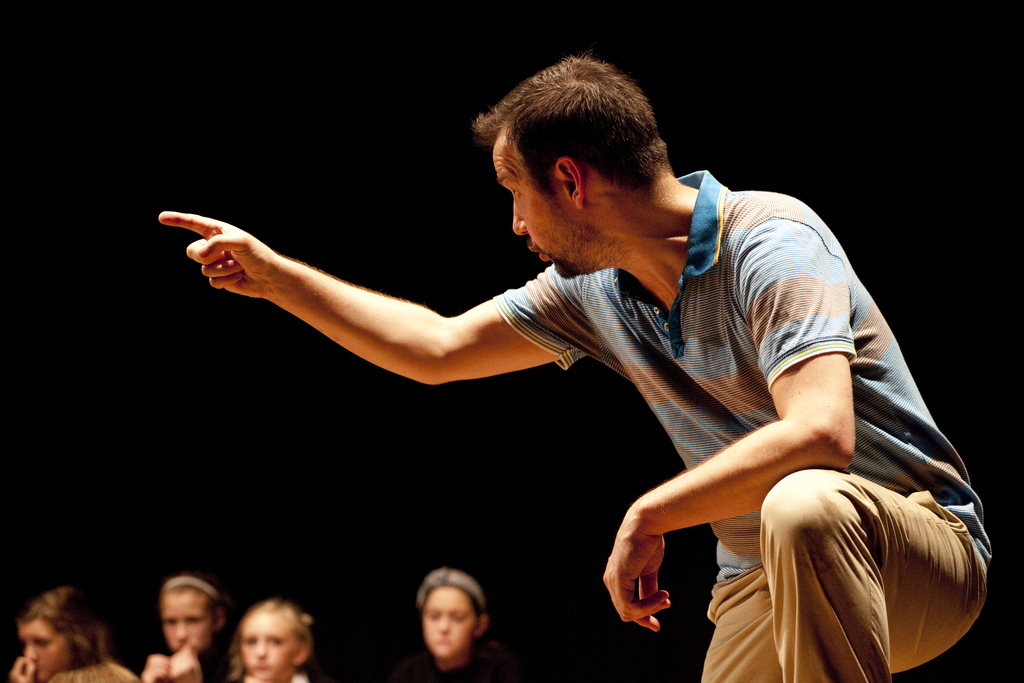
Martin, we discover, is a new year seven boy at school. He’s the main character in the story and will be played by Andy Manley, the only actor in the show. While it’s essentially Martin’s story, Andy plays all the other characters too, but more about that later.
It’s Simon McGurk’s first day at school too and a right couple of misfits he and Martin are. Martin hails from Birmingham and is soon being called Brummie, and not in a kind way, by a spiteful bunch lead by principal school bully Sharon McGinnis.
It’s somehow affirming to have the bully gendered as a girl. I’d not seen that before on stage but I had experienced it in real life. It all makes perfect sense, of course. Childhood and humiliation, they go hand in hand.
Martin and Simon make an odd couple but they get on. Simon is the arty one and Martin is the repressed footballer. They survive onslaughts from Team Sharon by using intelligence and cunning, largely conceived by Simon who saves Martin’s butt on more than one occasion, and our heroes label Sharon and her buddies “The Neanderthals” as a means of self protection.
After a delightful summer of making dens, working on their comic and generally being real boys they move from eccentric Mrs Nagel’s class to year eight and macho Mr Truman. Trials for the soccer team are obligatory and, to make a long story short, Martin is selected in the team and Simon isn’t.
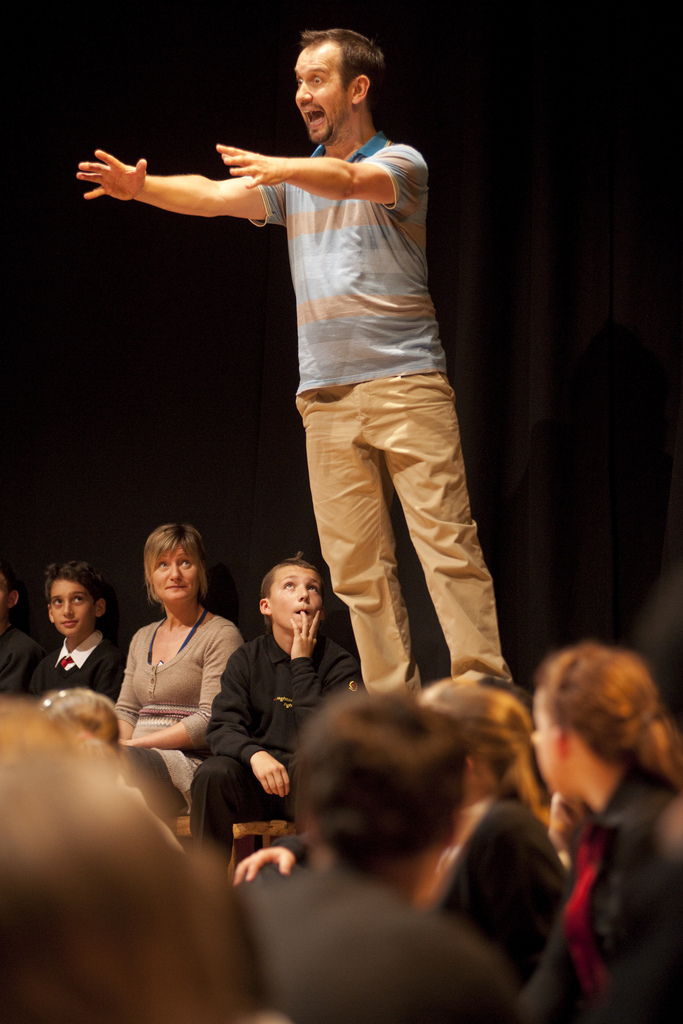
On an ill-fated class trip Simon, who can’t swim, is thrown “like a shot put” into a pond by Sharon and has to be rescued from the waist-deep water by Mr Truman. His appearance on surfacing ensures that he is nicknamed ‘Pondlife’ by The Neanderthals and the name stays with him for the remainder of his schooling. The smell emanating from him after his unplanned dip may have contributed to the name as well.
Martin is woo’d by The Neanderthals who are impressed by his football skills and he joins them, eventually denying any previous friendship with Simon and thus ending their fragile acquaintance.
Martin allows himself to get lost in the fog of admiration he receives as a football star and not only does he lose any sense of loyalty to his old friend, but he joins the others in cruelly calling him ‘Pondlife’. Worse, he tears up the comic they have been working on for months and thus destroys the only tangible remnant of their shared experience. “You think our stupid stories are important?” Martin asks Simon and we take that moment to question ourselves about our own narratives and how they underpin and inform exactly who we are.
Years later, well into his adult working life, Martin has one of those moments that clever people call an epiphany but that most of us simply call ‘waking up’. He realises what a dipstick he’d been when he was a kid and how he’d never truly valued what he and Simon had shared. He wonders what Simon’s doing now, Googles him, and finds that, not only has he become a successful designer and filmmaker, he has also taken ownership of the name ‘Pondlife’ and named his business after the unkind nickname he was labelled with as a child. There’s a list of the films he’s made too, and Martin is clearly impressed.

The play begins and ends with the moment the two men reconnect as adults, each identified by the nature of their adult footwear.
The set is simple and functional: four mats transected by four walk ways meeting in the centre with a wooden box at the outer end of each pathway. The audience can sit on chairs around the outside of the performance area or on the mats that separate the areas of the acting space. The primary colour is an attractive muddy tan which carries through from the mats to the boxes.
The sensory moments that Manley guides us through are wonderful, from the smell of newly cut grass to Judith, the kid who vomits all the time on the class trip. He also leaves us in no doubt as to what Simon’s unexpected swim in the pond looks, feels and smells like and the story skips along at a right old pace.
In short, Manley is a master craftsman, a storyteller supreme, who takes us on the unique journey he has fashioned with consummate professionalism and ticks every single box along the way. Not that we notice the nuts and bolts; we’re too busy being enthralled by a simple piece of real, live theatre.
The applause for this Catherine Wheels Theatre Company show was sustained and heartfelt and, while it’s essential to pay tribute to the contributions of director Gill Robertson, writer Rob Evans and sound designer Danny Krass – whose subtle and earthy soundscape really supported the work – the afternoon unquestionably belonged to Andy Manley who took us on a journey I doubt any of us will ever forget.
I suspect a few tears were shed and, who knows, the person sitting next to the person sitting next to me may even have shed a few herself.
One thing’s for sure, the importance of valuing friendship, of cherishing loyalty at all costs and of the healing power of human forgiveness rang out loud and clear in an upstairs room of the Bruce Mason Centre on a sticky, summer afternoon in March 2013 and won’t be forgotten any time soon by any of those who heard it.
 dykiegirl