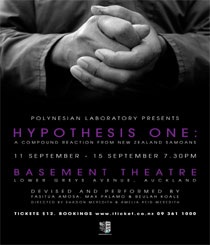
Hypothesis One: A Compound Reaction from New Zealand Samoans
Produced by Polynesian Laboratory (PLab)
A work devised by Fasitua Amosa, Max Palamo and Beulah Koale
Directed by Amelia Reid-Meredith and Shadon Meredith
Basement Theatre, Lower Greys Ave, Auckland
11 to 15 September, 2012 at 7.30pm
Reviewed on 15 September, 2012
Published at http://www.theatreview.org.nz
Ia su’i tonu le mata o le niu.
Now it’s my turn, my turn to do my share of the work and to try to go about this task in a proper way, to honour what I have had the privilege of sharing, to pay tribute where it’s due.
There’s plenty of praise to be lavished too, because Hypothesis One: A Compound Reaction from New Zealand Samoans was wonderful work
To be honest I had no idea what I was going to experience when I walked into the theatre for Hypothesis One. The title didn’t give much away, neither did the press release.
I checked out the meaning of hypothesis on the arrogant assumption that I knew what an hypothesis was. Hours later, and after much fascinating reading – hic et ubique – I realised that there are more things in heaven and earth than I’d dreamt of in my philosophy!
So, no definition today.
I’ve seen quite a lot of Pasifika theatre over the years beginning with the work of Pacific Underground in Christchurch in the 1980’s which included Fresh of the Boat (Simon Small & Oscar Kightley), Sons (Victor Rogers), Dawn Raids (Oscar Kightley), Romeo and Tusi (Oscar Kightley & Erolia Ifopo), Island Summer (Pos Mavaega) and Angels (Tanya Muagututi’a & Joy Vaele). Then there’s the unique work of Lemi Ponifasio and Mau Dance, Nina Nawalowalo and Conch Theatre’s memorable productions of Vula and, more recently, Masi, while here in Auckland ATC has collaborated with Pacific Institute of Performing Arts (PIPA) to produce Polyhood in Mumuland and Sinarella, Kila Kokonut Krew has staged Taro King while, later this month, Tales from the Kava Bowl is offering A Heart’s Path.
This is, of course, just a smattering.
It’s fair to say we’re blessed in Aotearoa, first, with the diversity of our cultural performing arts and second with the talent that has emerged from our fantastic Pacific communities.
I’ve already admitted that I had no idea what to expect because all I’d read about Hypothesis seemed to focus on the process rather than the content and reviewers tend to comment on the end product rather than the journey. If the journey has been good then the work probably will be too and the plumbing is invariably well disguised.
PLab – yes, that’s what they’re called – is a new collective founded by Fasitua Amosa who is one of our finest. His dream is to create an environment where Pasifika performing artists can try out new ideas, experiment and ultimately stage new work. Hypothesis: a compound reaction from New Zealand Samoans is the first work to bounce out of the lab and, frankly, it’s a wee ripper.
The set is a backdrop on which lighting guru D Andrew Potvin has projected tiny spots of green light. It looks for all the world like a star curtain – but it’s not. The reality is dull, old black screens given a wash of magic. A chair is placed in a spotlight centre. The lighting throughout was impressive especially given the limited resources of The Basement and was integrated into the action seamlessly.
The three male cast members are dressed throughout in creamy, white lava lava and a range of white tops.
As if prescient, the play opens with the men in a triangle focusing the breath – the breath, after all, is life – and chanting, singing and percussive sound feature significantly in this work as might be expected.
Fasitua Amosa plays Peni, the eldest son. He plays a lovely bunch of other characters too but more about them later.
Max Palamo plays Papa – and a plethora of other folk.
Beulah Koale plays grandson Lucky. He’s the new kid on the block, slender and ripped, a slight shadow of the older men but no less able. He’s stroppy, he’s sexy and he has attitude.
The heart of the work is anchored in notions of identity and displacement, in generations and generational change, in the loss of culture, and the central narrative never deviates from this.
Papa (an imposing Max Palamo) is at the centre of life in this family. He is Papa. He is aging. Dementia has set in and no-one is really dealing with it. To add to the complexity today is his birthday. He repeats often, in his dementia, ‘Did I tell you how I met your grandmother’ and we laugh. It’s funny, but when, in flashback, we experience that choice occasion, we laugh until the tears come and clever Palermo has opened us up to whatever comes next. Smart as. Love is tricky like that.
Peni (the wonderful Fasitua Amosa) is the eldest son. Born in New Zealand he is sophisticated, worldly and he’s made a decision he knows isn’t going to be popular but it’s his job. He’s the eldest son. He has arranged for his father to move into Riverside Retirement Home and he knows all hell is about the break loose.
Grandson Lucky loves his Papa. It’s an unequivocal, unquestioning love. He massages his shoulders, touches his arm, talks to him, listens, learns from him and loves him.
The narrative moves through an all-embracing array of familial relationships and idiosyncratic characters – some very young, some female, one at least who is fa’fa – and each is etched with precision, beauty and depth, albeit fleeting. Each personality is there and gone, often in a nanosecond, fashioned and refined through gesture, a walk, a special voice, a sound. There is chat about church – ‘the Lord doesn’t need the money because he’s the Lord’ – a scrumptious rendering of Po Kare, telling throw-away lines like ‘say it in English ‘coz it’s important’ and childlike questions about Papa – ‘will he die today? The key to the success of this pastiche of persona is the truthfulness and the love that is apparent between the actors, their characters and each other. It’s sublime to watch, rowdily comical and genuinely moving often in the same wonderful moment for these are story-tellers at the top of their game.
The action moves inexorably, often with riotous good humour, to the crisis moment when Peni announces at the birthday party that Papa is to move to Riverside. It’s harrowing stuff. Peni delivers the news to his aiga in a clinical, rational and rather European fashion and the generational void is complete. Lucky responds with fury and impotent anger, the silence in the theatre broken only by the violent slapping of hand on chest.
Papa, from the depths of his dementia says ‘I’m going home, I’m going home’.
There are precedents in European culture that have made devising theatre works seem, until recently, an almost exclusively European method of working. Etienne Decroux is often credited with being the first person to encourage performers to devise work and Theatre Workshop under the divine Joan Littlewood popularised the mode in the ‘60’s with Oh What a Lovely War.
Simon McBurney’s Théâtre de Complicité is probably the best known modern exponent of the form but Aotearoa New Zealand has also had its share of companies who have devised works in the European tradition, Amamus, Theatre Action, and Red Mole most immediately come to mind.
This, however, is different. This is a truly antipodean process that works in every way from Amosa’s vision, a shared trust, the extraordinary experience and skill of the actors and directors all underpinned by the affection that they clearly have for each other – and respect, all the time respect.
Hypothesis One: A Compound Reaction from New Zealand Samoans is a magnificent work, unique and profound. The Samoan story-telling tradition transcends the process and the work is accessible and rich. It’s beautifully ‘directed’ though I am hesitant to use that palagi word. Shadon Meredith and Amelia Reid-Merdith are cited as ‘directors’ but I suspect they’ve been much more than that. They’ve been co-conspirators in this cunning plot to open us up and wring our withers and, while providing the essential outside eye, they’ve clearly had a major part to play in crafting this astonishing work.
The night my family and I attended there was a large group of aspiring young actors from the Pacific Institute of Performing Arts (PIPA) so we had the pleasure of sharing in the open forum after the show. It was exciting to experience the generosity of spirit shown by the actors and director and to learn (from Amosa) that they’re primarily interested in presenting the stories of today. The flashback reference to the dawn raids of the ‘70’s and ‘80’s wasn’t political, he said, but more to show the emotional impact that this experience had on Papa. It did just that! Those stories had already been told, he said, and PLab were creating the theatrical reference point for the next generation by telling the stories of today. The suggestion made by one of the young actors that they’d quite like to be involved in Hypothesis Two said it all. This is work with an immediacy that is instantly attractive and, as such, has the potential to record the next fascinating chapter of this fascinating journey.
If PLab continue to make work of this quality – and there is nothing to suggest they won’t – then we’re all in for a treat. Samoan people may well have become ‘brown wall paper’ as was suggested during the forum but their voice is strong, their experience unique and I for one, want more.
Roll on, Hypothesis Two!
Fa’amalo, PLab, fa’amalo!
 dykiegirl