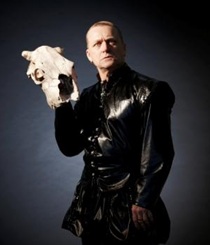
Michael Hurst’s ‘Bard Day’s Night’
(Premiered at the NZ International Festival of the Arts as ‘Frequently Asked Questions’)
Produced by Royale Productions
Written by Michael Hurst, Natalie Medlock and Dan Musgrave
Directed by Natalie Medlock & Associate Director Dan Musgrave
Designed by John Verryt
Lighting Design by Sean Lynch & Operated by Nik Janiurek
Costume by Lesley Burkes-Harding
Stunt Design by Glen Levy
At The Basement, Auckland
21 – 26 May 2012
Reviewed on 21 May, 2012.
Published at http://www.theatreview.org.nz
It’s May, 2012.
Who would have expected to wake this morning to the sound of right wing councillors Sharon Stewart and George Wood bleating on about the Auckland City Council’s plan to provide ASB with a $10m loan guarantee for Auckland Theatre Company’s proposed theatre in the Wynyard Quarter.
Stewart, given a D grade for her performance in Bernard Orsman’s recent report card, ranted on her Facebook page ‘I won’t be supporting them. They’re not Core business. I will not be supporting such an irresponsible decision. Arts and theatre are not priority. Tourists visit for a short time – we live here and we cannot have the situation where residents of Auckland are being flooded out of their homes while someone watches a play at Auckland Theatre.’
Yep, it’s May 2012 but it sounds like 1990.
Does anyone remember the Mercury?
Would it help to cry ‘Hark! Who’s there?’
Probably not.
I would give Stewart and Wood an E for vision – and just about everything else – but that’s not my core business. My core business is to talk about A+ performances and last night I saw one of the very best, a performance that would grace any stage in the world (except in Auckland where they’re like hen’s teeth).
Having said that The Basement venue is perfect for Hurst’s opus, as much for John Verryt’s splendidly downmarket set as for any other reason – but there are others.
Loads of them.
The thrust staging allows for an intimacy that is both absorbing and, at times, terrifying. It is an actor’s venue, so much so that being engaged by a work that explores – among many other things – the actor’s, post-performance state of mind seems singularly appropriate. Verryt’s garret-like set with its tactically placed grunge furniture and dull hues could be any actor’s digs anywhere in the world, the perfect place to reflect, have a drink and go quietly mad chitchatting with the voices in your head.
Supporting Verryt’s excellent setting is Sean Lynch’s clever lighting, admirably operated by Nik Janiurek.
Again, no frills but smart and subtle, and as sinister as could be imagined when required.
As we waited for the show to start, most of the audience realised that no frills were needed as the actor they were about to see was Michael Hurst.
I’ll say now that this is a solo show but, Hurst being Hurst, it never seems as though it is. The marketing tag for the show is ‘absurdity, schizophrenia and blank verse’ and there’s enough of each to satisfy the most discerning needs.
The plot, like the set and the lighting, is deceptively simple.
An actor playing Hamlet and still dressed in his ‘customary suit of solemn black’ returns home to his whisky bottle, his revolver, his hotplate and his solitude. His acrylic periwig – a cross between that of Olivier’s third Richard and a lifeless cat – is soon discarded and the beautifully spoken voices in his head begin. There’s a feral Macbeth, Dizzee Rascal Othello and a languidly loopy Lear and they link up with our melancholy Dane for an hour’s sublimely texted gambol through the canon’s tragic masterpieces, cul de sacs included.
There’s a point to it all so it’s not just fun and games though there are plenty of those. Deeply embedded in the comedy and pathos of Shakespeare’s magnificence and animated by Hurst’s substantial genius there lies an ominous exploration of mortality, the mortality of the characters Hurst invents of course, but the gloomy transience of the actor, alone and stripped of his guise, is in there as well. Here Hurst is Everyman as he examines himself and his universe via the medium of that most poignant toast ‘Here’s to a good story, eh’.
It’s deadly serious, but never for long, for this is a show that takes the Mickey out of itself and everything else. It’s mercifully mature stuff, for which we should all be thankful.
For it’s a rollicking good story that Hurst and his mates tell. There are moments when the stage seems as littered with idiosyncratic folks as a public bar on a Saturday night, other moments of aching solitude and yet more of deeply sinister menace.
It’s outrageous too.
There’s smoking (heaven forbid) and swearing (my God!) and a wonderful racist goading the like of which I haven’t heard since 1950 (Hurst wasn’t born then).
But always at the heart of this wonderfully jubilant piece is Hurst himself, mangling the text as Shakespeare would have wanted, eating it up, chewing it roundly, spitting it out with venom, passion, anger, lust and love. Where lesser mortals might have raged – ‘Blow, winds, and crack your cheeks’ – Hurst whispers; he tears our hearts out when he plays it straight for ‘life’s but a walking shadow, a poor player that struts and frets his hour upon the stage and then is heard no more. It is a tale told by an idiot, (he pronounces it ‘eejit’) full of sound and fury, signifying nothing’ before quietly reminding us, Paul Henry-like, that ‘you should never trust a woman with a beard.’
Hurst makes images sing and sometimes twang ‘like sweet bells jangled, out of tune and harsh’– the picture his Macbeth paints of Hamlet poncing around the castle with both thumbs up his arse is both physically challenging, riotously funny and more than a tad disturbing.
There is a simple egoless beauty in Hurst’s performance, a simplicity that defies description so I won’t even try. Suffice to say that it has all Shakespeare’s magnificence, his crudity, his wild radiant insanity, his love of life, his eternal search for spiritual peace – and more.
Hurst embodies each character with a subtle eccentricity that is unexpected yet oddly obvious, Macbeth’s unkempt impudence and graceless swagger, Hamlet’s mundane ordinariness, Lear’s wraithlike delicacy and Othello’s colossal physique (very clever this!) set each apart from the other while allowing space for his remarkable vocal fluency to bond them inseparably together. This is very smart work and not to be undertaken by the faint of heart.
The script is a cracker, and not just the bard’s bits. The rest is beautifully interwoven, funny, poignant and tailored to Hurst’s many talents. It provides a full range of vocal and physical challenges and allows him to give vent to his astonishing emotional depth. There are sections that Stoppard would be envious off – smart, intelligent and quirky – but unique, too, always unique. Underlying the whole experience is a magnificently contrived spontaneity and a deep and profound understanding of just what Shakespeare was about.
There are many surprises too and none more so than Hurst’s interpretation of that most famous of soliloquies. Most of us have grown up believing that the ‘to be or not to be’ speech was simply Hamlet talking to himself so it came as a shock to find that he was in fact talking to Macbeth, a shock, I must say, I have yet to recover from. It was fascinating, and in Hurst’s hands, disturbingly real.
Hurst has always had an incredible physicality. As a young man he was stunning, an athlete in fact, and a fine young leading man. Now, slightly later in life, he’s developed a rugged handsomeness that is also very attractive indeed – and, it’s good to report, the athlete is alive and well too.
In this production he takes his physicality to a new level and gives fresh meaning to the phrase ‘beating oneself up’. All credit for this goes to stunt designer Glen Levy, to Hurst himself – and probably to his physiotherapist – as the all-in brawl between the characters is utterly sublime.
So how does this extraordinary journey end?
I’m not going to tell you. Suffice to say that ‘there’s special providence in the fall of a sparrow. If it be now, ’tis not to come; if it be not to come, it will be now; if it be not now, yet it will come – the readiness is all.’
I wasn’t ready, and I didn’t want it to end – like life, I guess – but the wheel of fire had to go full circle and so end it did.
A couple of self-effacing curtain calls and it was over.
‘Bard Day’s Night’ is performance art at its very, very best
Arthur Schopenhauer said ‘Talent hits a target no one else can hit. Genius hits a target no one else can see’. In Michael Hurst, I believe we have a talented genius, as fine an actor as any in the world. Maybe I’ll have a chat with Sharon Stewart and George Wood. Perhaps it’s time they, and their ilk, went to the theatre again.
 dykiegirl