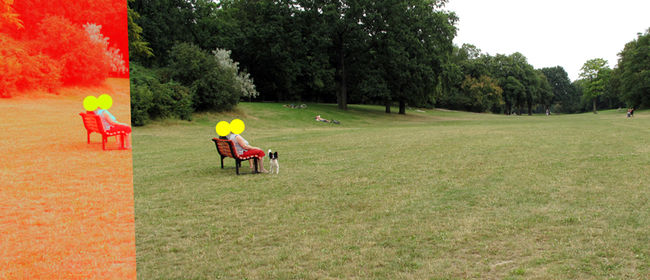
The Bench or Hello for Dummies
Conceived, written, edited and spoken by Ant Hampton and Glen Neath
Booked by Alterations who organised the locations etc
Experienced on Wednesday 18 April, 2012
Auckland Art Gallery (but don’t be fooled by this)
Co-commissioned by Norfolk and Norwich Festival (UK), Derby Festé (UK) and Fusebox Festival (USA) and supported in New Zealand by St Paul Gallery and Auckland City Council.
Reviewed by Lexie Matheson
I like random stuff.
The more random the better, truth be told.
Theatre is life.
Isn’t it?
It reflects real life, anyway.
Well, it should.
Shouldn’t it?
You don’t need to know much more than that.
The Bench or Hello for Dummies is pretty random in a constructivist sort of way so you can guess I liked it. Loved it, in fact.
I’m not going to tell you much about it though because, should you have the courage and the opportunity to engage with this unique experience, to tell you what happens in advance would be to spoil it completely. However, if you do want to know what it’s like in advance then experience it – then experience it again. Others have – and it apparently works. Any desire you may have to be in control of your theatre experience may well be satisfied by this.
Perhaps.
So what is The Bench or Hello for Dummies?
To quote the rather enigmatic press release ‘The Bench or Hello for Dummies is an intimate and lasting encounter that reflects on the experience of meeting strangers.’
It goes on to add that ‘in signing up for this play you will be guided to a specific park bench in central Auckland and paired up with a stranger.’
And so I was.
My park bench was on the observation deck of the Auckland Art Gallery overlooking AUT University and Albert Park. It was a beautiful, warm, sun-shiny autumn day. The ‘stranger’ I was paired up with was an attractive, beautifully dressed, intelligent and articulate young woman. I didn’t know this of course because I couldn’t see her – I just made it up – because, as usual, I filled in all the gaps as I wanted them filled on this gorgeous day.
What I didn’t know – but wanted to know and didn’t – I simply created for myself.
Much as politicians do.
Much as we all do.
To explain this I need to return, yet again, to the press release which told me that, through voicing a scripted conversation delivered to me via headphones I would inevitably build an experience of the play to be shared only with this partner who was, in turn, repeating her voiced script delivered to her by headphones, which interacted with mine and without ever seeing her face – or she mine.
Pretty clear instructions really, and that pretty much describes the process.
It won’t be like that for you though because your venue will be different and your partner different also – and you’re not me and the day may be cold, dark and overcast, your bench less comfortable and more accessible to random passersby than mine was, your partner nowhere near as nice – and so it goes on. On the day I engaged with this extraordinary piece of theatre at the Auckland Art Gallery it was also available at Western Park (Ponsonby Road Entrance) at 6.30am, Symonds Street Cemetery at 8.30am, and twice at the Auckland Central Library in the late afternoon. I can’t imagine the experience I had being replicated in the Symonds Street Cemetery for example. It just wouldn’t happen.
The Bench or Hello for Dummies is based on a technique that British-based artist Ant Hampton calls autoteatro and which involves giving pre-recorded instructions to unrehearsed but willing members of the general public, a general public which can, of course, include actors, directors, students, academics, techies and, on occasion, reviewers disguised (loosely) as everyday folks. The work is ‘managed’ byAlterations, a curatorial agency focussed on art and research, lead by the highly personable Amit Charan, Joel Cocks and Laura Preston.
This work involves meeting someone for the first time, someone who is chosen for you and with whom you may have nothing to otherwise connect you apart from a mutual desire to engage with the work. This can be daunting so it’s fair to say that this experience may not be for everyone but your personal power lies in whether or not you say yes to the idea and if you don’t no-one else will ever know. If you do say yes then it’s all on for young and old – quite literally.
The process has a wonderful theatrical integrity. There are actors of course and there is a script but there is also an audience – the casual passerby who simply comes across this delicate passion play – and there is a sense of rehearsal and the recreating of spontaneity. It’s real yet unreal, has a beginning, middle and end, lasts well beyond its formal ending and of course starts with the moment each participant begins their travel through their lives. Everything that happens is influenced by everything else. It takes place in a designated performance space where the public are, unwittingly, both active and passive participants. It has a director and a production team. Peter Brook would be impressed as here is the theatre experience at is most economical, at its most real.
Best of all, it’s art.
Personally, I found the experience invigorating, exciting and emotionally challenging. It took me out of my comfort zone and put me on my mettle. No sitting comfortably in the dark voyeuristically watching other people live distant lives in funny clothes, this was an ‘in-your-face’ – well, not quite because you can’t look at each other – incident that, like all participatory activity, has the potential to change lives. In the 40 minutes this sublime intertaction took to evolve I experienced emotions ranging from acute anxiety to deep affection, from bewilderment to lucidity, from awkward embarrassment to personal buoyancy and all within the framework of an evolving and thrilling truthfulness.
That doyen of Kiwi grumpiness Mervyn Thompson railed against ‘plays in rooms’ throughout his working life and applauded anyone who set their sights on creating work that rummaged around in the jumble and confusion beyond the fourth wall. He would have lovedThe Bench for its courage, its minimalism, its ‘outside the box’ thinking and its disturbing intimate immediacy. He would also have liked that the cast was small, management invisible, the emotional interaction intense and that it was free.
I liked it for all the same reasons.
Thompson also assessed the effectiveness of any theatre work in terms of the resonances left, the ‘aftertaste’, so to speak. I can only speak for myself of course but the journey has stayed with me, my fascination with the process is intense and my liking for my fellow traveller far greater than I could ever have imagined. I guess that means it worked, both as a piece of theatre and as a slice of life.
My desire to talk about the experience is such that, should my fellow traveller contact me here or on Facebook I’d happily return to the gallery, buy her a coffee and try to positively deconstruct the experience, to understand it better. It was that good!
So, would I do it again?
In an instant!
Do I recommend it to you?
I certainly do!
It’s exciting, it’s different – and it’s painless, too.
 dykiegirl
Hi, We’re very happy you enjoyed Hello for Dummies, it’s really great to read your review – but could you please correct your credits? It’s not a creation by Alterations. They booked it, organised the locations etc (and they did that very well!) But the work is written, conceived, edited and spoken by Ant Hampton and Glen Neath – see http://www.anthampton.com/hello.html
Many thanks.
Apologies – fixed. Please check to ensure I have the correct into this time