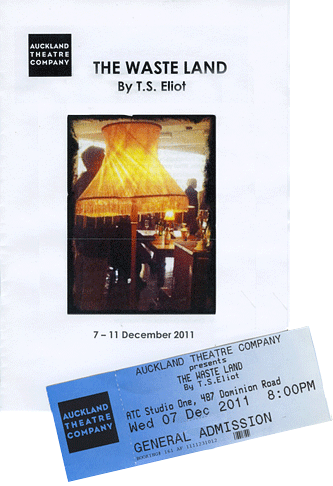
The Waste Land
By T.S Eliot
Directed by Michael Hurst
Musical Director John Gibson
Produced by Auckland Theatre Company
ATC Dominion Road Rehearsal Rooms
7 – 11 December 2011 at 8pm
Reviewed on Sunday 11 December
Published at http://www.theatreview.org.nz
April is the cruelest month, breeding
Lilacs out of the dead land, mixing
Memory and desire, stirring
Dull roots with spring rain
So it begins, and so it shall be …
Friedrich Schiller, the German playwright, poet, philosopher, historian, aesthete and critical cog in the development of Weimar Classicism, had quite a bit to say about the role of the theatre in society. He expounded his views in On the Use of the Chorus in Greek Tragedy (1803) – written as a prologue to his play The Bride of Messina – and The Stage as a Moral Institution (1784)and much of what he says relates to the presentation of ‘the truth’ in a satisfyingly didactic manner. He rather pompously added that the theatre was ‘a great school of practical wisdom, a guide to civil life, and a key to the mind’, that a mimetic theatrical presentation should be an exact representation of society, a depiction that involved each audience member receiving the play’s message in the same way and thereby agreeing on what moral changes needed to be made in the society of the time.
Shakespeare said it simpler when he suggested that the purpose of playing is to hold a mirror up to nature.
In choosing to present a theatrical staging of TS Eliot’s influential poem The Waste Land (1922 ) in the new Dominion Road rehearsal room with a cast of community volunteers all of whom were over the age of 65, Auckland Theatre Company has done more than pay homage to Shakespeare and lip service to Schiller, it has come up with what it calls ‘a new programme of community engagement’ which is, in fact, a stroke of contemporary genius.
By adding a couple of young’uns in Michael Hurst and John Gibson to the mix and providing this wonderful cast with a delectable venue, success was almost guaranteed.
On paper, only Eliot and his often incomprehensible work stood in the way.
Hurst’s must also be applauded for his choice of material. Eliot is difficult stuff for any actor let alone the inexperienced and The Waste Land ispossibly even more so but it’s to Hurst’s credit that he hasn’t patronised his cast by down-playing his expectations and he has been duly rewarded.
We, his audience, are the beneficiaries.
It’s not stretching it too much to say that Eliot had an obsession with aging.
In 1920, when still only thirty two, he pondered (in The Love Song of J Alfred Prufrock):
I grow old … I grow old …
I shall wear the bottoms of my trousers rolled.
Shall I part my hair behind? Do I dare to eat a peach?
I shall wear white flannel trousers, and walk upon the beach.
Like Eliot, our present government has an equally disturbing obsession with aging.
How often do we hear that the baby-boomers have become a burden on society simply by having the temerity to live longer than their forebears. Older people have inadvertently become a contemporary dilemma, an election issue, a yoke on the economy and a crisis is looming with the ‘elderly’ at the eye of the hurricane.
‘Cometh the hour, cometh the man’ as they say and, in this case, it’s Colin McColl and Auckland Theatre Company.
ATC has begun a process that places value on the elderly and which clearly sees them as a wonderful resource to be treasured and utilised in a manner that is both respectful and enriching.
If this production is anything to go by the repayment is hundredfold.
So ATC is holding the mirror up to nature in a Schilleresque way and this is a ‘first’ to be applauded – mutually rewarding community outreach at its very best. This was dignified, intelligent, worldly, articulate with not a creaky joint in evidence anywhere.
It’s rude to ask someone’s age so suffice it to say that, to have been born when Eliot was penning his masterpiece, the actor would need to be at least 89 years old. By 1946 – the low-end cut off date for actors to qualify to participate in this work, The Waste Land was already considered one of the great poetic works of the 20th century and Eliot’s status as one of the greats was guaranteed. Without prior knowledge I suspect most of this cast would have encountered Eliot first while at university in the 50’s and 60’s when Eliot’s flame burned brightest.
The Waste Land is an epic work though markedly reduced from the original draft by pre-publication editing largely by Eliot himself but also by friend, confidante and fellow intellectual Ezra Pound.
The five part dramatic monologue form is well suited to performance and Hurst’s clever – and accurate – interpretation makes even the densest and most convoluted passages – and there are plenty of them – clear.
There are sections evocative of Joyce’s Finnegan’s Wake and Ulysses, literally dozens of often obscure literary referencesand his use of multiple languages, while cocking a snook at Pound, doesn’t make things any easier for the generalist reader either. Eliot was, after all, nothing if not a Modernist, whatever that might mean!
It’s probably worth noting that those of us who claim lineage from the love generation – and I’m sure at least some of this cast did – adored Eliot. Not Eliot alone of course, also Emily Dickenson, F. Scott Fitzgerald, Robert Frost, J.D.Salinger, Gerard Manly Hopkins, the Beat poets, Jack Kerouac and Kingsley Amis to name but a few.
We were, we thought, an insightful, expressive and literate bunch.
Hurst’s actors, sourced from an advertisement which read ‘No experience necessary and no audition – the only requirement is to be over 65 years of age and willing to join us on a challenging journey of discovery’ appeared to come primarily from that generation and articulate they certainly were.
Peppered with a few seasoned professionals like Margaret Blay, Sunny Morete and Maggie Maxwell, the 33 strong cast ensured that The Waste Land zinged along at a perfect pace, creating beautifully a world of intelligence, splendour and elegance.
Better even than that was the dreamlike quality sustained throughout which allowed Eliot’s often mystical forays into the classical worlds of Dante, Ovid, Homer, Petronius, Shakespeare, Verlaine, Whitman and Sophocles to work effectively while never impeding or bewildering the forward movement of Eliot’s deeply personal and often elaborate journey.
Hurst’s lucid and unambiguous direction ensured that this 50 minute, in-the-round – or more correctly ‘in the oval’ – production was always visible, audible and accessible to the Sunday evening full house who may seemingly, to a casual observer, have gathered for a late afternoon high tea at the Savoy such was the sumptuousness of the setting and rich accuracy of the costumes (Jessika Verryt).

At the end of the day however, Eliot is all about the narrative, the imagery, the interrogatory, the classical provocations and the language and this is where Hurst’s production truly shone.
Lead by an austere and imposing Madame Sostoris (Pat Quirke) the funereal Sibyls, replete with clicking knitting needles and an old school Victorian menace, provided an impressive backdrop and a non-vocal commentary that was at once chilling and unsettlingly eloquent.
The use of sounds created by the actors was impressive throughout and enhanced an already rich aural texture.
Plaudits also go to John Gibson for his excellent musical vignettes. As always they’re subtle, appropriate and seamlessly woven into the whole.
Of Eliot’s five parts the third, The Fire Sermon, was the most effective with Hurst’s ensemble managing to separate and elucidate all of the intellectual complexities of the work without losing any of its innate eroticism and reference to increasingly decadent sexual dalliances. The almost indecipherable bickering between St Augustine (his Confessions is, of course, the source) and Buddha, whose sermon of the same name provides the title to the piece, is cleverly managed and the prevailing image of Tiresias, the wheelchair-bound blind seer who has ‘foresuffered all’ and who witnesses the deeply unsatisfying sexual experience of the young woman, will lurk in the psyche for a very long time.
No ecstasy here, merely another of Eliot’s sad whimpers.
It’s difficult not to be drawn into the profound intimacy of Eliot’s own life via this fine production as it’s presented warts and all with no attempt made to pull a shade on the turbulence of Eliot’s tortured journey. It’s very powerful stuff and the question needs to be asked whether a younger cast with less life experience could have explored this path with the same degree of openness and candour that these fine people with their three score years and five (minimum) travel on this earth brought to the venture. I suspect not, and it is to the credit of McColl, Hurst and Gibson that they’ve recognised this extraordinary community resource and had the courage to stage a work of this nature. No discredit to modern playwrights and their foibles but there are few in-depth roles for older folk and the side-by-side cults of youth and celebrity often preclude our being able to share the richness of lives lived that still have a good way to travel and a place in our theatrical tradition.
It’s to be hoped this is a trend that will be explored fully, not just by the innovative Auckland Theatre Company but by other companies as well. After all, there’s a resource such as this in every community. There’s an audience too, for the stories of those in what must now be called ‘mid life’ because 65 has to be the new 40 and I’ll gird my pensioner’s loins and fight anyone who says otherwise!
And so it ends …
Shantih! Shantih! Shantih!
 dykiegirl