
Finding Murdoch
By Margot McRae
Produced by Landmark Productions
Directed by Paul Gittins
Q Theatre Loft
13 – 23 October 2011
Reviewed on 13 October 2011
Published on http://www.theatreview.org.nz
Before crouch touch pause engage, Dan Carter rippling in his Jockeys, intimate peeks at the Rexona- refreshed armpits of All Blacks and Mils Muliaina slurping milk product from a tiny, crushable carton, rugby was a different game. No-one got paid, tours lasted three months or more, the All Blacks were all white when playing the pallid South Africans and Australia didn’t even have a fully representative Australian Rugby Union.
Imagine, if you will, Pinetree Meads in his Y Fronts, Kevin Skinner drinking milk and Alex Wylie attending to his personal hygiene with a fresh-smelling manly deodorant and I suspect you’ll agree. It’s quite simply unthinkable. The yarpies ate our children, we all knew that, and as for the French …
The Welsh, of course, were never mentioned, except, perhaps, in gruff undertones by my father who never forgave them for the 1905 defeat and that infamous, disallowed, last minute Bob Deans try. The fact that it happened five years before he was born always seemed somehow irrelevant. As the saying goes ‘you never beat Wales, you just get more points.’
Such tales are the stuff of legends – and legends are the stuff of rugger.
A different legend began in 1972 during the All Blacks tour of Britain, Ireland, France and North America. The tour began auspiciously enough with a 31 to 9 victory against British Columbia in Vancouver on 19 October 1972 and ended thirty two games later with a 6 to 3 victory over a French Selection in Cleremont-Ferrand on 7 February 1973. It lasted fifteen weeks which included Christmas and New Year and the AB’s won twenty five games, lost five (to France, Llanelli, North-Western Counties, Midland Counties (West) and the Barbarians) and drew two (Munster and Ireland). The loss to Midland Counties (West) by 16 to 8 on 6 December is probably the most telling as it occurred a mere four days after the All Blacks beat Wales and a little more than a day after arguably the darkest moment in New Zealand rugby history – the sending home of prop Keith Murdoch for punching a Welsh security guard.
Murdoch scored the only All Black try in what can best be described as an acrimonious match which ended in a 19 to 16 victory to the All Blacks and, after partying hard at The Angel hotel and being taunted by the guard, Murdoch knocked him down with a single punch. Team meetings were held and the upshot was that Murdoch was severely reprimanded and the team thought this was an end to the matter.
It wasn’t.
Unconfirmed rumour has it that considerable pressure for a harsher penalty was brought to bear by the home unions, pressure that team manager Ernie Todd buckled under and Murdoch was red-carded from the tour. Todd, himself terminally ill with cancer, took this decision alone and a stunned All Black team proceeded to lose the next game and many of the players have carried the guilt of their benign acceptance of Todd’s decision to this day.
Peter Jackson in this Letter from New Zealand published in the Irish Examiner on 29 September 2011 interviewed Tane Norton who said that the experience had ‘left some of his old team-mates nursing regrets which have not withered with the passage of time’ and that ‘given their time again the players would have stood behind Murdoch and given tour manager Ernie Todd a simple ultimatum: if he goes home, we all go with him.’ Norton goes on to say ‘the last thing I remember was that Keith seemed to indicate that they wouldn’t see him again in New Zealand.’
And so it was.
Back home, however, the level of anger at Todd’s decision was palpable and clearly reflected in Tim Bickerstaff’s Punch a Pom a Day campaign which included bumper stickers, anti-British jokes and ultimately saw retribution with his car vandalised and a car dealership who sponsored his show on Radio I having the tyres on just under fifty of the cars in the yard slashed as a result.
Margot McRae’s slender 90 minute script Finding Murdoch is evidence, should any be needed, that this story has cut to the quick of the national psyche but it’s also quite a bit more than that. It’s a none too subtle exploration of the way the media take personal narrative and, in some self-styled quest for the ‘truth’, have turned humiliation into a national armchair sport. Through the advent of Reality Television we can have snot and tears in our lounges without ever having to clean up the mess.
And so the search for Murdoch began.
McRae is ruthless with herself, too. She lets us know what side she’s on and never really wavers. She puts her body on the line for her team and hangs in to the bitter end. Its courageous stuff because she has to know that her viewers may well loath her for it but she does it anyway and, in so doing, tips her hat to her own less than attractive truth.
There’s a story does the rounds that the legendary rugby writer T.P McLean tracked Murdoch down in the Australian back-of-beyond during the ‘80’s. Tittle-tattle has it that McLean said something along the lines of ‘Hi Keith, it’s been awhile’to which Murdoch replied ‘You’ve got sixty seconds to get your arse out of here, McLean’ and McLean, ever the pragmatist, left, so it’s to McCrae’s credit that she not only found the reclusive Murdoch but that she got to talk to him – off the record – and snapped a few pics of the grey-bearded ex patriot.
To her credit?
Well, you can decide for yourself whether that was a good thing or not by checking out the production.
The intrigue begins when a somewhat unprincipled TV producer – Geoff (Alistair Browning) – decides that finding Murdoch and getting ‘that interview’ is the way to the future, a future to some extent imposed on him by the slow demise of quality current affairs programmes and news-based documentaries. Competition had raised its formidable head – it’s 1990, Rogernomics has the country by the throat and it’s our sesquicentennial year – and Geoff is going for it with all guns blazing in the hope that funding for his fledgling company will surely follow. He pits the curmudgeonly rugby-head Pete (Kevin Wilson) against the pretty new girl Jane (Sarah Somerville) and sends them on a quest to find the reclusive and elusive Keith Murdoch, rumoured to be in the outback of Australia, and, to cut a somewhat over-long story short, Jane triumphs, despite the overt and often obnoxiously sexist behavior of her colleagues.
Along the way she interviews the late Lin ‘don’t ever tell me it’s just a game’ Colling (John Glass) who is portrayed sympathetically, a reticent yet genuine Ian Kirkpatrick (Geoffrey Snell) and, by phone, a plethora of publicans and bar staff from the outback.
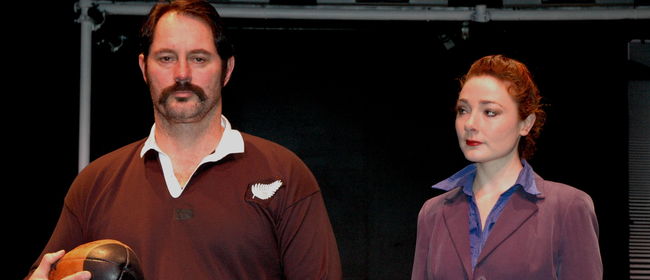
She finds Murdoch (Michael Lawrence) in a pub in Tully some 250kms north of Townsville where he’s working on a banana farm and gets to chat with him over a few chardonnays and a couple of beers and it all makes surprisingly spellbinding theatre. The evening is never dull but it does really comes to life with the arrival of Murdoch and, yes, he’s wearing the trademark jandals.
We know Journalist Jane by this time and the acutely anticipated meeting between she and Murdoch doesn’t disappoint. Somerville softens somewhat and the relationship between these unlikely companions is finely drawn and unexpectedly tender. There is a satisfying delicacy in the way the text zings along and Somerville is at her best in this sequence. Lawrence is quite superb as Murdoch and he avoids all the clichés that are possible in playing this man. What we experience is a man who lives his own truth. When he tells Jane that he’s happy where he is and being who he is we believe him. When she asks if he’ll return to New Zealand he says no. His reason? ‘It’s too bloody cold.
It would be easy to dismiss what Lawrence achieves by simply saying he bears a remarkable physical resemblance to the Murdoch of the past – which he does, Zapata moustache and all – but his performance is much, much more than that of a classy look-alike. Lawrence plays Murdoch with real heart, it’s just not the heart we might expect him to have. He also plays Murdoch as a man with few, if any, regrets and it’s only when he speaks briefly of Ernie Todd that we see a frisson of anger, an anger which is quickly suppressed. Lawrence is a fine actor and he is wonderful in this role, quite simply wonderful, and not least in his capacity to underplay and to allow us to do the work.
This isn’t a two horse race, however, and there are performances beyond those of Lawrence and Somerville that are achingly real and none more so than Kevin Wilson’s empathic portrayal of the dying Ernie Todd. The use of text from audio tapes sent by Todd to his wife Pat while on tour provide an impressive vehicle for Wilson’s monologues and he uses them to maximum effect cleverly playing against how Todd was portrayed in the popular press and showing him as a loving and thoughtful husband in an impossible situation.
Alistair Browning (Geoff) comes into his own in a final confrontation with Somerville and the snarling ill-will that spits from each is riveting, reinforcing, as it does, our voyeuristic love of emotional outpourings like these, eruptions that Murdoch’s calculated actions enabled him to avoid.
While the heart of Finding Murdoch is the meeting between Murdoch and Jane and the ensuing rich dialogue, this is effectively broken up by snippets of commentary from the 2 December test at Cardiff Arms Park as delivered by a Kiwi (Geoff Snell) and a Welshman (John Glass). This cleverly scripted duologue allows us to experience the nature of the game and the passion with which it was played and permits us to share the heightened nature of the events that lead to Murdoch getting his marching orders and to the birth of the legend that is Keith Murdoch today.
There’s a lot to like about Finding Murdoch and even a few answers, but at the final whistle, it’s still a play of two halves and Michael Lawrence as Keith Murdoch was the winner on the day.
It’s all credit to the boys … and (of course) to the girl!
 dykiegirl
One thought on “Finding Murdoch ~ a theatre review”