The Butcher and the Bear
By Michelanne Forster
Produced by Time Out Theatre
Directed by Sally Blackwood
Music Director Chris O’Connor
Herald Theatre at THE EDGE
8-15 October 2011
Reviewed on Monday 10 October 2011 at 11am
Published at http://www.theatreview.org.nz
Folk tales have a universality that cannot be denied. It’s the key to their appeal.
The noted anthropologist and folklorist William Bascom proposed in his 1954 article Four Functions of Folklore published in the Journal of American Folklore that folklore serves four primary functions: it allows people to escape from repressions imposed upon them by their society, it validates cultural rituals and institutions, it reinforces, pedagogically, morals, values, and wit and is a means of applying social pressure and exercising social control.
All of Bascom’s criteria are evident in Michelanne Forster’s The Butcher and the Bear which is most affirming as there is nothing more important in a kid’s narrative than allowing them to assume positions of power which, while seemingly the antithesis of the premise Bascom posits, actually feed right into it.
It’s why clowns have such power when ignorance rules.
TIME OUT Theatre brings to life a story from Forster’s past, a story that begins and ends the show, and that features her father, a serious childhood illness, a protracted stay in the tiny town of Seefeld – now a popular Tyrolean tourist destination but at that time a remote mountain village – a cunning Uncle Ludwig and an eventual recovery. Magic gypsy soup features prominently along with those reliable staples of children’s theatre, the chases, animals personified, mysterious musicians, chanting, clapping and a dollop of ‘he’s behind you’. The Brothers Grimm produced a somewhat more kindly butcher in Hans in Luck but The Butcher and the Bear, with itsdistinctly Eastern European feel, makes no such compromise to niceness or decorum which is great because kids certainly love their blood and guts.
The Herald Theatre is an extraordinary performance space with a rake at an angle terrifying to behold. As an audience member, making your way to your seat can be a hazard to the health and for actors it’s a challenge as to where to pitch and pan your performance. Still, I’ve grown to like it and always find myself admiring actors such as these who grow increasingly able to include everyone in the theatre in their performances, and audiences, particularly the elderly, who willingly potter up and down the steep rake to and from the seats in the front.
The audience – in this case a full house – was greeted on arrival by a dimly lit stage washed with a flecked forest gobo and a Harold Moot designed set of cutout trees and delicately painted ground rows in the centre of which sat a mysterious gypsy caravan. As the eyes grew more accustomed to the muted light four musicians perched at the side of the stage became faintly visible.
It’s worth digressing at this point to applaud the soundscape for the show. Made organically by the actors and accompanied by Miro’s Gypsy Strings there was no pre-recorded music or sound effects evident. All plinks, plonks and plunks, all foot-tapping, thigh-slapping, clapping, thumping and bumping was made by the actors as an accompaniment to the action and all the songs were accompanied by the band who, by means of style, costume and talent, supported the show beautifully and contributed heaps to the Romany feel.
The narrative begins with the actors, as themselves, creating an environment from which the storyline can grow and each quickly morphs into their principle character. The mode of introduction to the tale proper doesn’t sit that comfortably outside the main narrative but once the story is underway we cease to care about such structural idiosyncrasies.
As the storyteller Katie Scott serves the work adequately but as the Gypsy she is simply wonderful. The transformation from one character to the next is made with a few twists of costume and a full twirl of the psyche as modern narrator becomes the most exotic of gypsy women complete with accurate and sustained Romany accent, eccentric quirks and irresistible foibles. Scott’s personification is archetypal yet original and I cherished what she created almost as much as the kids did.
Bird was played with verve and enthusiasm by Josephine Stewart-Tewhiu and her honest and loving relationship with Bear sits at the heart of the work.
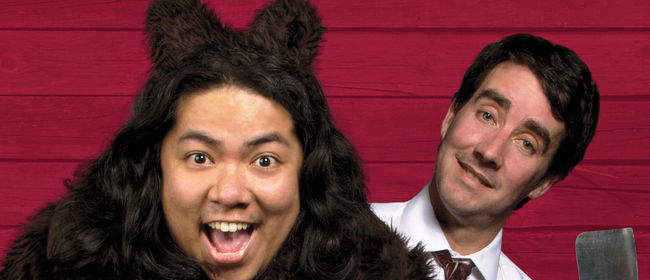
Leand Macadaan is Bear, a fur-suited, big-eared, tubby barrel of love who dances and plays as all imaginary bears should and doesn’t threaten the humans who live close to his cave in any way at all – except in the mind (and appetite) of Butcher who sees him unmistakably as the Hannibal Lecter of Bear World and a creature whose imminent demise is the only ending imaginable.
Butcher – described by one of the under tens who I accompanied to the show as ‘Psycho Butcher’ – is played delightfully by Jonny Brugh. Brugh preserves the illusion of enigmatic villain, one of those characters you’re never quite sure of, someone who might just run amok with a meat cleaver at any moment, someone you don’t quite turn your back on. During the chases through the audience it has to be said that Butcher Brugh in his blood-soaked apron and brandishing his little cleaver was not without his youthful supporters, many of whom would have been just as happy to see Bear slaughtered at their feet half way along Row H and slightly to the left of the grey haired Grandma who was sitting there mesmerized.
The Butcher and the Bear is an ideal holiday outing for the over fives and I had a great time. The level of professionalism is most satisfying and the performances of Katie Scott as the Gypsy and Jonny Brugh as Butcher are well worth the admission price. Add to that the captivating music of the Miro Gypsy Strings, an assortment of striking costumes, a fun set and an imaginative script and you have 55mins of theatre that will delight the most discerning young audience. My young friends – aged 9 and 10 and both male – were totally engrossed and when asked on the way home what they’d enjoyed the ten year old replied that it was like Tom and Jerry with Butcher being like Tom and always getting caught in his own traps while the nine year old observed that Butcher would be chasing Bear throughout eternity because that’s what happens in stories like this and that Gypsy would always be Gypsy because that’s how people are.
He was right, too.
It was, when stripped away, the equivalent of Sartre’s Hui Clos in its psychological complexity or Bergman’s The Seventh Seal for kidsbecause folk tales, even those sieved through the modern mind and presented imaginatively for the under twelves in the 21st century, connect us to our shared humanity by our similarities and by our collective fears.
That’s what universality is all about, and that’s the power of the theatre.
Plain as folks, that is.
 dykiegirl