
The Angel and the Beloved
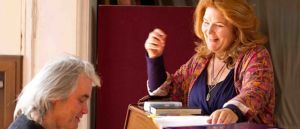
Sylvia Rands and John Gibson perform the poetry & prose of Rainer Maria Rilke
Hopetoun Alpha
5 – 16 October 2011
Produced and Directed by Sylvia Rands and John Gibson
Composition: John Gibson
Script: Sylvia Rands
Reviewed on Wednesday 05 October 2011
There’s an old theatre adage that performance starts where memory leaves off and this in nowhere better illustrated than in this fine boutique production.
Sylvia Rands and John Gibson perform Rainer Maria Rilke’s occasionally thorny writing as though they were born knowing it and have lived with its self-imposed intricacy throughout their creative lives. The attractive programme guides us to the performers intent which is to take the audience on a journey to an inner landscape – the world of the heart and spirit – a world beyond words where they (the artists, for that is what they are these two uncompromising souls) conjure a world where ‘even what is most delicate and inapprehensible within us … must be discoverable (Rilke)’
This is what they set out to do and this is, unquestionably, what they achieved which is no mean feat because Rilke’s verse and lyrical prose would be out of reach of most performers. This is, after all, a deeply literary work and may not be everyone’s cup of Darjeeling but it certainly was mine.
Creating live theatre is a complex, multi-layered business but one thing remains constant: you will only create art if you set out to create art. If you start with any other single goal –entertainment, self-gratification, making a political point – and leave art out of your intention then there’s little likelihood that ‘art’ will be the result.
No such problem with The Angel and the Beloved which is a beautifully constructed and aesthetically delightful piece of chamber performance art which, I have little doubt, was conceived in exactly that way.
The Angel and the Beloved is artists making art about art. What could be better than that?
When I first read the marketing material for this show I was struck by the way the publicist had described Sylvia Rands and John Gibson as ‘theatrical luminaries’ as this seemed to be at odds with how I felt these artists might view themselves. ‘Celebrity’, ‘VIP’ or ‘star’, as used in the conventional sense, just didn’t seem to describe performers who never put themselves above the work. Gibson, in particular, completely disappears and Rands, for whom disappearance is not an option as her instrument is the self, immerses completely in what she does and has always seems mildly confused when audiences love her work.
How about ‘achiever’, I wondered. Is that what the publicist means?
I could certainly see ‘achiever’ as an appropriate appellation as both Gibson and Rands have an enviable body of work tracking into both their shared and individual performance histories.
Any serious observer of New Zealand theatre over the past three decades will tell you that Rands’ Such Sweet Thunder, awork from the early 1990’s highlighting Shakespeare’s women, was as good as solo shows get, and Gibson has to be in the top tier of musical collaborators for performance having worked with Douglas Wright, Vincent Ward, Colin McColl, Shona McCullagh, Michael Hurst, Jack Body and almost everyone you can think of in virtually every genre imaginable.
My personal favourite performances are Rands’ sensual Madame in Genet’s The Maids (dir Roy Patrick somewhere in the late ‘70’s at Theatre Corporate) where she shared the stage with Jude Gibson and Erin Heffernan in what is still, to my mind, the best production of this classic play I’ve ever seen, and Gibson’s music (and acting) in the under-rated – and regrettably short-lived – early ‘80’s TVNZ series Heroes for which he won a GOFTA for Best Music for Television.
So, ‘achiever’ works fine as a label for these two but, having experienced The Angel and the Beloved, I think I’ll go with ‘leading light’ because seldom have I seen – or experienced – performance art that has so illuminated the often intricate and deeply pensive work of an artist like Rainer Maria Rilke with such clarity.
It’s a delicate journey, though, because the dear old Hopetoun Alpha, whilst it’s a remarkable building with handsome architectural features and a delight to be in, has creaks, scrapes, squeaks and churlish echoes that would challenge any performer. To the credit, mainly of Rands, this doesn’t prove to be too much of a problem even for those of us who are a bit challenged in the hearing department. Gibson, of course, has at his fingertips the capacity to eliminate even the most grating of architectural aural intrusions and he does so in the most rarified and exciting way.
Rainer Maria Rilke is quoted in the programme as saying I want a lot, perhaps I want everything and when it comes to theatre-going I tend to be the same. From The Book of the Hours, the poem goes on the say:
… it is not too late
to dive into your increasing depths
where life calmly gives out its own secret
and, to some considerable extent, The Angel and the Beloved allows us to do exactly that.
To achieve this Rands and Gibson do a wonderful thing. Very early in the piece they somehow give us permission to engage with them in this process of deep reflection, this inner journey, that allows us to change our state of mind and our state of being. It would have been fatal to keep the journey to themselves but they circumnavigate this pitfall with gentleness and ease
The content of the work is the poetry of the late 19th and early 20th century German writer Rainer Maria Rilke but a knowledge of his work isn’t essential for full engagement with the production as the informative programme tells us all we need to know.
Gibson and Rands do the rest.
It is worth noting, however, that Rilke is significant, that he is considered one of the greatest of German poets, that his work slithers from short versifying to long lyric prose pieces and that the subject matter is more often than not introspective and reflective. He is often considered to be the poet who best illustrates, for that period, the shift from the traditional to the post modern in both style and content. Germany was fortunate at the time to have great writers at the cutting edge of social change and Frank Wedekind comes immediately to mind.
If that description makes The Angel and the Beloved sound like a maudlin night on the ouzo then think again as the carefully chosen works are rich in humour – some dark, some fairy-like – and a wayward sensuality that you can almost taste.
The set is simple. It consists of a wide set of six stairs leading up to a platform with exits left and right and is perched at the base of, and between, two Doric columns which come with the venue and which are oddly appropriate to the pseudo-classic quality of some of the material. Centre right there’s a grand piano, black and imposing, behind which, against the wall, is an acoustic guitar. Above the stairs, and between the columns, is a bare, wintery tree silhouette against which there is what appears to be a giant white fabric moon.
On entry it’s all a bit chill.
The large opening night audience chatted cheerfully before the show as though a group of like-minded folks had gathered for a happily anticipated house concert that they knew was going to please. This was reinforced by the entry of the performers who seemed to bond immediately with their audience in a good-hearted and twinkly way. There was a hint of other-worldliness, of times past and styles seldom seen in a world now filled with plays like Shopping and Fucking, Haunted Child and Bang, Bang, Bang but this is somehow refreshing.
The Angel and the Beloved is rare in that it has quite narrow emotional parameters but what was achieved within those parameters was extraordinary and herein lies the show’s transformative power. It’s very subtle work that gives full reign to Rand’s astonishing control of the vocal mechanics that enable sound, emotion and physicality to merge and smack us right in the heart just when she wants to – and often when we least expect it. This is a rare quality and the result of a lifetime commitment to the voice which anyone who loves good theatre should make the effort to experience. It’s primal scream in a minor key and delicious to experience.
John Gibson doesn’t compromise.
I suspect ever.
His keyboard compositions range from the callous to the indolent with every modulation between and his singing is better than I have ever heard it. There are moments when his delicate tenor slides effortlessly into an angelic falsetto that is quite simply breathtaking, others where he is the embodiment of Emma Kirkby and yet more where he takes Rilke’s verse and makes it sound like Wedekind channeling Munch’s Scream as performed by The Velvet Underground.
You catch my drift?
No?
Oh well, better go hear for yourself …
Rilke said no great art has ever been made without the artist having known danger and somehow this seems to epitomize Gibson’s oeuvre and it’s quite simply fabulous.
Rands sings beautifully too, both alone and with Gibson, and together they manage an intentional disconnect that would have pleased Rilke whose writing so often engages with the notion that being together alone is no bad thing. Contralto to tenor – and these two voices in particular – fashion a sense of fragility that is at once anguished and audacious.
We often talk about the chemistry, that special spark, that exists between performers – Bogart and Hepburn, Allan and Keaton, de Niro and Streep – but there is no such spark evident between Rands and Gibson in The Angel and the Beloved. Here there is something deeper, something more primeval, less perceptible, less concrete, but stronger, richer, deeper, something that says ‘this matters so much that it doesn’t matter at all’.
As if to remind us that Rilke isn’t all deep and meaningful Rands unexpectedly shocks us towards the end with the startling sexuality of Child in Red andits summative conclusion:
It’s not so much that she steps out
of the small body enclosing her
but that all she carries in herself
frolics and ferments.
It’s this dress that she’ll remember
later in a sweet surrender
when her whole life is full of risks,
the little red dress will always seem right
And so it was with The Angel and the Beloved which seemed so right, so exact, so accurate, yet equally perfect in its abstracted regard for the eternal imponderables of sex, death and love.
Just like Rilke, The Angel and the Beloved has one final unforeseen surprise.
Gibson, the fixture, the co-conspirator, the anchor, is suddenly and unexpectedly gone from the stage, disappearing from sight below the moon onto which has been projected so many brilliant animated images throughout the preceding seventy minutes, disappearing, as if to death, while a dazzling Rands delivers Rilke’s potent Ninth Duino Elegy to the only music from the performance not composed by Gibson, John Taverner’s aptly chosen The Protecting Veil. It’s like a wake-up slap in the face and, just like the rest of the evening, pitched perfectly and owned by the actor in the most majestic way.
Rilke might well have described the evening as blooming most recklessly; if it were voices instead of colours, there would be an unbelievable shrieking into the heart of the night had he not used this wonderful phrase elsewhere.
As I scuttled away into the night to avoid the jolly, post-match festivities, the bubbles so generously offered and the asparagus rolls, I somehow knew that life for me for the next few hours would have to be introspective and contemplative – bliss-filled even – but that travelling for twenty minutes in a car with a nine year old who had just completed three hours of karate and a partner who had supermarket shopped alone might be somewhat of a chatty challenge but I needn’t have worried. Such was the power of my experience that the car was silent throughout the drive and I was allowed by family to retain the reverie that The Angel and the Beloved had entranced me with.
Entranced?
Well, illuminated, might well be a more appropriate word.
 dykiegirl