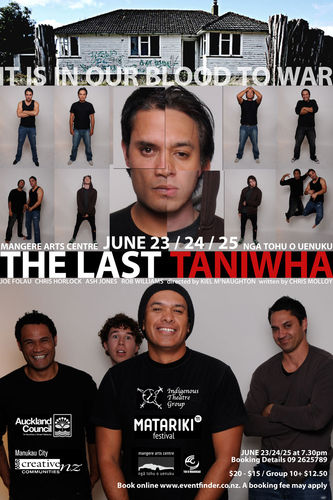
The Last Taniwha
By Chris Malloy
Directed by Kiel McNaughton
Produced by Indigenous Theatre Group
Mangere Arts centre
23 June 2011
Published in Theatreview
We all have to start somewhere and Chris Molloy has begun his writing career auspiciously. He’s never written a play before which is not to say he’s new to the theatre as he has an Advanced Diploma of Maori Performing Arts from Te Wananga O Aotearoa ki Rotorua, a Bachelor of Performing and Screen Arts degree from UNITEC and a Master of Arts in Drama from the University of Auckland.
Kiel McNaughton hasn’t directed a full length play before but he’s a UNITEC graduate also and it’s an impressive debut.
This is also a first time production by Indigenous Theatre Group. Well done them!
Virginity is a fragile thing, however, and they’ll never be first timers again. Virginity is like that. When it’s over, it’s over.
Having said all that, you’d never know they were first-times from the quality of the work. It’s raw, real and painful (in a good way) to watch, in part because of the nature of the play’s themes but also because of the company’s no-holds-barred approach to the play.
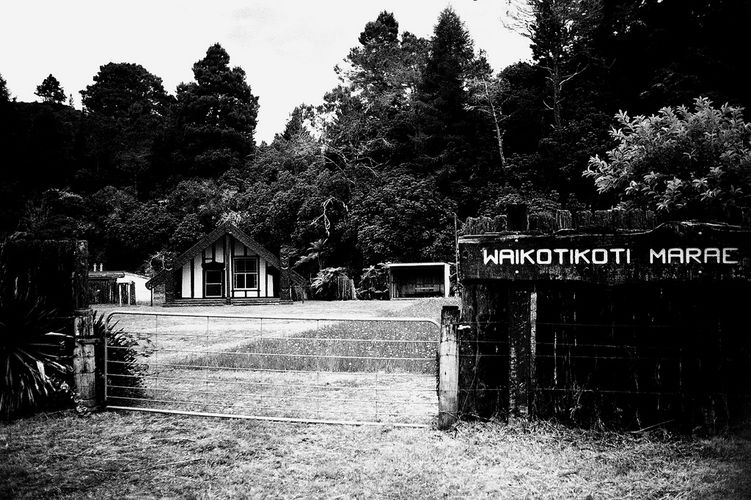
Murupara is where the narrative of ‘The Last Taniwha’ unfolds.
For those of you who don’t know Murupara it’s to be found in a remote part of the Bay of Plenty between the Kaingaroa Forest and Te Urawera National Park. Murapara means ‘to wipe off the muck’ and Murupara is a gang town.
Moko (Rob Williams), Guts (Joe Folau), Koro (Chris Horlock) and Buster (ash Jones) are all products of Murupara and it shows. It grips them and they cannot get away.
The narrative of ‘The Last Taniwha’ is multi-layered and all the layers interact seamlessly.
There’s the legend that Koro tells the kids of Kupe’s journey from Hawaiiki and the role played in this by the many taniwha who travel with the waka and protect the fleet from the sea monsters. This is woven beautifully into the other layers of the piece, the present, the recent past, the past of antiquity where the curse of the last taniwha that hideously marks the lives of all the present day participants is cast by, and the past of myth and legend.
There is a clue to what lies behind the play emblazoned across a heavily tagged, ramshackle 1950’s state house on the programme cover. ‘It is in our blood to war’ it says.
The production also encompasses, again without a glitch, a wide range of acting styles and the actors slip effortlessly from one to the other, from Koro’s traditional story-telling to the hip hop jive of the ever-wasted Buster.
‘The Last Taniwha’ is about family violence, violence towards women, violence towards kids and towards each other, it’s about violence, anger, retribution, death and prophecy. Don’t let these themes put you off participating in this work, however. It’s also very, very funny with some magic lines and some really recognisable characters. There are moments when you’ll catch yourself hooting and, at the same time, thinking ‘I can’t laugh at that!’ but you will, and that’s part of the message.
Expose us to enough of it and we’ll become immune.
I’m not going to give a synopsis of the plot as this would give it all away but I will say that this is a work of fine balance that builds to a powerful and uncompromising end.
‘The Last Taniwha’ has a currency that moves beyond the current flippant media debate that seems rooted in some ‘whether or not’ argument to a far more cavernous place, a place of horror and self-revulsion that is rarely explored on the stage outside ‘Medea’ and her killing of the children or perhaps ‘Titus Andronicus’ . There is no gratuitous violence, just a brutality driven by rage, retribution and the hope that this will provide a path to redemption.
Theatre that uses symbols effectively often does so through the names of the characters. Ibsen changed his character’s names draft by draft until he was satisfied that they worked on every level. The symbolism inherent in the names Guts, Moko, Buster, Koro, Kai Mokopuna and Mouse can’t be denied and it has to be said, in the hands of Chris Molloy, it’s a very effective tool.
The scariest thing about Moko (Rob Williams) is that he makes sense. The torrent of violence and anger, repressed as it often is, that flows just below the surface of this character has a logic that is frighteningly Pintereque. It’s excellent work and drives the action with the power of an old Holden Kingswood.
Guts (the very experienced and skilled Joe Folau) is often the foil and ultimately the undeserving victim of the piece. Guts is funny, he has smarts that keep him safe and which also allow him to provide a faint moral voice in the darkness. He creates the off stage character of Black Arse in a chorus-like way that would have made Sophocles brown with envy and is the epitome of everyone who ever took the blame for someone else’s actions. His smattering of ‘When I get my dole money’ dreams are priceless.
Chris Horlock’s Koro is a sweet grandfatherly figure with a dreadful story to tell. He anchors the chronicle and provides us with a link to his tipuna but he also allows us to see how the power of the legend can still work today. His generous impotence and warm ineffectiveness allow us to see just what a complex issue this family violence is and how easily the cycle can be allowed to continue. He makes no excuses and there is no explanation. Courageous stuff this.
Ash Jones’ loopy, drugged-out Buster is as gangsta as anyone south of Harlem could possibly be. His performance is a comic gem but he is also right there at the core of the text. He is the new Guts, the boy talented and stylish enough to leave the clutches of Murupara but who we know never actually will. It’s fine playwriting and a beautifully realised performance.
This is an exciting first effort from an already skilful line-up and Kiel McNaughton can be very proud of his first major directorial task. He and Chris Molloy make an excellent team. My only niggle, and it’s probably just an elderly person’s grizzle, is for the actors to be aware that mannered and accented language such as is used to great effect in this production can take a bit of getting used to especially early on and, at times, vital plot points can be lost. It’s a matter of knowing where your key points are and ensuring that even elderly Pakeha women sitting up the back can catch them!
The set is simple, a bare stage, two tall banners, a beer crate and a roadside cross. It works a treat as the actors weave whatever they need in the space with a physical lyricism that plays right against the content of the text. Costumes (Vanessa Molloy) are naturalistic and appropriate and the lighting (Katarina Chandra and Steve Renwick) and sound (Carl Austin) work well in the magnificent performance space at the Mangere Arts Centre. What an amazing facility this is. It should be compulsory for local government to build one in every town.
This is daring bloke theatre, but it’s still bloke theatre. No criticism, no complaints and much admiration but, having experienced ‘The Brothers Size’ and ‘The Last Taniwha’ in the last two months and been blown away by both productions I feel forced to ask ‘where are the women and the girls?’
On a personal level I’d like to see some Maori and Pasifika women’s narratives such as ‘Makarita Urale’s ‘Frangipani Perfume’ and Dianna Fuemana’s ‘Mapaki’. Having dined well at the bloke table, I’d like a second helping with the women. Or perhaps I’m being just a bit greedy. It’s possible, of course, that they’re happening and I’m just in the other place right now.
‘The Last Taniwha’ is a powerful night at the theatre and, if you like serious work that addresses sombre issues with depth and good humour, then this might well be for you.
 dykiegirl