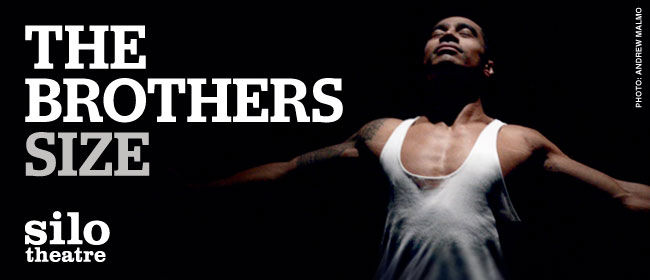
The Brothers Size
By Tarell Alvin McCraney
Directed by Shane Bosher
Produced by Silo Theatre
Herald Theatre at The Edge
Published on Theatreview.
If you engage with no other theatre experience this year then you must see The Brothers Size. Everything about the production is superb.
I could leave it at that but what would be the point, and there are a couple.
The Herald Theatre has to be the most intricate performance space in the country. Designed for mountain goats and stair-climbers, the steep rake is a challenge for designers, directors, actors and audience alike, but proved, in this rare instance, no challenge to anyone.
More about this later.
I attended on opening night which, from the behaviours I witnessed, was enjoyed by almost everyone. The social occasion, I mean, not the production, as the two seemed to elicit quite different responses from the same group of people. Call me an old wowser if you like but I have never cared much for opening nights, not as an actor or director, certainly not as a writer (or critic) and as an audience I invariably find them hateful (do I hear an echo of ‘old wowser’ and if I do I have to say I simply don’t care!)
I’ve been to opening nights in countless countries but in Aotearoa/New Zealand we seem to be unique in our response. And I do reiterate that this is my view and I accept that I am probably wildly outnumbered.
I skipped through the drinkers and jibber-jabberers in the foyer, hesitantly descended the stairs into the guts of the Herald and happily devoured the attractive programme.
It didn’t take long as it’s a slight volume but the emphasis on McCraney was invigorating and the lack of narcissistic stuff about the actors and production team was refreshing. Who needs it when Shane Bosher is the director, Rachel Walker, Tama Waipara and Vera Thomas are in charge of the design, Marianne Schultz is looking after the movement and Andrew Malmo has managed the whole kit and caboodle. It has class and maturity written all over it.
If you don’t know of these good folks then just sit back and be amazed because The Brothers Size doesn’t just have great parts, it sees these parts integrated in an organic and bouyant manner that makes the sum of the parts seem sublimely more.
In fact much, much more.
You’ll note I haven’t mentioned the actors. That’s because they’re OK too.
No surprise either to find that Jacque Drew was the dialect coach and clearly an integral part of this fine line-up providing a vital yet unobtrusive bond between actor and audience. The relationship between dialect coach and actors has clearly been impressive because the actors not only own the complex dialect of the Louisiana Projects and the bayou but they make it readily accessible to the audience as well.
But back to that first impression –
As I gobbled up the programme I became increasingly conscious of the escalating racket in the auditorium, that over-loud, opening night, ‘look at me’ prattle that somewhat belittles the occasion and I remembered that it seemed an eon since I last attended a ‘real’ opening night and all the reasons why this was the case. The only art so far on show seemed to be artifice, artfulness and artificiality.
Then there was the hum wafting up from the row below. Powerful – overpowering even – and though no angels fell from the sky the pong was alarmingly distinctive and wretchedly recognisable.
When the gentleman (and I use the term pejoratively) in the seat to my right began an epileptic tête-à-tête with his elbows and I began to be oofed and jostled as he spun his head like Linda Blair in the exorcist, hell-bent on seeing who was behind us on the hill that is the Herald, I began to ache, literally, for the lights to dim and the evening proper to begin but I was to, forlornly, wait until 8.20pm for the fun to really start.
While the pre-show encounter was, for me, less than perfect it’s also fair to say that, once the play began the audience was exemplary in its behaviour right down to the spontaneous – and thoroughly earned – standing ovation at the conclusion of the evening.
So it’s true: the play’s the thing.
The Brothers Size is an extraordinary achievement on so many levels. That it exists at all is a monument to the human spirit.
Playwright Tarell Alvin McCraney grew up in the Louisiana Projects which is a country mile from the Yale School of Drama Playwriting programme from which he graduated with the Cole Porter Award in 2007 and the Royal Shakespeare Company’s RSC/Warwick International Playwright in Residence post that he held in 2008.
In a word: this kid is the goods.
The Brothers Size is the centrepiece of McCraney’s triptych of life in the projects built around the context of Yaruba mythology and ritual and spat and slurped through the mystical and syrupy rhythms of the modern –and traditional – south. The trilogy of plays begins with In the Red and Brown Water which explores regeneration, procreation and the image of the child as a reflection of the mother who is, ironically, named Oya after the Yoruban goddess of fertility and nature.
Then comes The Brothers Size.
The third part of the trilogy is Marcus; or the Secret of Sweet which sees a young man exploring the why of his sexual identity through a connection with his deceased father.
The three plays share characters, setting and form and I’ll be surprised if we don’t see more of McCraney’s work staged in Auckland, though Wig Out! Is a more likely first option with its exciting and provocative exploration of the competitive and vicious world of the drag ball.
It’s Queen of the Whole Universe with teeth (and tits).
And with a team like this, who wouldn’t want to do more!
The tryptich is connected by the tag Exhale. Inhale. Tell the tale which encapsulates this set of works in a nutshell.
Rachel Walker’s set is divine in its simplicity: a raised, square platform, oil and water stained in a cool light blue. Lit by Vera Thomas’s subtle wash it is all things to all men in this archetypical man’s world or, more specifically, San Pere in Louisiana, near the bayou sometime in the distant present. The only break from the symmetry is John Ellis’s exquisitely executed percussion lurking ominously in the back corner.
Tama Waipara’s choice of recorded music is clever: minimalist but evocative, sweat-filled yet modestly understated.
And herein is the essence of this production’s success.
It’s as though all the components recognise each other, fit together, mesh like finely tuned cogs and compel the character driven narrative inexorably forward towards the moment – that timeless moment – when Ogun Size is alone in the world, alone in a world he never made, couldn’t have predicted, yet has gripped with such radiance in the moment preceding.
This is a play about moments and each has its own breath, its own thrash, its own pulse.
Only in the hands of the finest of directors can work of this quality be produced and, to his extraordinary credit, Shane Bosher’s exemplary hand is invisible in the result. It’s often said that when a production is crap the director gets the blame, when it’s good the actor’s get the credit. With no discredit to the actors, Bosher deserves the biggest of big-ups for this fine work.
I said earlier that the actors were OK.
I lied.
The actors were ferociously good. They were flawless in every way. From the authenticity of the dialect which never overpowered the narrative – how often do we see actors perform the accent and forget about the play – to their commitment to the Manly Art of Car Repair which permeated the text, these were performances of real stature, performances to treasure, performances of world class.
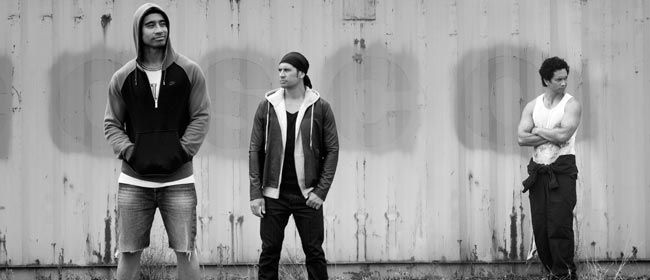
Ogun Size (Jarod Rawiri) is the taut and staunch older brother. Largely humourless, but never without humour, Ogun exemplifies the spirit of the pseudo-spiritual The Road is Rough of the opening episode. Wrenched kicking and screaming from Luke 10: 25-42, this work song, powerfully re-enacted, sets the tone for the entire production.
Oshoosi Size (the wonderful Pua Magasiva) is the embodiment of the younger brother. Recently out of jail and still on probation he is work-shy and hip. He is also the bane of his older brother’s life and the love between the two is at the heart of the play with Ogun trying his damnedest to keep Oshoosi out of strife while Oshoosi is drawn relentlessly back into it.
Enter Elegba (the gorgeous Te Kohe Tuhaka) who is the quintessence of cool and Oshoosi’s bête noir. He’s a buddy from the pen and frankly irresistible. This relationship – and Ogun’s onlooker status – is always going to end in tears, and so it does.
Manly, oil-stained tears, of course.
To say more is to expose the play’s narrative secrets – and there are a few – but the brilliance of the production exists in its wholeness as a work of pure art, in the performances, their relationships each with each and with us.
These are actors of whom we, as a nation, can truly be proud. They have exceptional craft and flexibility, they have monumental dollops of talent and they know how to truly respect the work. What’s more, they present as the epitome of beautiful young gods whose respect for their own physicality, and the uses to which they put the tools of their trade are simply remarkable. They have uniform vocal and physical power and each has access to an emotional range that is mid-boggling.
Best of all they have what Raymond Hawthorne once said was the soul of great acting: the ability to recreate a sense of spontaneity, of life happening for the first time, when in fact it has been carefully and thoughtfully rehearsed.
Mervyn ‘Proc’ Thompson often said that the success of a theatre work could best be measured by the resonances left after the experience. I have lived with Ogun Size’s last few moments vividly in my mind for the last 48 hours and have been more than happy to do so. This would not have been possible without the work of the entire ensemble that built to this moment and I applaud each and every one of you for allowing me the privilege of sharing this work with you.
Thank you from the bottom of my heart.
As I left the theatre, filled with the play, the emotions, the characters and all those wonderful resonances, I was confronted, on Queen Street by a street preacher who insisted that I could be saved if only I allowed Jesus into my life. I stood, transfixed, for a few moments as this quasi-southern Baptist evangelical mimic berated me before I realised, like a bolt from heaven, that I had left the truth of the theatre only to find bad acting and fraudulence out on the street.
So much for life imitating art.
I had just experienced art and life as one ~ but in the theatre, not on the street..
That’s good enough for me.
 dykiegirl